For most of my working life, the break between tasks looked like this: finish a piece of work, glance at the clock, realize I'm supposed to start the next thing, and then… check my phone for nine minutes. Then start the next block already behind, with yesterday's coffee mug still sitting next to today's water glass, both of them witnesses to my slow decline.
Now I do something different. When one work block ends and the next one hasn't started, I set a two-minute timer and tidy my desk. That's it. That's the whole system. And it has changed my workdays more than any app, any planner, or any productivity book I've ever read.
What the two-minute tidy actually looks like
Here's the entire procedure. Timer goes on — I use the one built into my phone, but honestly a kitchen timer would be more charming. For two minutes I put things back where they belong. Mug goes to the kitchen counter (or at least the "done" side of the desk). Loose papers get stacked, not organized — there's a crucial difference. Pens go back in the cup. The notebook closes. I wipe the desk surface with the microfiber cloth I keep in the drawer, the one that used to live under a pile of receipts and has now been promoted.
When the timer beeps, I stop. Even if there's still clutter. Even if I'm mid-wipe. The two-minute boundary is the point. This is not cleaning. Cleaning is a weekend activity with existential undertones. This is a reset — quick, superficial, and done on purpose.
Why two minutes and not five or ten
I tried longer first. Of course I did. The first version of this was a ten-minute tidy between deep-work sessions, and it died within a week. Know why? Because ten minutes is enough time to start reorganizing your filing system. Ten minutes is enough to find a box of old chargers and disappear into it. Ten minutes stops being a break and starts being a project.
Two minutes is too short to get ambitious. You can't reorganize anything in two minutes. You can only restore. The time limit is what keeps it a reset instead of a chore, and the chore version always loses to the phone. The reset version wins because it ends before your willpower notices it started.
There's also a psychological thing happening that took me a while to name. When I sat down to work at a desk that looked like a crime scene from a paper-based documentary, part of my brain kept doing background inventory: there's the mug, the sticky notes are spreading, that cable is coiled wrong. That low hum of visual noise doesn't feel like distraction — it feels like nothing. But it's quietly costing you attention you could be spending on the actual task.
The first time I tried it, it went wrong
The first time I tried this, I made a classic mistake: I tidied the whole room. Two-minute timer, and I walked out of my office to put the mug in the kitchen. The kitchen had dishes in the sink. I spent two minutes on those, reset the timer, did the living room, and somewhere around minute eleven I was alphabetizing spices. My next work block started twenty minutes late, and I was annoyed at myself for a whole hour.
So rule one, learned the hard way: the tidy has a territory, and the territory is the desk. Desk, immediate surroundings, that's it. The mug gets carried to the door of the kitchen and set down on the nearest flat surface. It's not about finishing the mug's journey. It's about the desk being clean.
This matters more than it sounds. The reason tidying is dangerous as a break activity is that tidying is expandable — every surface you clean reveals an adjacent surface that now looks dirty by comparison. Without a territory rule, the two-minute tidy becomes the two-hour deep clean, and you have accidentally procrastinated with a sponge in your hand.
The real benefit isn't the clean desk

The clean desk is nice. The real benefit is the seam between blocks.
Before this habit, my work blocks bled into each other. I'd finish writing something at 10:40 and the next meeting was at 11:00, and those twenty minutes were neither rest nor work — they were this gray zone of half-checking messages and half-dreading the meeting. Then the meeting started and my brain was still 30% in the writing. Multitasking research people will tell you this is called attention residue, and I don't need the studies — I've felt it. You finish one thing, start the next, and the old thing's ghost follows you for twenty minutes.
The tidy creates a physical ending. You literally stand up. You move things. You put the old block's artifacts away — the notebook closes, the printouts stack, the browser tabs get closed or at least pushed aside. By the time the timer beeps, the old block is a closed chapter. Your brain got a ceremony, and ceremonies work. They're why graduation matters even though you already did the coursework.
I stand by this: the tidy is the cheapest focus ritual that exists. It costs two minutes, zero dollars, and the only equipment is a desk that's already messy.
What I keep within reach for it
After a few months, I've converged on a small kit. A microfiber cloth in the top drawer. A small trash bin under the desk, positioned so I can drop things in without getting up. A "landing tray" — it's just a shallow box, but calling it a landing tray makes me feel like an air traffic controller — where loose stuff goes instead of spreading. Pens in one cup. The current project's notebook. Everything else has a drawer.
The landing tray deserves its own paragraph, because it's the trick that makes the whole thing take two minutes. Without it, tidying means deciding where each thing goes, and deciding is slow. With it, the decision is always the same: it goes in the tray. Once a week I spend ten minutes emptying the tray. The tray is a decision deferral machine, and deferral is fine as long as there's a scheduled time to un-defer it.
I also keep a coaster. This sounds unrelated, but rings of coffee on the desk were half of my visual clutter, and a coaster is a thirty-second fix that prevents a two-minute scrub. Productivity is mostly this: small systems that make the big system unnecessary.
The mistakes I've made since the spice incident
Mistake two: tidying during the block instead of between blocks. I once "quickly tidied" in the middle of writing because the desk was bothering me, and the tidy turned into a twenty-minute fidget because there was no timer and no boundary. Now the rule is strict: clutter during a block is information — it means you're working. Clutter between blocks is noise. The tidy only happens at the seam.
Mistake three: tidying someone else's desk. My partner's side of the shared office was a disaster, and I "helpfully" tidied it during one of my two-minute windows. It took nine minutes, she was annoyed that I moved her system, and I started my next block irritated. Clean your own territory. Other people's mess is their business, no matter how loudly it offends your eyes.
Mistake four: the aspirational tidy. There was a phase where I used the two minutes to try to fix things that actually needed real maintenance — the cable management behind the desk, the drawer that sticks. Two minutes is not enough for repairs. Repairs go on a list. The tidy is for restoration, not improvement.
How it fits into the rest of my day
I work in roughly 90-minute blocks, so on a typical day this happens four or five times. That's eight to ten minutes of total tidying, scattered through the day. It's invisible as a time cost and enormous as an effect.
What I notice most: I stop losing things. The keys, the notebook, the specific pen I like — they all have places now, because the tidy keeps reinforcing the places. Before, I'd spend five minutes hunting for my headphones three times a day. Fifteen minutes of search time, gone, replaced by ten minutes of tidying. The math works.
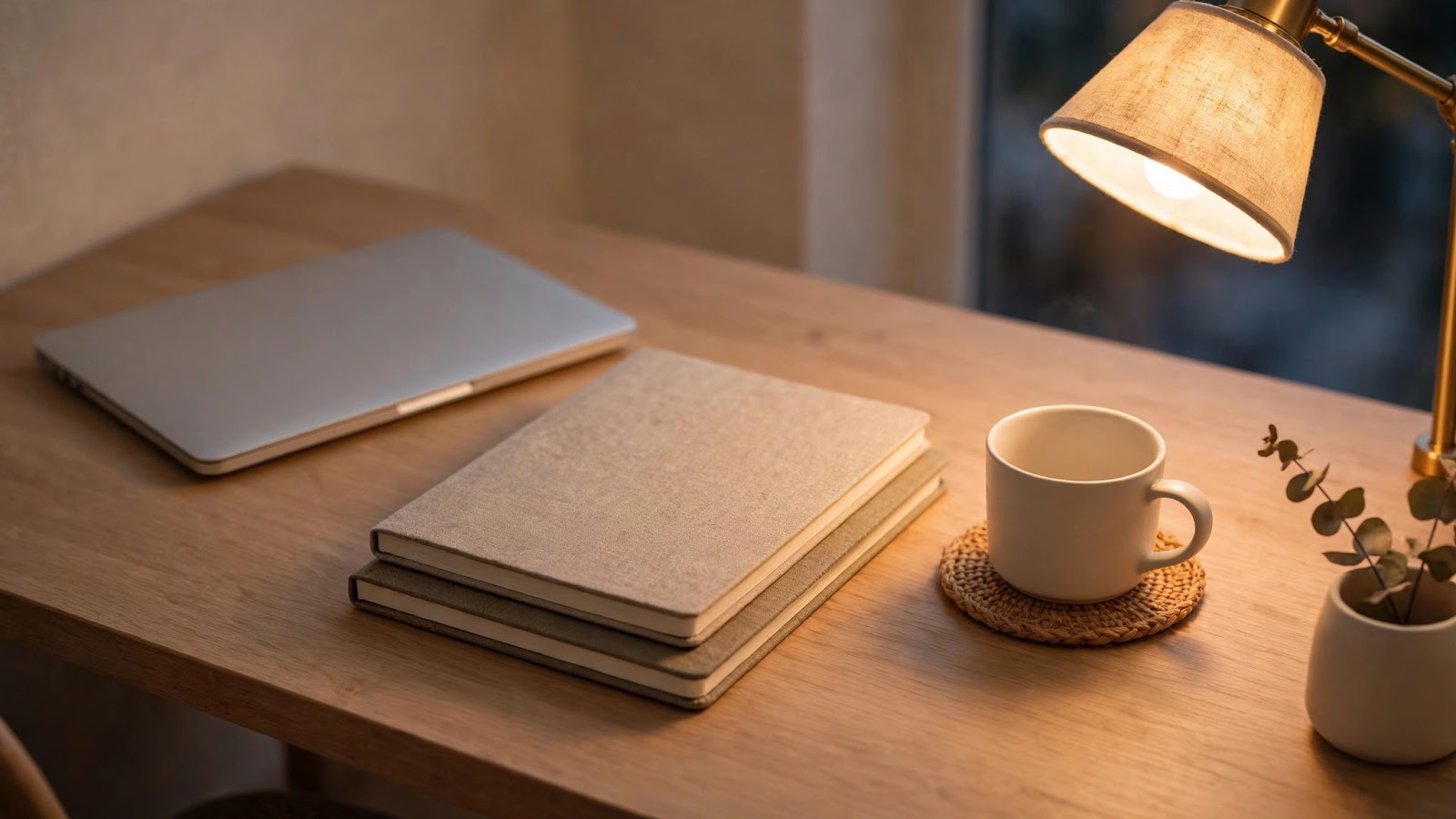
Also — and this one surprised me — I eat lunch at a clean desk now. The pre-lunch tidy clears the workspace, and eating at a clear desk instead of pushing papers aside feels absurdly luxurious. It's a tiny thing. Most of productivity is tiny things stacked up until they're not tiny anymore.
Does it work on terrible days?
Honest answer: it's the only thing that works on terrible days. On a day when I can't focus, can't write, can't think — the tidy still happens, because two minutes is too small to fail at. And here's the weird part: on those days, the tidy sometimes unlocks the next block. Not always. But there's something about doing one small complete thing — start, finish, done — that reminds your brain what completion feels like. It's a ladder with one rung. Sometimes one rung is enough to reach the next thing.
I've also noticed it changes how I end the day. The last tidy, the one before I close the laptop, is the best one. I stack everything, close the notebook, wipe the desk, and the desk looks like morning. Walking away from a clean desk and coming back to a clean desk is one of those quiet upgrades that compounds. Monday-you thanks Friday-you. That's the whole trick of systems: making your future self's life slightly easier, one two-minute window at a time.
What two minutes can't fix (and that's fine)
Let me be honest about the limits, because every productivity habit has them and the gurus never mention theirs. The two-minute tidy does not fix a fundamentally chaotic workspace. If your desk is buried under three weeks of unfiled paperwork, two minutes just moves the top layer around. The tidy is maintenance, not rescue. If you're starting from disaster, do one real cleanup session first — an hour, a weekend morning, whatever it takes — and then let the tidy keep it there. I did a full reset one Saturday in March, and the tidy has held the line ever since.
It also doesn't fix digital clutter, and digital clutter is where most of us actually live now. A clean desk with 47 browser tabs open is like a tidy kitchen with the oven on fire. I've started doing a digital version: between blocks, I close tabs I don't need and quit apps I'm done with. Same two minutes, same timer, same rule — restore, don't reorganize. The physical tidy came first and taught me the pattern; the digital one was just applying it to the other desk.
And it doesn't work if you're using it to avoid the next block. I'll admit there were days early on where I "tidied" for two minutes, then found another two minutes of tidying, then watered a plant that didn't need watering — the tidy had become a very clean form of procrastination. The timer is the guardrail. When it beeps, you sit down and start. If you can't start, that's a different problem — task too big, task too vague, task too scary — and no amount of tidying will solve it. Name the real problem instead of polishing around it.
If you want to try it today
Don't buy anything. Don't set up a system. Just do this: the next time you finish a work block, set a two-minute timer and put things back. Desk only. When the timer beeps, stop, and start the next block. That's the experiment, and it costs you exactly two minutes to run.
Give it a week. The first two days will feel silly — you'll tidy and think "this is what I'm doing with my breaks now?" By day four or five, you'll notice the seam.
One more thing worth knowing: the tidy gets faster. My first attempts genuinely took the full two minutes, sometimes spilling over. Now I usually finish in about ninety seconds, because there's less to restore each time — the habit maintains the baseline, so each tidy starts from "pretty good" instead of "disaster." Maintenance is always cheaper than rescue. That's true of desks, inboxes, health, and just about everything else, which is probably why this tiny habit keeps teaching me things I didn't sign up to learn.
The old block will feel closed. The new block will start cleaner, literally and mentally. And the phone-check gap between blocks will have shrunk without you fighting it, because you gave your hands something better to do.My honest opinion after months of this: it's the highest-return habit I've ever adopted, measured in effect-per-minute. Ten minutes a day for cleaner focus, less lost stuff, and a workday that feels segmented instead of blurred. Small rituals beat big overhauls, because the ritual you actually do always wins over the system you abandoned. I'll take that trade every single time.


