I thought I knew where my focus went. I was wrong about almost everything. A little notebook I carried for one week told me more about my attention than years of productivity advice ever did — mostly because it showed me what actually happened instead of what I told myself happened.
The idea came from a frustrating Thursday. I'd planned a four-hour writing block and produced about forty minutes of actual work. When I tried to account for the missing time, I genuinely couldn't. It wasn't one big distraction. It was just... gone. So I decided to stop guessing and start logging.
What an attention diary actually is
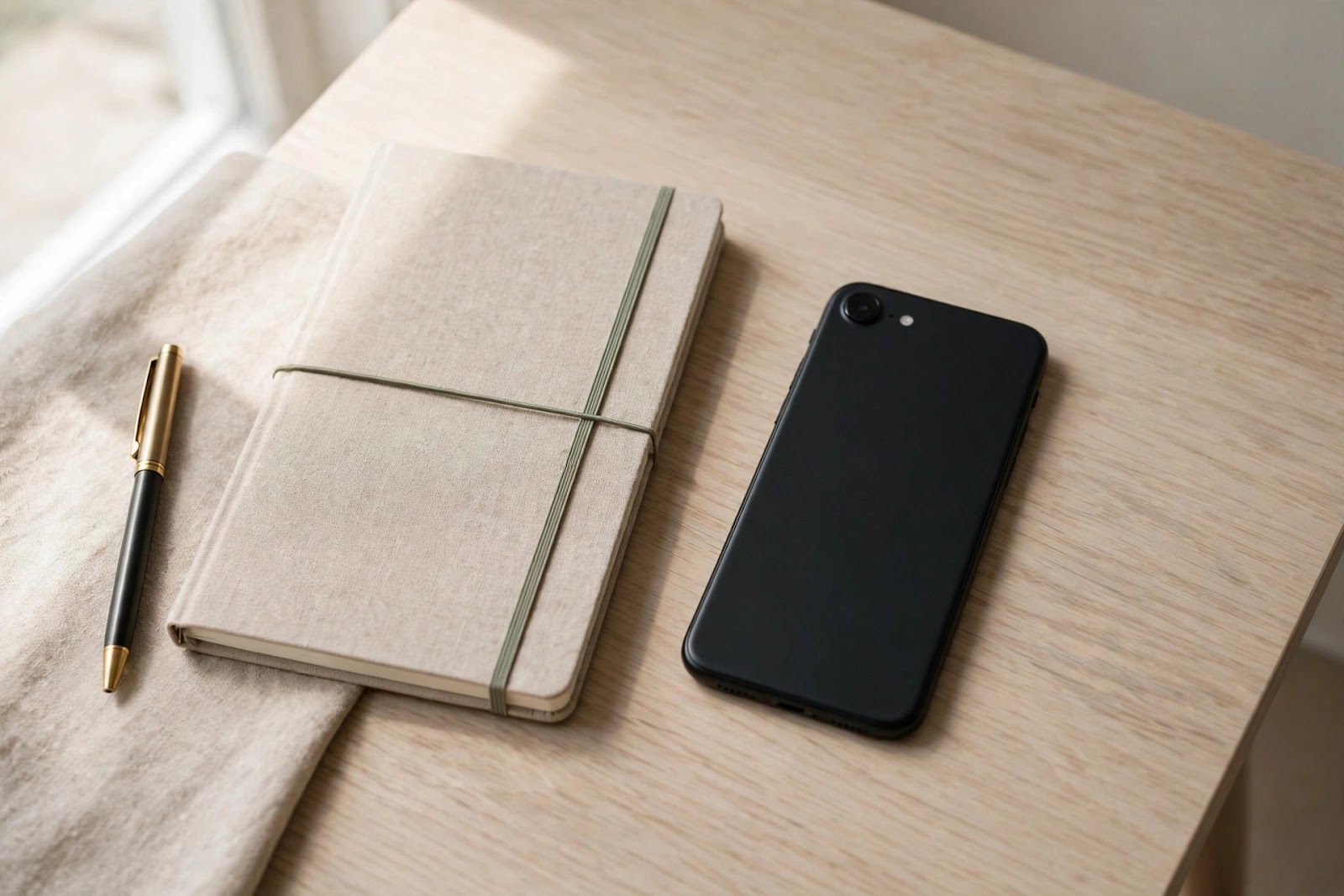
Forget anything complicated. For one full work week, I kept a small pocket notebook next to my keyboard. Every time I noticed my attention had left the task I was working on — a phone check, a tab switch, a wander to the kitchen, a sudden urge to reorganize my downloads folder — I wrote one line: the time, what I was supposed to be doing, and what pulled me away.
That's it. No judgment, no analysis in the moment. Just a line. The whole point is to make the invisible visible. You can't fix a pattern you can't see, and attention leaks are almost entirely invisible while they're happening.
The rules I set for myself
I gave myself exactly three rules to keep it honest. One: log everything, even the embarrassing ones. If I spent twelve minutes reading about a celebrity's house, it went in the notebook. Two: never log before the distraction ends — I finished the distraction, then wrote the line, so logging never became its own interruption. Three: no self-punishment. The notebook wasn't a judge. It was a camera.
That third rule mattered more than I expected. The first day, I kept wanting to skip the shameful entries — the forty-minute scroll spiral, the three "quick checks" of the same chat. Writing them felt like confessing. But the confession was the data.
Monday: the day that humbled me
By lunchtime on day one, I had eleven entries. Eleven. Let me share a few, verbatim from the notebook: 9:42 — writing brief / checked news headlines. 10:05 — writing brief / Slack thread about Friday lunch. 10:31 — email draft / remembered I never replied to Ali. 11:20 — reading report / phone lit up, checked, then Instagram.
The pattern hit me before noon: almost none of my distractions were planned or dramatic. They were micro-decisions — five seconds of "let me just check" that cost fifteen minutes each. I wasn't falling into distractions. I was choosing them, reflexively, dozens of times a day.
And here's the part that stung: I could not remember, by evening, even half of what I'd logged. My brain had already edited the day into a story about "working hard with a few interruptions." The notebook told a different story: working in fragments, with focus being the interruption.
The five patterns that kept showing up
By Wednesday I had enough data to see the shape of my own leaking. Your patterns will be different, but I'd bet money some of these are familiar.
1. The transition leak. Most of my distractions happened in the sixty seconds after finishing something — a subtask, a paragraph, an email. The moment my brain released one task, it grabbed the nearest novelty before I'd chosen the next task. Twenty-three entries in five days had this shape. The fix was embarrassingly small: decide the next task before finishing the current one. That one sentence on a sticky note closed the gap.
2. The phone-face-down lie. I kept my phone face-down on my desk, which I thought counted as "phone in another room." It did not. Fourteen entries involved the phone lighting up or my hand reaching for it without a notification at all — pure reflex, like scratching an itch. The diary made this undeniable: face-down wasn't a barrier, it was a decoration. The phone now lives in the kitchen during work blocks.

3. The legitimate-looking distraction. Roughly a third of my entries weren't obviously frivolous — checking a related document, "researching" one small point, reviewing a teammate's update. They felt like work. The diary revealed they were work-adjacent procrastination: technically defensible, timed exactly for when the real task got hard. Now I have a rule: if a side-quest takes more than five minutes, it gets scheduled as its own task or it doesn't happen.
4. The emotional weather. This was the surprise. My worst distraction days lined up with feeling anxious or unsettled, not bored. When something was bothering me — a tense email, an uncertain decision — my focus shattered and the log filled up. Distraction wasn't the problem on those days; it was the symptom. The fix wasn't stricter rules, it was dealing with the underlying worry — usually by writing it down or making the one small decision I'd been avoiding.
5. The recovery cost. The diary made me track something I hadn't planned to: how long it took to get back. After each distraction I noted the time I'd returned to the original task and whether I actually resumed it or drifted somewhere else. The honest average for getting back on track was around nine minutes — not the two minutes it felt like. A "quick check" was never quick. It was a nine-minute tax, paid in focus.
Wednesday: the day I spotted my own tricks
Mid-week, the diary started showing me something sneakier than simple distraction: my own avoidance tactics. Tuesday afternoon I'd logged 3:12 — writing launch email / "researching" competitor subject lines (18 min). Eighteen minutes of research for one email. When I was honest with myself, I'd needed maybe two minutes of it. The rest was my brain negotiating: as long as I was "working," I didn't have to face the actual writing, which felt uncertain.
This happened with hard tasks constantly. The diary entries around difficult work were twice as long as entries around easy work. Easy tasks got done in flow; hard tasks attracted a cloud of side-quests. Once I saw it written down, I couldn't unsee it. Difficulty didn't cause distraction — difficulty caused avoidance disguised as productivity, which is the most expensive kind because you feel virtuous while it's happening.
The practical fix I tested on Thursday and Friday: when I caught myself starting a side-quest next to a hard task, I set a visible timer for ten minutes and committed to the hard task for just that long. Not the whole thing — ten minutes. The diary shows the timer worked about eight times out of ten. The other two times, at least I caught myself honestly.
Friday: the review that changed my routine
On Friday afternoon I sat down with all five days of entries — about seventy lines total — and did the review. I grouped them, counted them, and looked for the story. The numbers were sobering: roughly two and a half hours a day lost to logged distractions, plus the recovery tax, plus the ones I surely missed. I wasn't a focused person with a distraction problem. I was a distracted person with occasional focused stretches.
That sentence felt harsh. But it was also freeing, because it meant the problem was mechanical, not moral. I didn't need more discipline. I needed fewer leaks.
So I changed exactly three things, based on the diary's evidence and nothing else: the phone moved to another room during work blocks, I started writing my next task down before finishing the current one, and I gave work-adjacent research a five-minute cap. Small, specific, targeted at my actual patterns — not generic advice from the internet.
A month later: what actually stuck (and what didn't)
The diary is over — I don't log anymore — but the three fixes stuck because they were mine. The phone habit alone recovered something like an hour a day. The next-task rule killed the transition leak almost entirely. And the five-minute research cap stopped me from "quickly looking something up" for forty minutes.
I'll be honest about what didn't stick: the ten-minute timer for hard tasks. It worked during the diary week, but once the week ended I slowly stopped reaching for it, and the side-questing around hard tasks crept back a little. I know it's a gap. The diary at least taught me to name it when it happens — "this is the avoidance cloud" — which gets me back faster than the old oblivious version of me ever did.
Perfection wasn't the goal. The goal was seeing clearly, and that part is permanent. I'm not going to tell you I'm distraction-free now. I'm not. I still lose focus, especially on anxious days — but now I notice it fast, because the diary trained my attention-attention. The notebook is gone, but the habit of noticing stayed. I catch myself mid-reach for the phone. I catch the transition gap before it opens. That noticing is the whole prize.
How to run your own week
You don't need my exact rules, but you do need honesty. Here's the minimal version: any notebook, any app, one week, work hours only. Log every distraction in one line — time, task you left, what pulled you away. No analysis until Friday.
A few practical notes from my week. Don't log at home first — do it during real work days when your attention actually costs something. Don't show the notebook to anyone mid-week; the performance pressure makes you cheat. And don't try to fix anything during the week itself. The week is for observing, not improving. Improvement comes after, from the evidence.
If writing by hand annoys you, a notes app works — but keep it dumb-simple. One note per day, one line per entry. The moment your logging system needs its own tutorial, you've built a distraction machine.
One more tip: pick a week that's genuinely busy. I almost did mine during a quiet week and I'm glad I didn't — the diary is most valuable when there's real pressure on your attention, because that's when your true patterns show up. A calm week's data flatters you. A hard week's data fixes you.
And give yourself permission to be a little appalled. Everyone I've described this to says the same thing: "I don't think I could do that, I'd be too embarrassed." That's exactly why it works. The embarrassment is the mechanism. Seeing your own behavior in writing is the fastest cure for the story that you're doing fine.
The uncomfortable part (and the point)
The reason this works where reading about focus doesn't is that your brain lies to you about your own behavior, constantly, kindly, and without malice. You remember your intentions, not your actions. The diary is a record of actions. And actions are the only thing your results are built from.
A week of that truth is uncomfortable. It's also the most productive uncomfortable hour of review you'll do this year, because everything you fix afterward will be aimed at the real problem — not the story you told yourself about the problem. I can't recommend it enough. Grab the notebook. Be honest. Then fix what the notebook shows you.


