For years, my mornings started the same way: I woke up, stared at my phone, and tried to remember what I was supposed to be doing. Not in a dramatic, lost-my-purpose way. In a small, ordinary, irritating way. I knew I had things to do, I just could not name the first one without scrolling through messages, emails, and a mental list that rearranged itself every time I looked at it. By nine o'clock I had answered three messages, started two tasks, finished neither, and felt behind before the day had properly begun.
Then, about eight months ago, I started planning my day the night before. Not a fancy system, not a colour-coded planner, not an app with reminders and streaks. Just ten minutes at my desk, the evening before, writing down what tomorrow would look like. It sounded too simple to matter, and I resisted it for a long time because simple things that work feel suspicious when you have spent years buying complicated solutions.
It mattered. Mornings stopped feeling like a scramble, and I want to be honest about what changed and what did not, because the internet is full of people claiming a habit transformed their entire life. Mine did not transform my life. It just made my mornings calmer, my workdays clearer, and my evenings less haunted by the feeling that I had forgotten something important.
What my old mornings actually looked like
Let me paint the old picture properly, because I think a lot of people will recognise it. I woke up to an alarm, checked my phone, and immediately let other people's priorities set my day. A message from a colleague became the first task. An email became the second. By the time I sat at my desk, my attention had already been spent in five directions, and the work I actually cared about was waiting behind a queue of other people's urgencies.
The worst part was the decision fatigue before I had even started. Every morning I had to decide what to do first, what mattered most, what could wait, and whether I had forgotten something. Those decisions are small, but making them while half awake, with a phone buzzing, is a terrible way to start. I often picked the easiest task, not the most important one, just to feel like I had begun, and then wondered at lunch why the important thing was still untouched.
I also carried a low hum of anxiety through the morning, the feeling that something was slipping. It usually was: a reply I meant to send, a bill I meant to pay, a task I had promised someone and not written down anywhere reliable. My brain was doing the job of a planner, badly, and it resented the extra work. No wonder I felt tired by ten.
The ten-minute evening habit
Here is exactly what I do now, because vague advice about planning helps nobody. At around nine in the evening, after dinner, I sit down with a paper notebook and a pen. I look at tomorrow's calendar, I look at today's unfinished tasks, and I write three things. Not ten, not a full schedule down to the half hour. Three things.
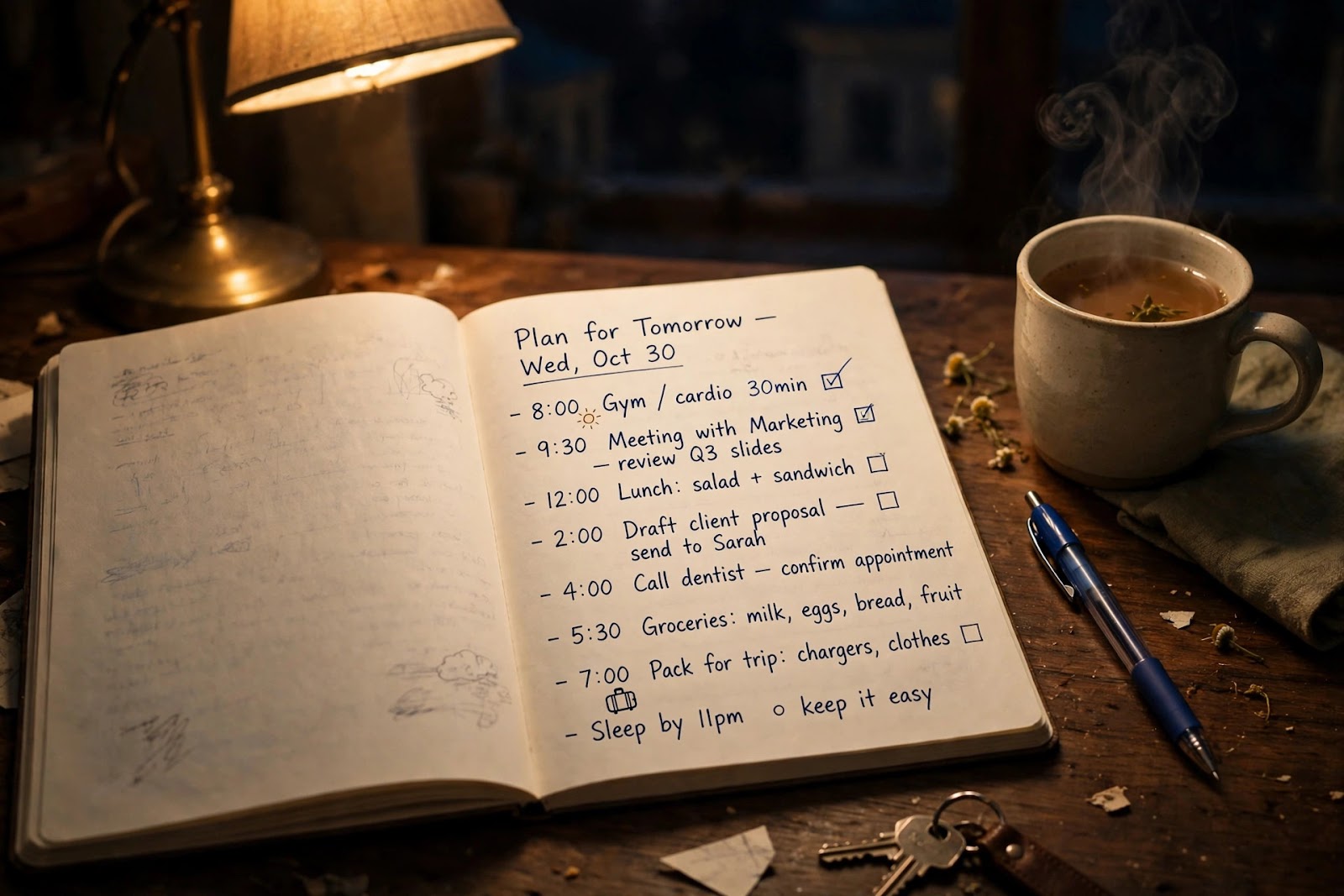
The first is the one thing that matters most tomorrow, the task I will do first, before messages, before email, before anything that can wait. The second and third are supporting tasks, things that should also get done but will not ruin the day if they slip. Underneath those three, I write a short list of small jobs, the quick emails, the calls, the admin, and I keep that list to five items at most.
Then I do one more thing that turned out to be surprisingly important: I write down what I am NOT doing tomorrow. If a task is nagging at me but does not belong tomorrow, I write it on a separate later list, with a date or a note saying when I will look at it again. That sounds like extra work, but it is what stops the nagging. My brain trusts a list it can see. It does not trust a vague promise to remember later.
The whole thing takes ten minutes on a normal night, fifteen if the next day is complicated. I do it on paper because paper does not buzz, and because crossing something off with a pen feels more finished than tapping a checkbox. If you prefer an app, use an app. The tool is not the point. The decision, made the night before, is the point.
Why the night before works better than the morning
I tried morning planning first, and it failed, and the reason is worth saying plainly. In the morning, you are already inside the day. Messages have arrived, people need answers, and every plan you make competes with fresh urgency. At night, the day is over. Nobody is messaging about tomorrow yet, the house is quieter, and you can think about priorities without someone else's emergency elbowing in.
There is also a sleep benefit I did not expect. Before I planned at night, I used to lie in bed running through tomorrow's tasks, trying not to forget them, which is a terrible way to fall asleep. Now that the plan is written down, my brain lets go of it. I still think about tomorrow sometimes, but the thought ends with it is on the list, and that is enough to stop the loop. I sleep better, and better sleep makes the morning easier, which makes the plan easier to follow. It is a small virtuous circle.
The other benefit is that my morning now starts with an instruction, not a question. I open the notebook, I see the first task, and I start. No scrolling, no deciding, no negotiating with myself about whether to check email first. I still check email, just after the first task is underway, when I have already done something that matters and the inbox feels less like a boss and more like a mailbox.
What a planned day actually looks like
A typical planned morning now goes like this. I wake up, make coffee, open the notebook, and start the first task by eight-thirty. It is usually writing, because that is the work that needs my freshest attention. I work on it for about ninety minutes before I open messages. By ten, the most important thing is either done or well underway, and the rest of the day feels like downhill rather than uphill.

That does not mean every day goes to plan. Some days a genuine emergency lands and the plan goes out of the window, and that is fine. The plan is not a prison. On those days I still benefit, because I know exactly what I am postponing, and I can move it deliberately instead of losing it in the chaos. A plan you abandon consciously is very different from a day you never planned at all.
I also learned to plan less than I think I can do. My early lists had eight items, and I finished four and felt like a failure every night. Three main tasks plus a few small jobs is honest about what a day actually holds, once you count messages, meals, interruptions, and the fact that some tasks take twice as long as you estimate. Finishing the list feels good, and feeling good about a plan is what makes you keep planning.
The mistakes I made at the start
My first mistake was over-scheduling. I wrote a timetable for the whole day, nine to ten this, ten to eleven that, and then felt defeated by ten-thirty when reality disagreed. A day is not a train timetable. Now I plan tasks, not hours, and I let the order flex while the priorities stay fixed. That one change kept the habit alive past the second week, which is where most of my systems used to die.
My second mistake was planning only work. My evenings felt squeezed because personal tasks, a call to a friend, a household job, buying groceries, kept ambushing my workdays. Now one of my three tasks is often personal, and the small list includes life admin. A plan that only covers work is a plan that ignores half your life, and half your life will interrupt it.
My third mistake was skipping the nightly review when I was tired. Tired nights are exactly when the next morning needs a plan most, and they are exactly when I want to skip it. I made a rule for those nights: a two-minute version. Just the first task, written down, nothing else. Even that tiny version saves the morning, and it keeps the streak alive without demanding a full ritual when I have nothing left.
If you try this tonight
Try it tonight, not on Monday, not when you buy a new planner, tonight. Take any piece of paper, write tomorrow's date, and pick one thing that matters most. Write it down, then add two supporting tasks and a few small jobs. Put the paper where you will see it in the morning, on your desk, not in a drawer. That is the whole experiment, and it costs nothing.
Give it a week before you judge it, because the first two mornings feel odd, like following someone else's instructions. By day four or five, you will notice the difference: less scrolling, less deciding, less of that morning scramble feeling. You might also notice, as I did, that your evenings get calmer, because the day ahead is already decided and your brain can rest.
I am not going to claim this habit will change your life. It changed my mornings, and my mornings used to set the tone for everything after them. A calm start does not guarantee a perfect day, but a scrambled start almost guarantees a frazzled one. Ten minutes at night, three tasks on paper, and a morning that starts with a clear first step. That is a trade I would make again every single evening.


