Last spring I counted my to-do apps and felt embarrassed. I had four of them. One for work tasks, one for personal errands, one that synced with my calendar, and one I had downloaded during a late-night burst of optimism and then forgotten completely. Between them I was carrying 63 open tasks, and I still forgot to buy printer paper three weeks in a row.
That was the moment I stopped pretending the system was working. The apps were supposed to make my life easier. Instead, every morning started with me opening one app, remembering something in another, and then losing twenty minutes to reorganising lists that nobody else would ever see. I was managing my tasks more than I was doing them.
So I did something that felt almost rebellious. I bought a plain A5 notebook for less than five dollars, grabbed the black pen I actually like writing with, and moved my whole day onto one page. No syncing. No notifications. No little red badge counting my failures.
The morning I ditched the apps
I didn't delete anything on day one. That would have been dramatic, and drama is a terrible productivity strategy. I just decided that for one week, paper would be the boss. The apps could sit there, untouched, like old textbooks on a shelf.
My first paper list had nine items on it. Nine. The apps had given me 63, because it costs nothing to add one more thing to an app. A digital list never runs out of room, so it never forces you to choose. Paper does. When the page fills up, you have to admit that you cannot do everything, and that admission is the whole point.
I wrote the list at 7:40 in the morning, standing in my kitchen with coffee going cold. I put a small square box next to each item, not a circle, because a square feels more satisfying to tick. Then I did the hardest task first, which that day was calling a client I had been avoiding for four days. It took eleven minutes. I had spent longer than that just staring at the call in my app.
By lunch I had ticked five boxes. I could see the progress without opening anything, scrolling anything, or waiting for anything to load. The page just sat there on my desk, quietly keeping score.
Why paper forces better choices
Here is the uncomfortable truth I learned in that first week: most of my digital tasks were not tasks at all. They were wishes, reminders, ideas, and vague worries wearing a task costume. "Learn Spanish" is not a Tuesday task. "Fix the website" is not a task either, not until you break it into something a person can actually finish in one sitting.
Paper punished vagueness. If I wrote "work on report," I would stare at it all morning and do nothing, because I had not decided what "work on" meant. So I started writing verbs with objects. "Draft the first three paragraphs of the report." "Email Sarah the revised dates." "Book the dentist for Thursday." Each one took under a minute to write properly, and each one saved me ten minutes of dithering later.
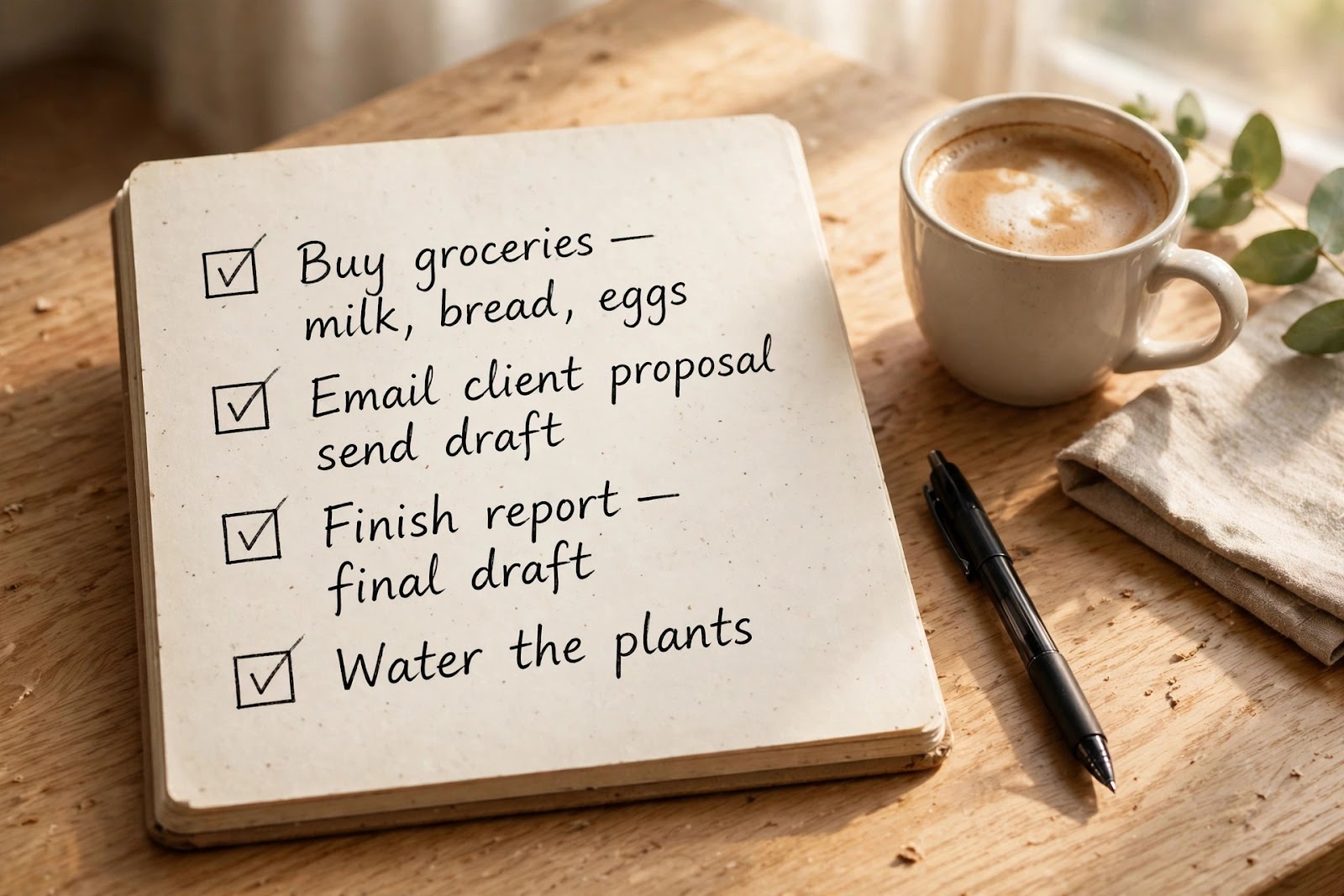
I also learned to cap the list. My rule now is simple: no more than ten items, and only three of them get a star. The starred ones are the real work of the day. Everything else is bonus. On a good day I finish eight or nine. On a bad day I finish the three starred ones and call it a win, because it is.
That cap changed how I say yes to things. When a colleague asks me to squeeze in one more job, I look at a full page and say, "I can do it Thursday, not today." Before, I would have tapped it into an app, felt briefly organised, and then watched it rot there for two weeks while guilt piled up.
My exact paper setup (it is boring, and that helps)
People always want to know what notebook and pen I use, as if the stationery is the secret. It is not, but since you asked: a plain lined A5 notebook, nothing fancy, and a pen that does not skip. I tried a fancy leather journal once. It made me afraid to write anything imperfect in it, which is the opposite of useful.
Each morning I draw a line under yesterday's page. If something did not get done, I make a choice. I either rewrite it on today's page, which means I still care about it, or I cross it out for good, which means I never really did. I do not let tasks silently roll forward forever. That silent rollover was exactly how my apps ended up with 63 items.
I keep one running page at the back of the notebook for ideas that are not for today. Book recommendations, a course I might take, a project for next month. They live there, out of sight, until I deliberately promote one to a daily page. The daily page stays clean. The back page holds the dreams.
I also write the time next to appointments, but I do not schedule every task into a time slot. Time-blocking every task made me feel like a train timetable, and one late meeting would wreck the whole day. The list tells me what matters. My calendar tells me when I have to be somewhere. They do different jobs, and I stopped asking one tool to do both.
What about the things paper cannot do?
Fair question, and I asked it too. Paper cannot remind me about a deadline next month. Paper cannot be searched. Paper cannot be backed up if I spill coffee on it, which I have done exactly once, and yes, it was a sad morning.
So I kept one safety net. Every Friday afternoon, I spend fifteen minutes looking at the next two weeks and writing any hard deadlines on a single index card stuck to my monitor. Tax filing, a project launch, a flight booking. The card holds maybe six dates. Everything else lives in the notebook, one day at a time.
Recurring tasks got a simple fix too. I have a small weekly checklist on the inside cover: water the plants on Sunday, take out the bins on Tuesday night, submit my hours on Friday. I glance at it when I start a new week. I do not need an app buzzing at me to remember the bins.

And when I travel, the notebook comes with me. It weighs less than my phone charger. It never runs out of battery, never asks for an update, and never shows me an ad for a different productivity app while I am trying to work.
The week everything clicked
Three weeks in, I had a day that sold me on paper for good. I had a report due, two calls to make, and a pile of small admin I had been dodging. In the old days I would have opened three apps, felt overwhelmed by the backlog, and started with the easiest tiny task to feel productive.
Instead I looked at my page, saw my three starred items, and did them in order. The report draft took ninety minutes. The calls took twenty. The admin took another thirty. By 2 p.m. the important work was done, and the rest of the afternoon felt like found time. I used it to go for a walk, which I did not even put on the list, because some good things do not need to be tasks.
That evening I ticked the last box with a bit more force than necessary. It felt good. It still does, months later. There is something about a physical tick that a digital checkbox has never given me. You can see the day getting done, in ink, in your own handwriting.
How to try it without overhauling your life
If you want to test this, do not buy a whole productivity system. Buy one cheap notebook and try it for five working days. Write tomorrow's list tonight, or this morning's list with your first coffee, whichever feels easier. Keep it to ten items or fewer. Star three.
Write tasks as actions you can finish. Not "sort out finances" but "call the bank about the duplicate charge." Not "get fit" but "walk for twenty minutes after lunch." If a task takes more than an hour, split it. Your future self will thank you at 9 a.m. when the list actually makes sense.
At the end of each day, spend two minutes on the handover. Tick what is done, carry forward what still matters, cross out what does not. That two-minute ritual is the real system. Without it, paper becomes just another junk drawer. With it, one page a day quietly runs your whole working life.
One warning: your handwriting will be messy some days, and your list will have crossings-out. That is fine. A working list is supposed to look worked on. The beautiful, untouched lists in my old apps were the ones that never helped me at all.
I also do a quick Sunday reset that takes about ten minutes. I flip through the past week's pages, notice which tasks kept rolling forward, and ask myself honestly whether they still matter. Last month I found the same vague item, "sort out storage," on five different days. I finally split it into three small jobs, did the first one that Sunday afternoon, and the other two the following week. The list stopped nagging me because I stopped letting it stay vague.
My apps are still on my phone, by the way. I use one of them for shared grocery lists, because my partner needs to see that list too. Everything else, the work that actually moves my day forward, lives on paper. I finish more, I stress less, and I no longer start my morning by managing a system instead of doing the work. If your lists feel heavier than the work itself, try one page tomorrow. You might be surprised how light a day can feel when the list fits in your hand.


