For years I planned my workdays the way everyone does: a to-do list, ordered by urgency, attacked from the top at whatever hour I happened to sit down. Some days I flew through hard tasks. Other days the same kind of task felt like wading through wet cement. I blamed motivation. I blamed sleep. I bought a better chair.
Then a friend asked me a question I couldn't answer: "When are you actually sharp?" I guessed "mornings, probably." Probably. I had no idea. So I did what any obsessive productivity nerd does — I turned myself into a two-week experiment.
The Tracking System
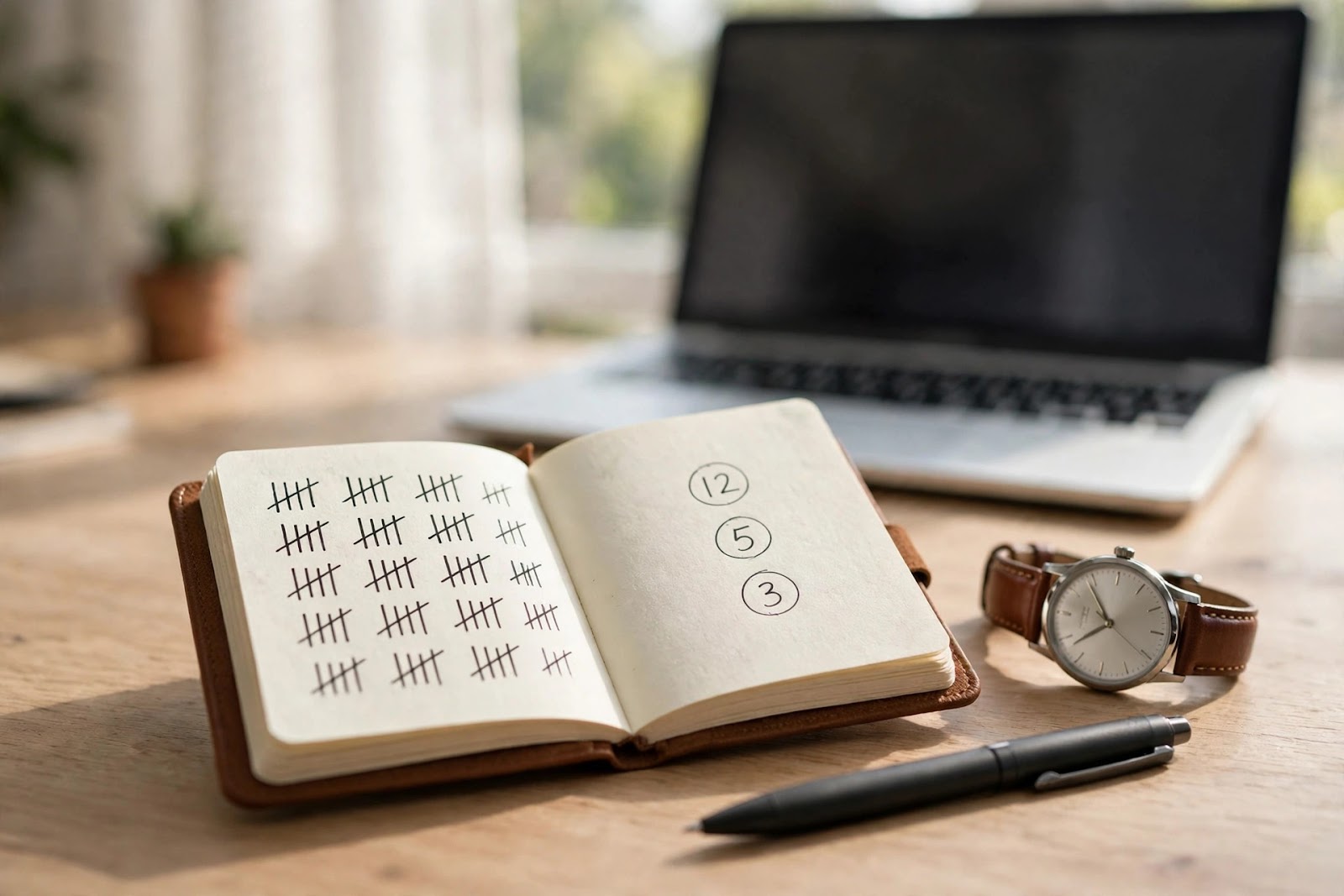
Nothing fancy. I took a small notebook and, every hour on the hour during workdays, wrote a number from 1 to 5. One meant barely functioning. Five meant I could think in complete paragraphs. Beside the number, I jotted one or two words: "coffee," "skipped lunch," "bad sleep," "meeting ran long," "walked at noon." That was it. Took about fifteen seconds per entry.
I chose paper over an app on purpose. Apps want to graph things and send me insights and gamify my self-awareness. I didn't need a dashboard. I needed a habit so light I'd actually keep it up for fourteen days. The notebook sat open next to my keyboard, which meant the hourly check-in was one glance away. When I tried an app version first, I forgot it existed by day three.
The rules were simple. Score honestly, not aspirationally — a 2 is a 2, even if you wish it were a 4. Don't change anything about your routine during the two weeks. You're measuring, not fixing. That part was harder than it sounds. Once you see yourself scoring 1s at 2pm every day, every fiber of you wants to start chugging espresso and "fixing" it. Resist. The data is the point.
To keep the scores consistent, I wrote a tiny key on the notebook's inside cover: 1 = "barely awake," 2 = "foggy but functional," 3 = "fine, normal," 4 = "sharp, ideas flowing," 5 = "unstoppable." Without the key, my 3s drifted — by day four I was calling everything a 3 out of laziness. The written definitions kept me honest. I also set a quiet hourly chime on my phone. Not an alarm that interrupts, just a soft ping. Missed hours happen; I filled them in from memory at the next check-in and marked them with a little asterisk so I'd know which scores were real-time and which were reconstructed.
What Two Weeks Showed Me
The pattern was embarrassingly clear by day five, and the full fourteen days just confirmed it.
My peak was 9 to 11 in the morning. Not "morning" in some vague sense — a specific two-hour window where my scores were almost always 4s and 5s. Sentences came easily. Hard problems felt like puzzles instead of threats. After 11, I'd dip to a 3, and after lunch came the cliff: 1:30 to 3 was a wasteland of 1s and 2s. Then, surprisingly, a second wind from about 4 to 5:30 — not as strong as the morning, mostly 3s with a few 4s, but real. After 6pm I was done, and the scores proved it.
The food notes were the revelation inside the revelation. The days I ate a heavy lunch, the afternoon trough was deeper and longer — 1s stretching to 3:30. Light lunches pulled the recovery forward by almost an hour. I hadn't expected nutrition to show up so loudly in a sample size of ten workdays, but there it was, underlined in my own handwriting.
Sleep showed up too, but not the way I expected. It wasn't total hours that moved my morning scores — it was consistency. Nights where I went to bed within the same hour as usual gave me 5s at 9am even on six and a half hours. Nights where I stayed up late scrolling, even with eight hours of sleep, gave me 3s. My body cared more about rhythm than quantity.
And here's the part that stung: I'd been spending my golden 9-to-11 window on email, Slack, and "quick questions" for years. My sharpest hours were going to my shallowest tasks. The two weeks didn't just show me a pattern. They showed me a waste.
One more pattern worth mentioning: Fridays looked different from the other days. My morning peak was shorter — more like 9 to 10:30 — and the afternoon trough started earlier and ran deeper. By Friday at 2pm I was consistently a 1, no matter what I ate or how I slept. A week's worth of decisions had simply used up the tank. I stopped fighting it. Fridays now get lighter work by design, and the Friday review lands in the late-afternoon second wind, which is exactly demanding enough to feel productive without needing peak focus.
Meetings showed up in the notes too, and not kindly. A 10am meeting didn't just cost me an hour — it shattered the peak window on both sides. I'd spend twenty minutes before it getting ready and twenty after getting back into the work. The scores around meeting days looked like someone had taken a bite out of the morning. That single finding changed my calendar more than anything else: no meetings before 11, ever, unless the building is on fire.
What I Got Wrong the First Week
The first week of tracking was a mess, and I'd be lying if I pretended the data came out clean. I made three mistakes that nearly made me quit, so let me save you the same stumble.
First: I scored my intentions, not my state. At 3pm on day two I wrote a 4 because I'd just finished a decent piece of work — but the previous two hours had been pure fog, and I'd spent them pretending to read a report. The score captured the highlight, not the hour. Once I caught myself doing it, I changed the rule: score the worst fifteen minutes of the hour, not the best. Your honest number is always the low one, not the peak one. That single change redrew the whole afternoon trough.
Second: I confused a bad day with a broken pattern. Day four was a disaster — I slept terribly the night before, scored 2s until noon, and almost threw the notebook out. Then day five looked exactly like day three again, and I realized the sleepless day was the outlier, not the evidence. The rule I learned: one weird day is weather, five normal days are climate. Don't redesign your schedule around weather. Third: I tracked too many variables. By day six I was logging water intake, screen time, room temperature, and whether I'd stretched — half a page per hour, and I started dreading the chime. The data that actually mattered was the one number plus two words. I cut everything else mid-week and the habit became invisible again. Track less than you want to. The notebook is a thermometer, not a hospital chart.
Looking back, the misreads were the most valuable part. Every wrong score taught me what an honest one felt like, and by week two the numbers were trustworthy in a way week one's never were. If your first few days feel sloppy, that's not failure. That's calibration.
The Wednesday That Changed My Schedule
Halfway through the second week, I broke my own rule and ran an experiment. I had a writing task I'd been dreading — a long piece that needed real thinking, the kind I'd normally start at 1pm and drag through until dinner. Instead, I put it at 9:15am, right in the middle of my peak window, with my phone in the other room.
I finished the draft by 10:30. An hour and fifteen minutes. The same kind of task had taken me four fractured hours the week before, spread across an afternoon of 2s. I sat there staring at the finished draft feeling slightly cheated, like I'd discovered the test answers had been under my chair the whole time.
That afternoon I did my email and admin in the trough — deliberately. And you know what? Email doesn't care if you're a 2. Nobody can tell the difference between a 2-energy email and a 5-energy email. The trough is the perfect home for shallow work, because shallow work is all the trough can hold. I'd been doing it backwards for years: saving the easy stuff for my best hours out of some misguided sense of "warming up."

How I Rebuilt My Day
After the two weeks, I rearranged my schedule around the scores instead of fighting them. Here's what a typical day looks like now.
9 to 11 is sacred. That's deep work only — writing, hard problems, anything that needs a 4 or 5. No email, no messages, no meetings. My phone lives in the kitchen. If someone needs me, they can wait two hours. They always can.
11 to 12:30 is the shallow pile: email, messages, scheduling, the quick questions. My energy is a 3 here, which is plenty. I batch it all together so it doesn't leak into the deep-work window. This is also when I take meetings if I can choose — I'm present enough to be useful, and I'm not spending peak hours listening to status updates.
Lunch is light and I walk for fifteen minutes after. That walk was the single highest-ROI change from the whole experiment. It doesn't just help digestion — it marks a line. Morning is over, afternoon is starting, and my brain gets the memo.
1:30 to 3 is the trough, and I stopped pretending otherwise. This is admin, filing, reading, errands, anything that needs a body more than a brain. I do not schedule thinking here anymore. Trying to force deep work into the trough was like trying to run in a swimming pool. The resistance wasn't a character flaw. It was biology.
4 to 5:30 is the second wind, and I use it for planning and creative work — reviewing the day, sketching ideas, prepping tomorrow's deep work so I can start at 9 without deciding anything. It's also when I do the Friday brain dump, actually. Reviewing the week takes a 3, not a 5, and ending Friday in the second wind means I leave work feeling capable instead of drained.
After 6, I'm off. The scores were unanimous: nothing good happens after 6. I'd been "working late" for years and producing 1-energy output I had to redo the next morning anyway.
Protecting the 9-to-11 window took some doing. The first week, three different people tried to book over it, and saying "I'm busy then" felt rude until I realized nobody questions a blocked calendar. I made it a recurring private event called "Focus." No explanation, no apology. Urgent things still got through — I check messages once at 10 for true emergencies — but the casual "got a minute?" requests learned to wait. Two months in, people just stopped asking. Your calendar trains people faster than your words do.
The Finding I Didn't Expect: It Was Never Laziness
The biggest thing the two weeks changed wasn't my schedule. It was the story I told myself about the afternoons.
For years, hitting the 2pm wall felt like a personal failure. Everyone else seemed fine. I'd watch colleagues power through the afternoon and conclude I lacked discipline, which made me push harder, which made the wall worse, which made me feel worse. A perfect little shame spiral, running on schedule every single day.
The tracker broke it in a week. When you see fourteen days of 1s and 2s at 2pm next to fourteen days of 4s and 5s at 10am, in your own handwriting, the laziness story stops making sense. Laziness isn't that consistent. Laziness doesn't keep office hours. What I was looking at was a rhythm — as regular as a tide — and you don't feel guilty about the tide going out.
That shift mattered more than any schedule tweak. Once the guilt was gone, I stopped wasting the trough on self-criticism and started using it for what it's good for: easy tasks, a walk, sometimes just sitting with a coffee and letting my brain idle. Rest stopped feeling like stealing. It started feeling like maintenance, because the numbers said that's exactly what it was.
What Didn't Work
Honesty section, because the internet is full of people pretending every experiment succeeds.
First, I tried to brute-force the trough with coffee. Double espresso at 1:45. It worked for about forty minutes and then the crash was worse — I'd go from a jittery 3 to a flat 1 by 3pm. Caffeine doesn't create energy. It borrows it, with interest.
Second, I flirted with the 5am club for exactly four days. My scores at 6am were 2s across the board. Turns out I'm not a morning person in the heroic sense — I'm a 9am person. There's a difference, and the tracker wouldn't let me lie about it. Waking up earlier just moved the trough; it didn't eliminate it.
Third, the tracker itself got annoying around day ten. Hourly check-ins started feeling like homework. If I did it again, I'd do ten days instead of fourteen — the pattern was clear by day five anyway. Don't let the perfect experiment stop you from starting a good one.
Try It for Ten Days
You don't need my schedule. You need your own numbers, because your peak might be 7am or 3pm or split into weird chunks. Everybody's rhythm is a little different, and guessing is what got me into trouble in the first place.
So here's my honest recommendation: grab any notebook, set an hourly reminder for your workdays, and score yourself 1 to 5 for ten days. Don't change anything. Just watch. By day five you'll see your own shape — the peak, the trough, the surprise second wind you didn't know you had.
Then do the one thing I did: put your hardest task in your peak window and your shallowest tasks in your trough, for one week. That's the whole intervention. It costs nothing, it takes ten days of fifteen-second check-ins, and it might hand you back two focused hours a day you didn't know you were wasting. I wish someone had made me do this five years ago.


