I used to wear exhaustion like a badge. If I worked straight through lunch, skipped breaks, and answered messages at 9 p.m., I told myself I was serious about my work. The truth was simpler and less flattering: by 3 p.m. my brain was mush, I reread the same paragraph four times, and a job that should have taken an hour dragged on until dinner.
What changed things was not a new app or a motivational quote. It was a kitchen timer, a fifty-minute block, and a break I was not allowed to skip. I started working in 50-minute blocks with a real break between them, and within two weeks my afternoons stopped feeling like wading through wet cement.
The idea is embarrassingly simple. You work for fifty minutes on one thing, then you stop for ten minutes, properly stop, and then you start again. Four blocks make a solid morning. Three more make an afternoon that actually ends. It sounds too basic to work, which is exactly why I ignored it for years.
The afternoon I hit the wall
The day I finally tried it, I had a client report that was already two days late. I sat down at 9 a.m. determined to power through it in one heroic sitting. By 10:30 I had written two decent paragraphs and spent forty minutes checking email, refilling water, and staring out of the window. I was busy all morning and productive for about an hour of it.
At 11 a.m. I set a timer for fifty minutes, mostly out of spite. I told myself I would work until it rang and then I would allow myself ten minutes of guilt-free wandering. No phone, no inbox, just the report and a glass of water.
Something odd happened. Knowing the timer would save me in fifty minutes made it easier to start. I did not need to summon willpower for the whole morning, just for the next block. When the timer rang, I had drafted the whole middle section, and I actually wanted to keep going, which is when I learned the second rule: take the break anyway.
I stood up, walked to the kitchen, stretched, and looked out of the window at nothing in particular. Ten minutes later I sat back down and finished the report before lunch. The same report that had beaten me for two days took one focused morning, once I stopped trying to do it all at once.
Why fifty minutes, not twenty-five or ninety
People ask why fifty and not the famous twenty-five. I tried twenty-five first, and it felt like being interrupted just as I got going. By the time I had loaded the context of a tricky task into my head, the timer was ringing. It works fine for answering emails or clearing small admin, but for real writing or planning, I need longer to warm up.
Ninety minutes, on the other hand, sounds impressive and feels terrible by minute seventy. My attention starts leaking around the hour mark. I check my phone, I reread sentences, I start thinking about lunch. Fifty minutes sits in the sweet spot for me: long enough to do meaningful work, short enough that my brain trusts the finish line.
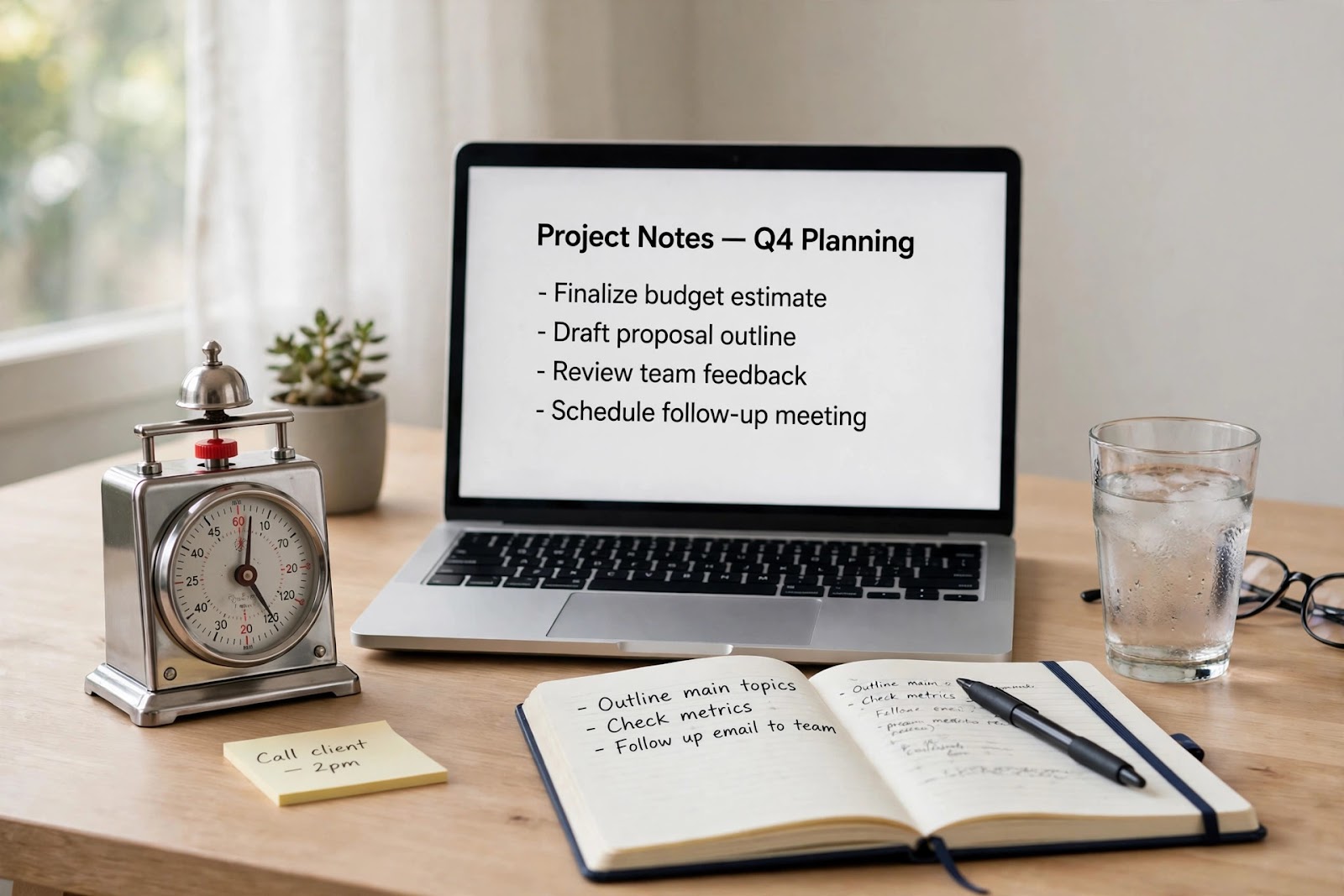
That trust matters more than I expected. When a block is only fifty minutes, starting feels cheap. I can tell myself, "It is just one block," and suddenly the scary task is not scary anymore. And when I know a break is coming, I do not sneak little breaks into the middle of the block by checking messages. I save the urge, because ten minutes away, I get to indulge it properly.
What counts as a real break
This is where most people, including past me, cheat. A real break is not switching from your report to your inbox. That is just doing different work and calling it rest. A real break is not scrolling social media either, because ten minutes of scrolling leaves your brain more tired than before, not less.
My breaks are deliberately boring. I stand up and walk around the flat. I refill my water, open a window, stretch my shoulders, or step outside for two minutes of fresh air. If the weather is decent, I walk to the end of the street and back. That takes about eight minutes, and it clears my head better than anything on a screen.
I also eat lunch away from my desk, every day, no exceptions. Not a sandwich eaten one-handed while typing, but an actual lunch at the table, phone in another room. It takes twenty-five minutes, and it is the best reset in my whole day. The first block after lunch is often my sharpest, which tells me everything I need to know about what skipping lunch was costing me.
One rule I keep strict: the phone stays face down during work blocks and only comes out during breaks, if at all. I check messages in the break, reply to the urgent ones, and put it away again. The block is a closed room. The break is when the door opens.
A day built from blocks
Here is what a normal day looks like for me now. I start at 8:30 with a block for the hardest task of the day, the one I used to push to the afternoon and then dread. Then a ten-minute break. Then a second block for the next piece of real work. Another break. By 10:30 I have done two solid hours of focused work, and I have earned a longer break, about twenty minutes, with coffee.
After that I do two more blocks before lunch. Emails and messages get their own block, usually the one just before lunch, so they do not bleed into the whole morning. Admin, invoicing, and scheduling fit there too. If something urgent lands mid-block, I write it on a sticky note and deal with it in the next break or the next admin block. I do not let it hijack the block I am in.
Afternoons are three blocks, with a longer break in the middle. I stop at 5:30, and I mean stop. In the old days I would drift until 7 p.m., half-working and half-wasting time, then feel guilty all evening. Now the day has an edge to it. When the last block ends, work ends, and the evening is actually mine.
Some days fall apart, of course. A call runs long, a client needs something urgently, a block gets eaten by a meeting. On those days I do not throw the system away. I just start the next block when I can. Two good blocks beat a perfect plan that collapsed at 10 a.m. and never recovered.

The mistakes I made at the start
My first mistake was treating the break as optional. On a busy day I would skip it to "get ahead," and by the third block I was useless. Skipping breaks does not buy you time. It borrows it from your later self, with interest.
My second mistake was picking vague block goals. "Work on the project" for fifty minutes is a recipe for drifting. Now each block gets one sentence on a sticky note before I start: "Draft the pricing section," "Reply to the six client emails," "Outline Thursday's presentation." If I cannot write that sentence, the task is not ready, and I spend five minutes breaking it down first.
My third mistake was using the timer as a punishment. If the timer rang mid-sentence, I used to force myself to stop instantly, which felt awful and made me dread the next block. Now I finish the sentence, or the paragraph, and then I stop. The timer is a rhythm, not a prison guard. A minute either way does not matter. The pattern matters.
I also learned to protect the first block of the day like it is made of glass. No email before it, no news, no "quick check" of anything. The first block sets the tone, and if it gets eaten by other people's priorities, the whole day follows that pattern.
How to start this week
You do not need special equipment. Your phone timer works fine, though I now use a cheap kitchen timer because it does not tempt me to check notifications when I pick it up. Pick one task for tomorrow morning, set a timer for fifty minutes, and work on only that task until it rings.
When it rings, stand up. Seriously, stand up. Walk away from the desk, drink some water, look out of the window. Do not open another tab "just for a second." Ten minutes of real rest will do more for your next block than ten minutes of half-work ever will.
Do three blocks tomorrow and see how it feels. Not eight, not a perfect day, just three. Notice when your mind wanders, notice what pulls you away, and notice how much easier it is to come back when you know the break is real and the block is short.
If fifty minutes feels long at first, start with forty and build up over a week. The number is not sacred. The rhythm is: focused work, real rest, focused work again. Find the length that lets you do deep work without dreading the timer, and then guard it.
There is one more small habit that made a big difference: I keep a glass of water on my desk for every block. It sounds trivial, but refilling it became part of my break ritual, and staying hydrated stopped the dull headaches I used to get by mid-afternoon. I also keep the room a little cooler than I used to, because a stuffy room made the second afternoon block feel twice as long. Small comforts are not distractions; they are the conditions that let focus happen.
I still have long days and messy afternoons. The blocks did not turn me into a productivity machine, and I am glad, because machines do not get to enjoy lunch. What they did give me is a day that ends on time, work that gets done in hours instead of dragging across days, and afternoons that no longer feel like punishment. If your work keeps spilling into your evenings, try one block tomorrow morning. Fifty minutes, one task, and then a break you actually take. Your 3 p.m. self will notice the difference before the week is out.


