Every flat has one: the drawer where paper goes to die. Mine was the top-right drawer of my desk — the shallow one, perfect for swallowing letters, receipts, warranty cards, and "I'll deal with this later" notes. For two years, my system was simple: open drawer, insert paper, close drawer, forget. It worked flawlessly, in the sense that the paper disappeared. It failed completely in every sense that mattered.
The drawer finally rebelled on a Thursday evening when I was looking for a plumber's invoice and the drawer wouldn't close. Not "stiff" — physically incapable of closing, because the paper mountain inside had reached critical mass. I stood there, holding a drawer full of two years of unprocessed life, and realised I had no idea what was in it. There could have been anything in there. There was, as it turned out, a cheque for £180 I'd forgotten to pay in. It had expired.
That expired cheque cost me £180 and bought me a system. Here's the Friday sweep that ended the pile for good.
The Drawer of Doom
Let me describe the old system honestly, because I suspect yours is identical. Paper arrived — post, mostly, plus the occasional receipt, appointment card, or scribbled note. I'd glance at it, decide it needed "filing" or "action," and put it in the drawer. The drawer was my filing system, my to-do list, and my archive, all in one shallow wooden tray.
The problem isn't the drawer. The problem is that "put it in the drawer" feels like dealing with it. Your brain gets the little dopamine hit of completion — paper handled! — without any actual handling occurring. It's procrastination disguised as organisation, and it's incredibly convincing.
Worse, the drawer became a source of low-grade anxiety. Every time I opened it for a pen, I saw the pile and felt the weight of unknown obligations. Was there a bill in there? A letter needing a reply? The expired cheque proved the answer was yes. The drawer wasn't storing paper; it was storing dread.
I tried the obvious fixes first. A filing cabinet — bought a little two-drawer unit, spent a Sunday creating labelled folders, filed everything beautifully. Within a month the cabinet was full of neatly filed paper I never looked at again, and the desk drawer was filling up again with new arrivals. Filing isn't the problem; the intake is the problem. Nobody needs a better archive for paper they should have thrown away.
The Friday Sweep
The system that actually worked is embarrassingly simple: every Friday at 4pm, I empty the entire drawer onto the desk and process every single piece of paper. Ten minutes, once a week, drawer to zero. That's the whole thing.
I picked Friday at 4pm deliberately. Late enough in the week that the week's paper has accumulated, early enough that I'm still in work mode and won't just shove it all back. I put a recurring calendar event — "PAPER SWEEP," all caps, because it amuses me — and I treat it like a meeting I can't skip. In eight months I've skipped it twice, both times on weeks I was travelling, and both times the following Friday took twenty minutes instead of ten. The system punishes skipping just enough to keep you honest.
The processing itself follows a strict rule: every piece of paper gets one of four fates, decided in under ten seconds. One: act on it now (if it takes under two minutes — pay the bill, send the reply, make the call). Two: file it properly (and I mean properly — the filing cabinet exists for the 10% of paper that's genuinely worth keeping). Three: recycle it immediately. Four: photograph it and recycle the original (receipts for warranties, reference numbers, anything I might need to look up but don't need physically).
The ten-second rule is the engine. The old failure mode was picking up a letter, reading it, thinking "hmm, I should deal with this," and putting it back. The sweep forbids that. You touch it once, you decide, it leaves your hands. Most paper — I'd say 70% — goes straight to recycling. It was never important; it just looked important in a pile.
The Three Trays
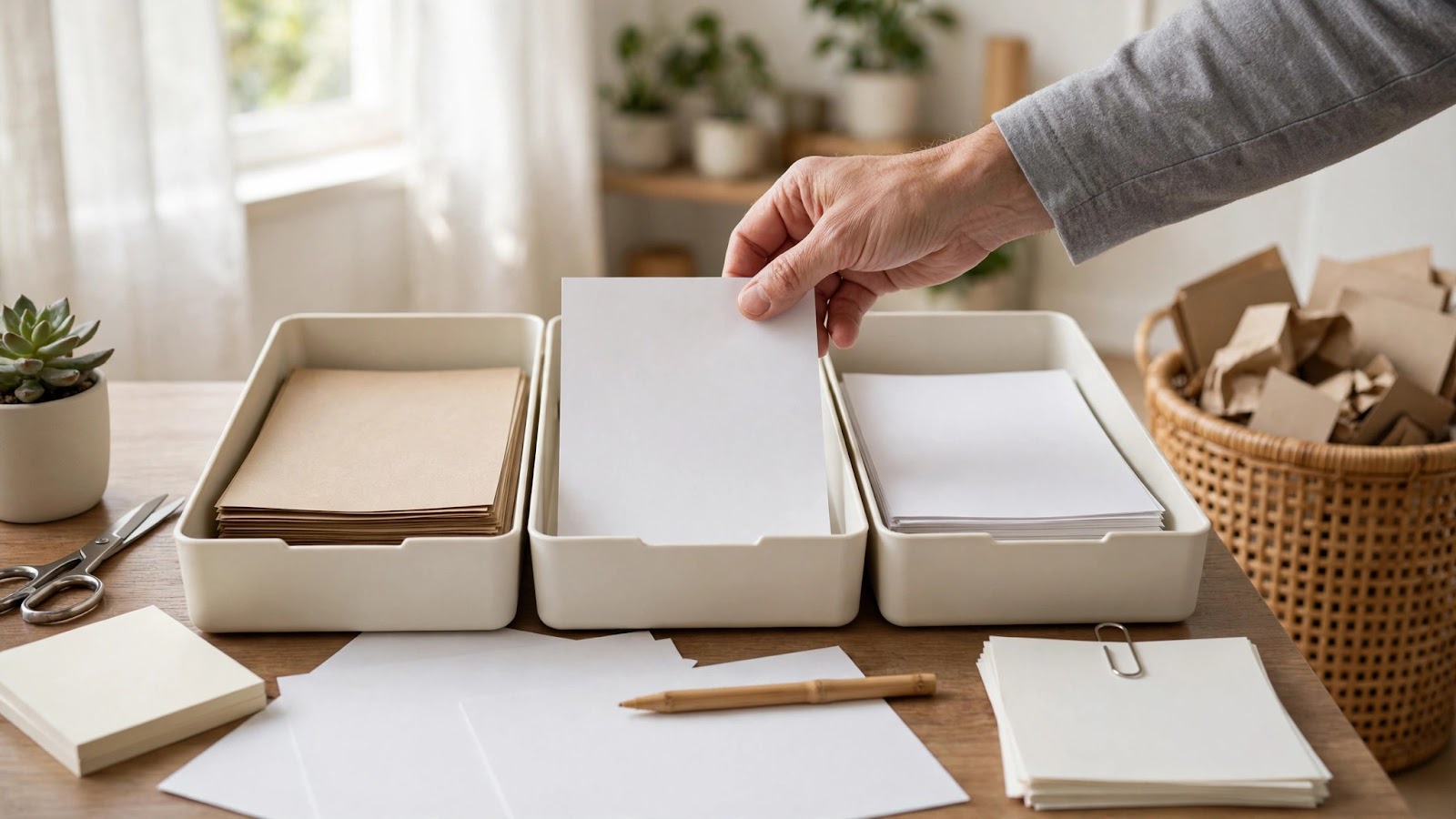
The sweep needed somewhere for paper to live between Fridays, because "straight into the drawer" was the original sin. So I bought three cheap letter trays — £6 for the set, grey plastic, nothing fancy — and labelled them with a marker: IN, ACTION, FILE.
IN is the new drawer, but honest about what it is: unsorted intake. Every piece of paper that enters the flat goes in IN, on top, no exceptions. No more "I'll just put this here for now" on the kitchen counter, the bookshelf, the windowsill. One place. The tray is small, which is the point — when it's full, it's visibly full, and visible fullness creates pressure. The drawer hid its fullness; the tray advertises it.
ACTION is for the small number of items that need doing but can't be done in the Friday sweep's two-minute window — the form that needs a signature and a stamp, the letter that needs a proper reply. The rule: ACTION must be empty by the following Friday. If something sits in ACTION for two weeks, it's either not actually actionable (recycle it) or I'm avoiding it (do it Monday morning, first thing, no excuses).
FILE is the staging area for the filing cabinet — the 10% worth keeping. Birth certificates, tax documents, the boiler service record, that kind of thing. It gets filed properly on the first Friday of each month, which takes about five minutes because there's never much in it.
The trays sit on the left of my desk, visible, slightly ugly, completely functional. My desk finally looks like someone works here rather than someone drowning here.

What I Found in the Great Clear-Out
The first sweep — the archaeological dig through two years of drawer — deserves its own telling, because it was genuinely shocking. I spread two years of paper across my desk and my bed, and processed it piece by piece. It took forty-five minutes. Here's what I found:
The cheque. £180, from a freelance client, dated fourteen months earlier. Expired, uncashable, gone. I emailed the client, explained like an idiot, and to their enormous credit they reissued it. I paid it in the same day via mobile banking, standing in my kitchen, feeling the particular shame of someone who lost £180 to a drawer. That cheque alone justified every minute I've spent on this system since.
Three warranty cards for appliances I no longer own. A reminder letter for a dentist appointment from 2024 — I'd missed it, obviously, and then missed the reminder about missing it. Seventeen takeaway menus. A birthday card from my mum with £20 in it that I'd forgotten — the £20 was still there, which softened the cheque blow slightly. Four identical "we've tried to deliver" cards. A parking fine I'd already paid, kept "just in case" for eighteen months.
And — the item that haunts me — a letter from my energy supplier offering a fixed tariff that would have saved me about £200 over the winter. The offer expired three weeks after the letter arrived. I'd put it in the drawer "to think about" and never thought about it again. Between the cheque and the tariff, the drawer cost me roughly £380. An expensive drawer.
Here's the thing that stung most: almost everything in that pile had been mildly time-sensitive, and time had simply passed. The drawer wasn't a filing system; it was a place where urgency went to expire. Every piece of paper in there was a decision I'd deferred until the decision made itself.
Why It Keeps Working
Eight months in, the sweep takes ten minutes on a normal Friday, sometimes seven. The reason it stuck — when the filing cabinet, the app-based systems, and the "inbox zero for paper" attempts all failed — comes down to three things.
First: it's scheduled, not aspirational. "Deal with paper regularly" is the difference between intention and action. I don't decide to do the sweep; the sweep happens, and I comply.
Second: the trays make the invisible visible. The drawer hid the problem; the IN tray displays it. When the tray is overflowing on a Thursday, I feel the Friday sweep approaching like weather. There's no more blissful ignorance. Some people might find that stressful — I find it honest. I'd rather see the pile than dread the drawer.
Third: the ten-second rule prevents the sweep from becoming its own form of procrastination. The failure mode of any organising system is organising instead of deciding. The sweep forces decisions. Touch, decide, move on. It's almost violent in its efficiency, and that's why it works.
I've also learned to ruthlessly photograph-and-recycle. My phone's camera has replaced about half my filing cabinet. Receipts, reference numbers, instruction manuals (nearly all available online now), business cards — photo, recycle, done. The photo goes in a "paper" album on my phone, searchable and weightless. The filing cabinet, once stuffed, is now two-thirds empty. I should probably get rid of it, but it holds the printer paper, so it stays.
The One Exception
Sentimental paper bypasses the system entirely. Birthday cards from people I love, the postcard my brother sent from Japan, my daughter's first drawing of our house (stick figures, enormous sun) — these don't go through the sweep. They go in a box in the wardrobe, unsorted, unprocessed, unjudged.
This matters, because the fastest way to kill an organising system is to make it handle things it shouldn't. The sweep is for administrative paper — bills, letters, receipts, forms. The moment it has to adjudicate the emotional value of a Mother's Day card, it becomes fraught, and fraught systems get abandoned. Keep the sacred separate from the administrative. The box in the wardrobe has no rules, no schedule, no ten-second limit. It just holds the good stuff.
The Annual Purge
Once a year — I do it in the first week of January, when the Christmas decorations come down and everything feels like it needs a reset — I empty the filing cabinet too. Not a sweep; a purge. Every folder comes out, and I ask one question per document: if the house burned down tomorrow, would I actually need this?
The answer is almost always no. Old tax returns beyond the required years — shredded. Manuals for things I sold — recycled. Bank statements from 2019 — shredded, since they're all online anyway. Last January's purge removed about 60% of the cabinet's contents. The cabinet is now so empty it rattles when I open it, which feels like success.
The purge matters because filing cabinets, like drawers, accrete. The Friday sweep stops new accumulation; the annual purge clears the historical kind. Without it, you'd eventually need a second cabinet, then a third, and you'd be running a paper archive instead of a life. One hour a year keeps the whole thing honest.
I shred rather than recycle anything with personal details — name, address, account numbers. A basic cross-cut shredder cost me £25 five years ago and it's still going. The shredded paper goes in the compost bin, which feels like the perfect end of the pipeline: bill becomes mulch becomes tomatoes. There's probably a metaphor in there about the circular economy, but I'll leave that to the sustainability bloggers.
The Skip Temptation
One last honest note: the system has a known failure mode, and it's me on a tired Friday. Twice now I've looked at the calendar event at 4pm, looked at the IN tray, and thought "I'll do a double sweep next week." Both times, next week's sweep took twenty minutes and I spent the intervening week with the tray glowering at me. The lesson isn't discipline — it's that the system's maintenance cost is so low (ten minutes!) that skipping it is never rational, only emotional. Now when the temptation hits, I tell myself: it's ten minutes, the kettle's on, just start. Starting is the whole battle. I've never regretted a sweep; I've only regretted skipping one.
Start This Friday
You don't need the trays to start — a single "in" pile on the desk works for week one. What you need is the calendar event: Friday, 4pm (or whatever end-of-week slot suits you), ten minutes, non-negotiable.
First session: empty wherever your paper currently lives — the drawer, the pile on the microwave, the carrier bag of doom — and process it all with the ten-second rule. Act, file, photograph, or recycle. Expect to find something you forgot. Everyone does. Mine was a £180 cheque; yours might be kinder.
Then buy the trays (£6, or use three shoeboxes with labels — the system doesn't care about aesthetics). IN, ACTION, FILE. Every paper goes in IN from now on. Friday, you sweep.
My one upgrade: a cheap label maker (£12) for the trays, because handwritten labels curl and fade and start looking like part of the mess. Printed labels make the system feel permanent, and permanent systems get respected. It sounds fussy. It also works.
Ten minutes a week. That's the price of never losing £180 to a drawer again — the cheapest peace of mind I've ever bough


