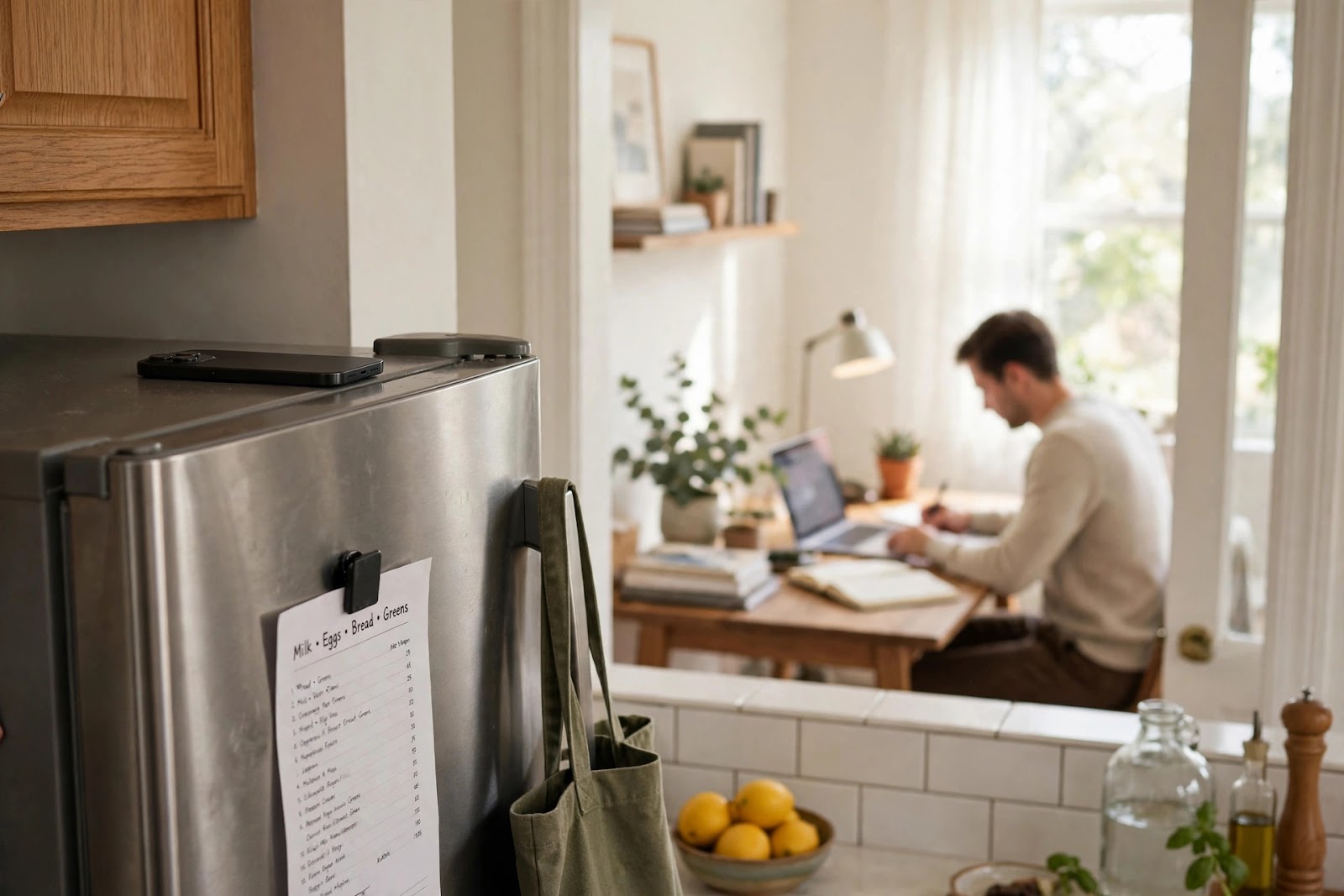
On Sunday night, I did something that felt slightly ridiculous: I picked up my phone, walked it into the kitchen, placed it on top of the fridge, and closed the door behind me. It stayed there all week during my work hours, and that one small act of physical distance did more for my concentration than any app, timer, or productivity book I have ever tried.
I am not anti-phone. I like my phone. I use it for music, maps, photos, and keeping in touch with people I care about. But I had reached a point where I was checking it without deciding to check it — reaching for it during a pause in a sentence, while a page loaded, while I waited for a colleague to reply. My screen-time report said I was picking it up 87 times a day on average, and I did not even believe that number until I watched myself do it for an afternoon.
Why "just put it on silent" never worked for me
I had tried all the sensible half-measures first. Silent mode, do-not-disturb, notifications off for everything except calls, the phone face-down on my desk. None of it stuck for more than a day or two, because the problem was never really the notifications. It was the availability.
When the phone sits within arm's reach, checking it costs nothing — no effort, no decision, no friction at all. My brain learned that a tiny hit of novelty was always one hand movement away, and it started reaching for that hit every time work got slightly difficult or slightly boring. Willpower is a terrible defence against something that easy. Distance, on the other hand, is a brilliant one.
Putting the phone in another room adds about twenty seconds and a walk to every check. That sounds trivial, and it is — but it is exactly enough friction to turn an unconscious habit into a conscious choice. I still checked it sometimes during that week, but each time I had to stand up, walk to the kitchen, and admit to myself that I was choosing to interrupt my own work. Most of the time, I decided not to bother. That is the whole trick.
The rules I set for the week
To keep the experiment honest, I set simple rules and wrote them on a card by my desk. Work hours were 9 to 5, with a lunch break from 12:30 to 1:30. During work hours, the phone lived in the kitchen, on top of the fridge, on silent. During lunch, I could use it freely. After 5, it came back to my pocket like normal.
I made two exceptions, and I think exceptions matter, because a rule with no escape route gets abandoned at the first real need. First, if I was expecting a genuinely urgent call — a delivery driver, a family member in hospital, that kind of thing — I told people to call my laptop via a messaging app instead, or I kept the phone nearby for that specific window only. Second, if I needed the phone as a tool — photographing a document, using it as a hotspot — I fetched it, used it for that job, and returned it immediately.
I also told my closest people what I was doing. A short message to my partner, my mum, and two friends: "Trying a phone-in-another-room week for work, so I will be slower to reply between 9 and 5. Call twice if it is urgent." Nobody minded. In fact, two of them said they wanted to try it themselves, which tells you how common this problem is.
Day by day: what actually happened
Monday was uncomfortable in a way I had not expected. I reached for my phone at least a dozen times and found empty desk. Each time I felt a small jolt of irritation, almost like phantom limb pain for a device. By the afternoon, though, I had finished a report section that normally took me two days, because I had not broken my train of thought every nine minutes to see what was new online.
Tuesday was easier, and also revealing. I realised how often I had been using my phone to procrastinate on hard tasks — not to check anything important, but to escape the discomfort of a difficult paragraph or a tricky spreadsheet. Without the escape hatch, I had to sit with the difficulty for a few extra minutes, and almost every time, the answer came. Boredom, it turns out, is where a lot of my best thinking was hiding.
Wednesday brought the first real test: a message I actually needed. A colleague was trying to reach me about a meeting change, and I did not see it until lunch. The meeting still happened, I just joined five minutes late and apologised. Lesson learned: for truly time-sensitive work, I now check messages at two set points — 11 am and 3 pm — by walking to the kitchen deliberately, rather than living in a state of permanent half-attention all day.
Thursday and Friday felt almost normal. I stopped noticing the phone's absence, my work felt steadier, and something unexpected happened in the evenings too: I was less twitchy with my phone after hours, because I had spent the day proving to myself that I could leave it alone. The habit was loosening its grip in both directions.
What changed, in plain numbers
I tracked a few simple things all week, because feelings lie and numbers are harder to argue with. My daily pickups fell from an average of 87 to 31, and almost all of those 31 happened at lunch or after 5 pm. My screen time during work hours dropped from about two hours a day to under twenty minutes — mostly the two deliberate message checks.

More importantly, I finished my main task before lunch on four out of five days, compared with about two out of five in a normal week. I also slept better, which I had not predicted at all: I think spending the day less wired meant I wound down faster in the evening, though I will not claim a proven cause and effect there. It is just what I noticed.
Was anything worse? Yes, one thing. I missed a couple of casual social messages that would have been nice to answer promptly — a friend sharing a meme, a group chat planning a weekend meetup. Nobody was upset, and I caught up at lunch, but if your job or life depends on instant social replies, this experiment will cost you a bit of that immediacy. For me, the trade was worth it many times over.
Keeping it going after the experiment ended
The week ended, and I did not go back to the old setup. My phone still lives in the kitchen during my morning focus block, and I do a full phone-in-another-room day three or four times a week. On the other days, when I need to be more reachable, it sits in a drawer in my desk — not on the desk surface, not in my pocket, but close enough that a real call still gets answered within a minute or two.
If you want to try this, do not start with a whole week if that feels daunting. Start with one morning. Pick your hardest task, put the phone in another room with the door closed, and work until lunch. Notice how many times your hand moves towards an empty space. That itch is the habit revealing itself, and watching it fade over a few days is oddly satisfying.
One practical tip: charge your phone overnight in that other room, not by your bed. It makes the morning separation automatic — you simply do not bring it to your desk in the first place — and it improves your sleep too, since you are not scrolling in bed. Two wins from one small change in where a charger lives.
A week of distance did not make me a monk, and it did not fix my attention forever. What it did was prove something I needed to prove to myself: my phone is a tool I own, not a leash I wear. The difference between those two things turned out to be about six metres and a kitchen door. Try it, and see how far your own focus can go when nothing is buzzing in your pocket.


