For years, my mornings looked productive and felt terrible. I would open my laptop at 8:30, check email, answer two messages, start a report, remember a bill I needed to pay, open another tab, and by 10 o'clock I had touched six tasks and finished none of them. I was busy all morning and somehow behind by lunch. Sound familiar? It took me far too long to admit that the problem was not my workload. It was the way I was starting the day.
The change came from a boringly simple idea: one task, ninety minutes, no switching. I first heard about it from a colleague who blocked her calendar from 9 to 10:30 every morning and treated that block like a meeting she could not move. I was sceptical — ninety minutes felt both too long and too short — but I was also desperate enough to try anything for a week. That week changed how I work, and I have kept the habit for over a year now.
Why ninety minutes, and why mornings
Ninety minutes is not a magic number, but it is a practical one. It is long enough to get into real depth on a hard task — writing, planning, analysis, anything that needs your full brain — and short enough that you can hold focus without your mind completely wandering off. Shorter blocks, like 25 minutes, always left me just as I was warming up. Longer blocks, like three hours, turned into a slog by the end.
Mornings work because that is when my brain is freshest and the world is quietest. Before 10:30, very few people expect an instant reply from me, and I have not yet accumulated the small decisions and interruptions that drain willpower later in the day. Your peak window might be different — a night owl friend of mine does his block at 10 pm — but for most people with a normal office rhythm, the first ninety minutes of the workday are the most protectable.
I also learned to be ruthless about what counts as a "block task". Email does not count. Admin does not count. Catching up on messages does not count. The block is for the one piece of work that would make the day feel like a win even if everything else went sideways. Some days that is drafting a proposal; other days it is finishing a report I have been avoiding for a week.
The first week went wrong in a useful way
Day one was a disaster, and I am glad it was, because it taught me everything I needed to fix. I sat down at 9, opened my document, and within four minutes I was checking a notification on my phone. Ten minutes later I was refilling my coffee. By 9:40 I had answered a "quick question" from a teammate, and the block was effectively over before it started.
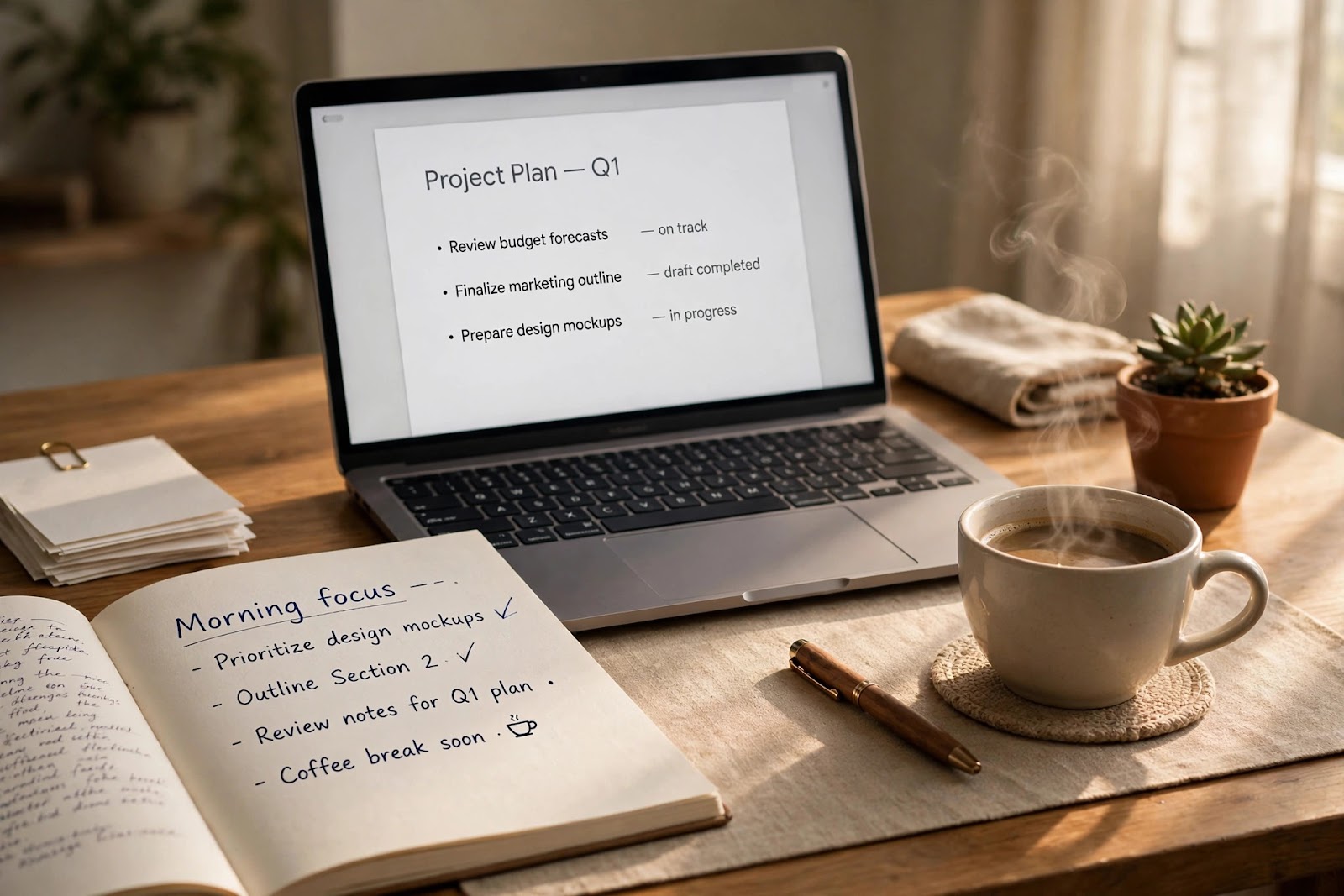
What went wrong was not my discipline; it was my setup. My phone was on the desk, my email tab was open, and my door — metaphorically, since I work from home — was wide open to anyone who wanted a piece of my attention. Willpower alone was never going to beat that environment. So on day two I changed the environment instead of scolding myself.
Now my setup takes about three minutes and I do it the night before where possible. Phone goes on silent in another room (more on that in my other article this week). Email and messaging apps stay closed until the block ends — I mean fully closed, not just minimised, because a little red badge is a trap. I put a simple paper sign on my home-office door that says "In a block until 10:30", and my family respects it because they know I will be properly available afterwards. I also write the next morning's task on a sticky note the evening before, so I never waste the first ten minutes deciding what to work on.
What a good block actually looks like
Here is a real example from last Tuesday, because abstract advice is useless. My block task was a client proposal that had been sitting half-written for five days. I started at 9:02 with a coffee and a glass of water, phone in the kitchen, email closed. From 9 to about 9:25 I just re-read my notes and sketched the structure on paper. That slow start felt unproductive, but it meant the actual writing flowed afterwards instead of stalling every paragraph.
By 10:10 I had a full first draft — around 1,400 words — that would previously have taken me two scattered afternoons. I spent the last twenty minutes tightening the opening and listing the three things I still needed from the client. At 10:30 I stopped, even though I was in the middle of a sentence I liked. Stopping on time matters: it trains your brain to trust that the block will end, which makes starting the next one much easier.
Not every block produces a neat result like that. Some days I spend ninety minutes wrestling with a problem and end up with a page of notes and a clearer sense of what I do not know yet. That still counts. A block is not a promise of output; it is a promise of undivided attention. The output usually follows, but on the days it does not, the attention itself was still the work.
The numbers that convinced me to keep going
I am not going to invent a productivity statistic for you, but I can tell you my own before-and-after, tracked in a plain notebook for a month. Before the blocks, I finished my main task before lunch on roughly two days out of five. After a month of daily blocks, that rose to four days out of five. My afternoons did not get longer, but they got calmer, because the big thing was already done.

Another change I did not expect: I stopped working late as often. When the important work happens first, the afternoon can absorb the inevitable interruptions — meetings, messages, small requests — without the whole day feeling derailed. I leave my desk at a reasonable hour more often now, and I am less resentful about it, which my evenings appreciate.
There is a cost, and I should name it. Protecting a morning block means saying no, or at least "after 10:30", to people who are used to instant access to you. A manager who expects immediate replies at 9 am may need a conversation, not just a calendar block. I had that conversation, framed around output rather than preference — "I deliver better proposals when I have this window" — and it went far better than I feared. If your job genuinely requires constant availability in the mornings, try the block at a different time rather than fighting a losing battle.
How to start on Monday without overhauling your life
Do not start with a perfect system. Start with three things. First, pick tomorrow's block task tonight and write it down somewhere visible. Make it specific: not "work on report" but "write the first draft of section two of the quarterly report". Vague tasks are where blocks go to die.
Second, set a timer for ninety minutes and close everything that is not that task. Not minimised — closed. If you need a reference document, open only that one. If a thought pops up about something else, jot it on paper and return to it after the block. That paper list becomes surprisingly useful; mine usually holds two or three genuinely important things I would otherwise have forgotten.
Third, protect the block with one visible signal. A calendar event titled "Focus block — please message after 10:30" works in an office. A closed door and a note works at home. You do not need an app, a course, or a new notebook system. You need a start time, a single task, and a closed door.
Try it for five working days before you judge it. Day one will probably be messy — mine was. Day three is usually when it clicks. By day five, you will know whether this is your thing, and if it is, you will wonder why you spent so long starting every day by reacting to other people's priorities instead of your own. My mornings used to happen to me. Now I run them, for ninety minutes at least, and that small patch of control has changed my whole working day.


