My desk used to look like a crime scene by Thursday. Coffee rings, three pens without caps, a stack of papers I meant to file, cables tangled like spaghetti, and a mug from Tuesday that I kept meaning to wash. I would sit down, sigh, and spend the first ten minutes just moving stuff around so I had room to work.
Then a friend told me about the 2-minute rule, and I laughed. It sounded too simple to matter. If a task takes less than two minutes, do it right now instead of writing it down or putting it off. That was it. No app, no system, no course. I figured it would fail by lunch, like most of my desk plans.
It did not fail. It saved my desk, and honestly, it saved my mornings too. Here is what actually happened when I stopped letting tiny tasks pile up, and how a rule that small changed the way my whole workspace feels.
The Pile That Was Quietly Running My Day
Here is the thing nobody tells you about small tasks. On their own, they are nothing. A pen without a cap takes three seconds to fix. A paper on the floor takes five seconds to pick up. But when you leave twenty of them lying around, they stop being small. They become a landscape you have to work in.
I used to walk past my desk and feel a little sinking feeling. Not dramatic, just a low-grade dread. I knew I would have to clear a space before I could start, and that clearing felt like work before the work. So I put it off, checked my phone instead, and the pile grew by one more item.
That pile also stole my attention in sneaky ways. Every time I glanced up, I saw the unfiled paper, the dead battery, the sticky note I should have thrown away. Each one was a tiny unfinished job, whispering at me. I could not focus properly because my eyes kept landing on things I knew I should have dealt with.
The real cost was time, and I measured it one week because I was annoyed enough to care. I spent 52 minutes that week just searching for things on my own desk: a charger, a notebook, a password I had written on a scrap of paper. Fifty-two minutes, gone, because I had not spent two minutes putting things away when I first used them.
My First Morning With the Rule
I started on a Monday, which was either brave or stupid. I sat down, looked at the mess, and set a timer for 15 minutes. My only job was to do every tiny task I could see, one by one, without stopping to judge the pile. Pen cap on. Mug to the kitchen. Paper in the bin. Cable untangled.
It felt weirdly satisfying. Each tiny finish gave me a little hit of done-ness, and after about twelve minutes, my desk looked like a different place. Not perfect, not magazine-ready, just clear. I had a flat surface, a working pen, and room for my laptop and my notebook. That was enough.
Then I made my first mistake, and it is one you should watch for. I found a report that needed proper filing, which would take at least twenty minutes, and I tried to do it anyway because I was on a roll. I burned half an hour, missed my first work block, and felt annoyed. The rule is for tiny tasks only. If it takes longer than two minutes, it goes on a list, not into your morning.
By lunchtime, I had a new test. I finished a coffee, and instead of leaving the mug for later, I walked it to the kitchen. It took ninety seconds. I came back, sat down, and realised something: the desk was still clear. For the first time in months, my workspace at lunch looked like my workspace at 9 in the morning.

How I Actually Use It Now
These days, the rule has three simple triggers. When I finish using something, I put it back right away if it takes under two minutes. When I notice something small out of place, I fix it on the spot instead of adding it to a mental list. And when I sit down to work, I spend the first two minutes clearing anything tiny that landed there since yesterday.
That last one matters most. I call it my two-minute reset, and I do it before I open my laptop. It is not cleaning, exactly. It is just: bin the scraps, cap the pens, stack the papers, plug in the charger. Two minutes, tops, and then I start work with a clear surface and a clear head.
I also keep a small tray on the right side of my desk now. Anything tiny that I cannot deal with in two minutes goes in the tray, not scattered across the desk. Loose receipts, a battery, a key I found in a drawer. Once a week, on Friday afternoon, I spend ten minutes emptying the tray properly. The tray is the difference between a system and a wish.
Let me give you real examples from last week, because vague advice helps nobody. I filed one invoice the moment it arrived, 40 seconds. I wiped a coffee ring, 20 seconds. I replied to a one-line question from a colleague, 90 seconds. I hung up my headphones instead of leaving them on the keyboard, 10 seconds. None of these felt like achievements. Together, they kept my desk clear for five straight days.
What It Did to My Focus
Here is the part I did not expect. A clear desk made my brain quieter. I used to think I was messy but creative, and that tidiness was for other people. Turns out, I was just distracted. When my desk stopped shouting at me, I could hear my own thoughts again, and my first work block got noticeably longer.
I tracked this loosely, because I am not a scientist, just a person with a notebook. In the month before the rule, my average first work block was about 35 minutes before I got distracted. In the month after, it was closer to 55 minutes. The work did not get easier. The room just stopped interrupting me every few minutes.
There is also a confidence thing happening here, and I did not see it coming. Finishing ten tiny tasks before 9:30 makes you feel capable. It is a small, stupid win, but it is real, and it carries into the bigger work. I start my day already having finished things, instead of starting my day by avoiding things.
My colleague noticed before I did. She walked past my desk one Wednesday and said it looked different, calmer. I laughed, because calmer is a weird word for a desk, but she was right. A calm desk makes for a calmer worker, and I was less snappy in meetings that week, which my team probably appreciated.
The Traps I Had to Learn Around
The rule has traps, and I fell into most of them. The first trap is using tiny tasks to avoid big ones. If you have a hard report to write, suddenly every pen on earth needs capping. I learned to spot that move: if I am tidying for the third time in an hour, I am procrastinating, and I need to sit down and start the hard thing.
The second trap is the two-minute lie. Some tasks look tiny and are not. Replying to that email looks like ninety seconds, but it needs a file you have to find, and suddenly it is fifteen minutes. My fix is simple: if I open a task and it is clearly bigger than I thought, I stop, I write it on my list, and I move on. No shame, no spiral.
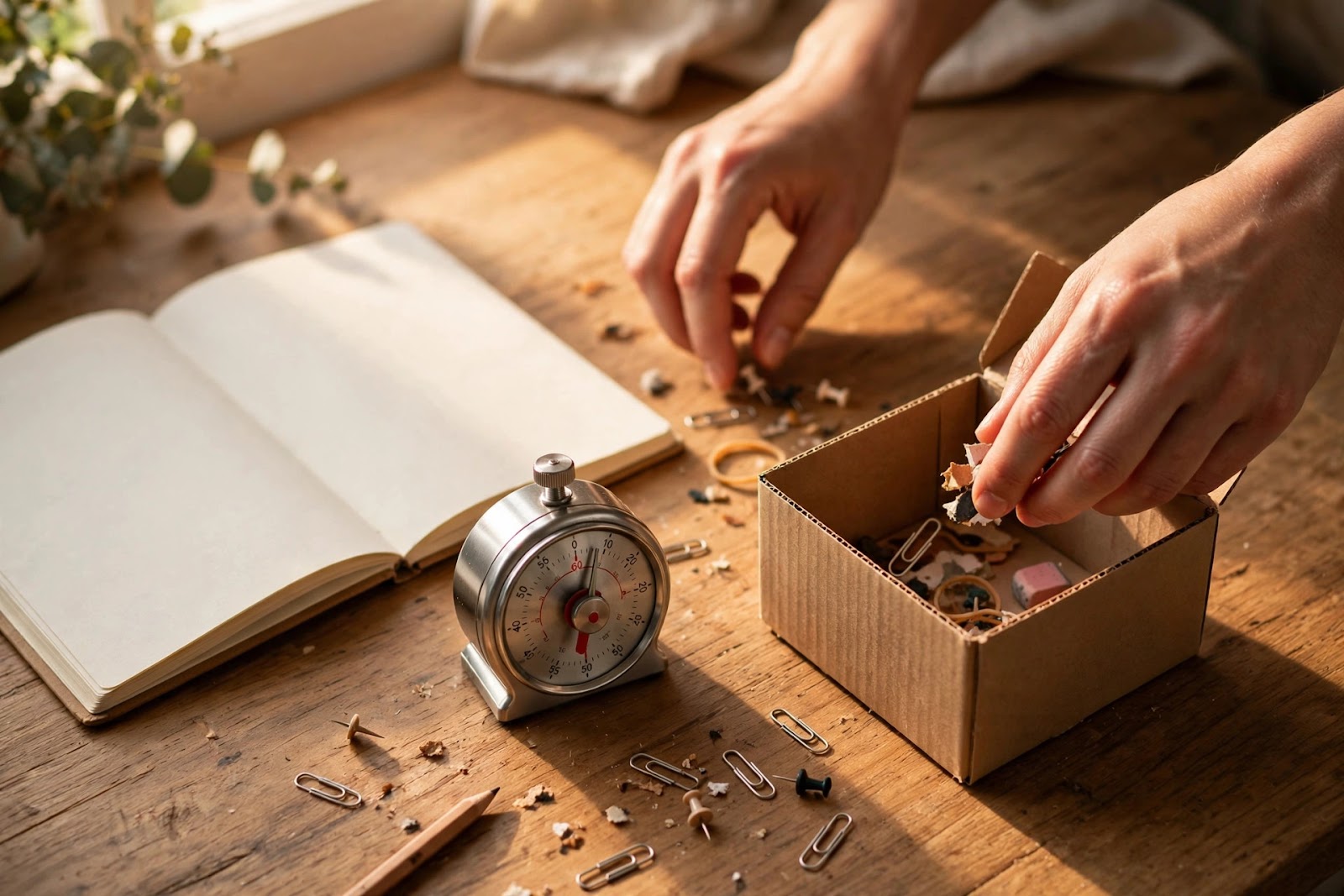
The third trap is perfectionism. The rule is not about a spotless desk. It is about a usable desk. I do not dust, I do not reorganise drawers, I do not colour-code anything. Those are weekend jobs, or never jobs. The rule only covers the tiny, obvious, right-now stuff, and that boundary keeps it from eating my day.
I also had to learn when not to use it. During a deep work block, I do not jump up for every tiny thing. I jot it on a scrap of paper and handle it in the next break. The rule serves my focus, not the other way around. If it starts breaking your concentration, it is time to pause it until your break.
A Desk That Stays Clear, Mostly
Let me be honest about the limits. My desk is not always clear. On busy weeks, papers still pile up, and on Friday afternoons it can look rough again. The difference is that now I know exactly how to fix it, and the fix takes fifteen minutes, not a whole Saturday morning of dread and sorting.
The Friday reset helps a lot. Ten minutes, tray emptied, papers filed or binned, pens checked, cables untangled. I leave on Friday with a desk I would be happy to sit at on Monday, and Monday me is always grateful. Future me, it turns out, is a person worth being kind to.
I also changed one small thing about how I buy desk stuff, which sounds unrelated but helped a lot. I stopped buying multi-packs of cheap pens that dry out and clutter the drawer. I bought three good pens, and I keep them capped and in one cup. Fewer things, better things, less mess. It is a boring lesson, but it works.
If your desk is driving you mad, do not buy a new organiser or watch a video about minimalism. Just try this for one week: if it takes less than two minutes, do it now. Cap the pen. Bin the scrap. Wash the mug. Reply to the one-liner. See what your desk looks like on Friday, and see how your head feels when you sit down to work.
Why Tiny Tasks Accumulate So Quickly
Psychologically, postponement feels inexpensive because each individual deferral demands almost no immediate sacrifice. Unfortunately, accumulation transforms those inexpensive deferrals into a substantial cognitive burden, because every unfinished micro-task continues occupying background attention long after you have consciously forgotten it. Researchers describe this phenomenon as attention residue, and I recognised it immediately: my concentration felt fragmented not because my work was particularly demanding, but because dozens of unresolved trivialities were competing silently for mental resources.
Addressing those trivialities immediately interrupts that accumulation before it becomes overwhelming. The satisfaction is not merely aesthetic; it is functional. A workspace free from visual reminders of unfinished business allows sustained concentration, reduces unnecessary decision fatigue, and creates a professional environment where important responsibilities receive the undivided attention they genuinely deserve, rather than competing with coffee rings and unfiled paperwork.
Over several months, this seemingly insignificant habit produced surprisingly durable improvements in my overall organisation. My colleagues began commenting favourably on my responsiveness, not because I worked longer hours, but because straightforward requests no longer disappeared into a chaotic pile of miscellaneous clutter. Reliability, I discovered, is frequently built from unremarkable consistency rather than dramatic, occasional bursts of extraordinary productivity.
Start tomorrow morning, not next Monday. Two minutes, one tiny task, and then another. Momentum builds remarkably quickly once the first few finishes are behind you.
Small tasks are only small when you do them. Leave them, and they grow into a pile that eats your time, your focus, and your mood. Do them now, and they disappear. My desk is not perfect, but it is mine again, and that two-minute habit is the reason why.


