I Ask What's the Smallest Useful Version Before I Start — And My Tasks Finally Fit My Day
Three weeks ago I had a task on my list that I had already moved forward four times. "Redesign the onboarding email sequence." It sat there in my notebook, underlined, starred, and completely untouched, while I did smaller things around it and told myself I was being productive. The truth was simpler and less flattering: every time I looked at that task, I saw a mountain. New emails, new timing, new design, approval from two people, testing, scheduling. It felt like a two-day job hiding inside a single line, and since I never had two free days, I never started. Then one morning, running late and annoyed with myself, I asked a different question: what is the smallest useful version of this?
The answer came back fast. Rewrite the first email only, the welcome one, and send it as a draft to one colleague for a quick read. That was it. No redesign, no sequence, no approvals from two people. Just one email, improved, in front of one person. I did it in forty minutes before lunch. The next day I did the second email. By Friday the sequence was done, not because I found two free days, but because I stopped waiting for them. That one question has quietly changed how I start almost everything now, and this is the honest story of how it works, where it helps, and where it can go wrong.
The Task That Taught Me the Question
Let me tell you about the onboarding emails properly, because the details matter. The sequence had five emails. They were not terrible, but they were stale: the welcome email still mentioned a feature we had removed months earlier, the second email linked to a help page that no longer existed, and the whole thing read like it had been written by a committee in a hurry. Everyone agreed it needed work. Nobody, including me, had touched it in months. When I finally sat down with it, I made the classic mistake. I opened a fresh document, titled it "Onboarding Redesign Plan", and started mapping the whole project: audience segments, timing gaps, design templates, success measures. An hour later I had a beautiful plan and zero emails rewritten. I had turned a writing job into a planning job, and planning felt like progress while producing nothing.
That evening I complained about it to a friend, the way you do, and she said something that stuck. She said, "What would you do if you only had forty minutes?" I did not have a good answer at first, because forty minutes felt insultingly small for a job I had built up into a project. Then I thought about it properly. In forty minutes I could rewrite the welcome email. That was real. That was useful on its own, because the welcome email is the one almost every new user actually reads. The other four could wait. The smallest useful version was not a compromise. It was the most valuable piece, done first.
I want to be clear about what "useful" means here, because it is doing a lot of work in this question. Useful does not mean perfect, and it does not mean finished. It means someone can use it, or something changes because it exists. A rewritten welcome email is useful because new users read a correct email instead of a wrong one. A one-page summary of a messy report is useful because a manager can make a decision from it. A rough draft sent to one person is useful because it starts a conversation. If the smaller version does not change anything for anyone, it is not the smallest useful version. It is just a smaller pile of unfinished work.
Why Big Tasks Freeze Me (and Probably You Too)
I have spent a long time assuming my problem was laziness or poor discipline. I do not think that anymore. My problem, most of the time, is size. When a task looks big, my brain treats it like a single object that has to be lifted all at once. I cannot lift it, so I do not try. I walk around it. I tidy the desk next to it. I answer emails near it. The task gets bigger in my head every day I avoid it, because avoidance adds a layer of guilt to the original work, and guilt is heavy.
There is also a quieter problem hiding underneath, which is that big tasks are vague. "Redesign the onboarding sequence" does not tell me what to do first. Do I write? Do I research? Do I ask someone? Do I design? A task that does not name its first step is not really a task. It is a wish with a deadline attached. And wishes do not get done on Tuesday mornings. They get postponed, because postponing a wish feels costless in the moment.

How I Ask the Question Now
These days the question has become a small ritual I run before I start anything that looks big. It takes about sixty seconds, and I do it on paper, not in my head, because in my head the task always negotiates its way back to full size. I write the task at the top of a page, then I ask three questions underneath it, and I answer each one in a single sentence. That is the whole ritual. No app, no template, no colour coding.
The first question is: who is this for, and what will they do with it? If I cannot name a person and an action, the task is not ready to shrink yet. It is still a vague wish. For the onboarding emails, the answer was easy: new users, and they will read the welcome email instead of an outdated one. For a report I was avoiding last month, the answer was my manager, and she would decide whether to approve a budget. Naming the person and the action does something useful. It reminds me that the work has a reader, not just a deadline.
The second question is: what is the smallest piece that still does that job? This is the heart of it, and it takes the most honesty. The temptation is to say "the first three emails" or "a draft of the whole thing", because that feels safer. But safety is not the test. Usefulness is. One rewritten email does the job for the person who reads it. A one-page summary does the job for the manager who needs a decision. A single cleaned-up spreadsheet tab does the job for the colleague who needs one number. I keep pushing the size down until removing one more piece would break the usefulness, and then I stop. That is the version.
The third question is: how long will that piece take, and when will I do it? If the answer is more than ninety minutes, it is still too big, and I shrink it again. If I cannot name a time today, it goes into the next shared work session or the first block tomorrow morning, and I write the time down. A smallest useful version without a time is just a smaller wish. The time is what turns it into a plan.
Five Times It Worked (With Real Details)
The second was a report I owed my manager. The full report was meant to be a proper document: background, data, options, recommendation, appendix. I had been avoiding it for two weeks because it felt like a day's work. The smallest useful version was a one-page summary: three options, one recommendation, one paragraph each. I wrote it in an hour, sent it, and my manager replied within the afternoon saying the recommendation was approved and the full document could wait until next month. The full document was never actually needed. The one-page version was the work. I had been avoiding a job that, in its useful form, took an hour.
The third was a presentation for a team meeting. I kept imagining twelve slides with charts and a careful narrative. The smallest useful version was five slides: the problem, three options, the ask. I built it in ninety minutes the morning of the meeting, and the discussion it produced was better than any polished deck would have been, because people argued about the options instead of admiring the slides. Nobody asked where the other seven slides were. Nobody missed them.
The fourth was boring and domestic, but it counts, because boring tasks are the ones that pile up fastest. My filing system, digital and physical, had collapsed. Folders inside folders, duplicates everywhere, a drawer full of papers I was afraid to throw away. The full fix was a weekend project I would never do. The smallest useful version was one drawer, emptied and sorted, in thirty minutes. I did one drawer a week for a month. The system is not perfect now, but I can find things again, which is the entire point of a filing system.
The fifth was a personal one: a message I owed an old colleague, a proper catch-up, the kind of message that deserves a real paragraph, not a thumbs-up. I had been meaning to write it for weeks, and every time I thought about it, I imagined a long thoughtful letter. The smallest useful version was three sentences: I was thinking of you, I saw your new role and it looks great, let us talk properly soon. I sent it while waiting for a kettle to boil. She replied within the hour, and we talked properly the next week. The long letter was never the point. The contact was.
Where It Goes Wrong (I Have Done All of These)
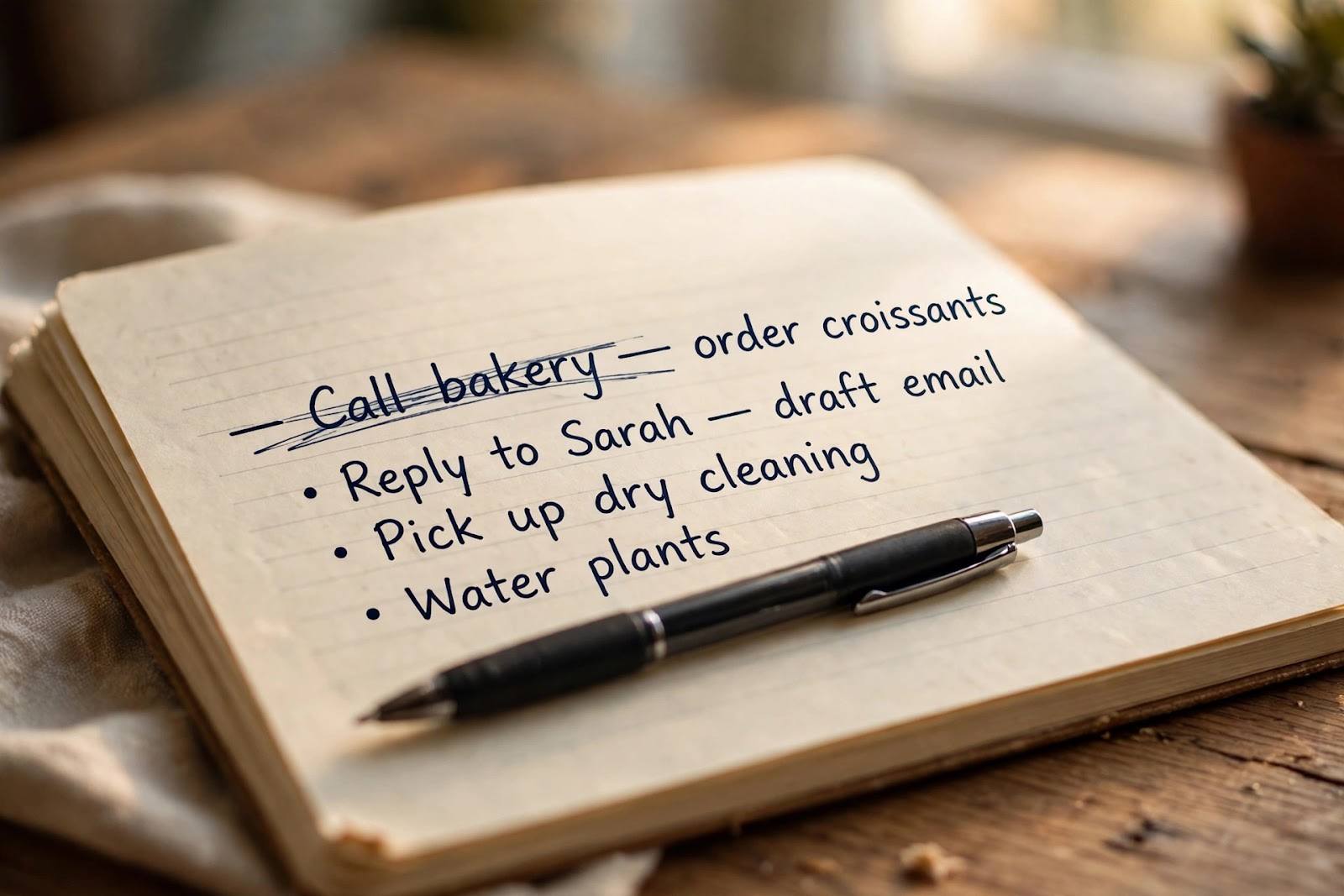
Now the honest part, because a trick that only ever works is a trick I have not tested hard enough. The smallest-useful-version question can go wrong, and I have done it wrong in every way I am about to describe, so none of this is theoretical. The first failure mode is shrinking the wrong piece. Early on, I shrank a task by cutting the hard part and keeping the easy part, which felt productive and was actually avoidance in a clever costume. I "finished" a proposal by writing the introduction and calling it the smallest useful version. An introduction is not useful to anyone. It does not change a decision or help a reader. It is just the easiest paragraph. The test saved me eventually: I asked who would use it and what they would do with it, and the answer was nobody and nothing. If your smallest version is suspiciously easy, check whether you cut the value or just the effort.
The third failure mode is using the question as an excuse to lower the standard every single time. If every task gets shrunk to the smallest possible thing, the work gets thin. Reports become notes. Plans become sketches. I caught myself doing this for about two weeks, and the quality of my output dropped in a way I could feel before anyone else noticed. The fix was simple, and I still use it: I ask the question once at the start, and I do not re-ask it halfway through to shrink the task again. One shrink, then work. If the task turns out to need more, I add it back deliberately, not by accident.
The Difference Between Shrinking and Dumbing Down
People sometimes hear this idea and think it means doing worse work. It does not, or at least it should not. Shrinking a task means cutting scope, not cutting quality. The one email I rewrote was rewritten properly. It was checked, it was proofread, it linked to the right page. It was simply one email instead of five. The one-page summary for my manager was a good summary: accurate numbers, clear options, an honest recommendation. It was not a sloppy version of a long report. It was a careful version of a short one. That distinction matters, because the moment shrinking becomes an excuse for careless work, the whole idea collapses.
How It Fits With the Rest of My Week
The question does not live alone in my week. It sits next to a few other habits, and I want to describe the arrangement honestly, because a single trick rarely survives on its own. On Monday mornings I plan the week, and that is when I spot the tasks that are big enough to need shrinking. I write them down, and next to each one I write the smallest useful version in plain words. That list is what I actually work from during the week, not the original big list. The big list stays in the notebook as a reminder of the whole job. The small list is the one that gets done.
I also pair the question with a fixed stopping point. When I sit down to do a smallest useful version, I decide in advance what finished looks like, and I stop when I get there. No gold-plating, no adding one more improvement, no turning the one email into a quiet redesign of all five. Stopping is a skill, and it is the one this method demands most. The version is done when it is useful. Useful is the finish line, not perfect.
Try It on One Task Today
If you have a task on your list right now that you have moved forward more than once, that is the one. Take a piece of paper and write the task at the top. Then answer the three questions underneath it, one sentence each. Who is it for, and what will they do with it? What is the smallest piece that still does that job? How long will it take, and when will you do it? If the piece is still over ninety minutes, shrink it once more. If you cannot name a person who will use it, the task might not be a task at all. It might be a worry wearing a task's clothes, and that is useful to know too.
Then do the piece. Not the plan, not the preparation, the piece itself. Set a timer if it helps. Work until the piece is useful, then stop and send it, share it, file it, or cross it out. Notice how it feels to finish something that has been sitting on your list for weeks. For me, that feeling was the real discovery. It was not relief, exactly. It was surprise. Surprise that the mountain had been a molehill with good branding, and that I had been walking around it for a month for no reason at all.
I still have big tasks. I still plan big projects, and some of them genuinely take days, and no question in the world will change that. But the daily work, the ordinary list of things that need doing, has got smaller and more doable, one useful version at a time. My list is not shorter because I am doing less. It is shorter because I am finally starting the things on it. And starting, it turns out, was the hard part all along. The rest was just work, and work I can do.


