My mornings used to belong to my phone. I'd wake up, reach for it before my feet hit the floor, and the next thing I knew it was 9:40, my coffee was cold, and I'd read three news stories, fourteen group-chat messages, and a thread about a celebrity I don't even like — and I hadn't done a single useful thing. The worst part was that I didn't feel entertained. I felt behind. Every morning started with me already losing.
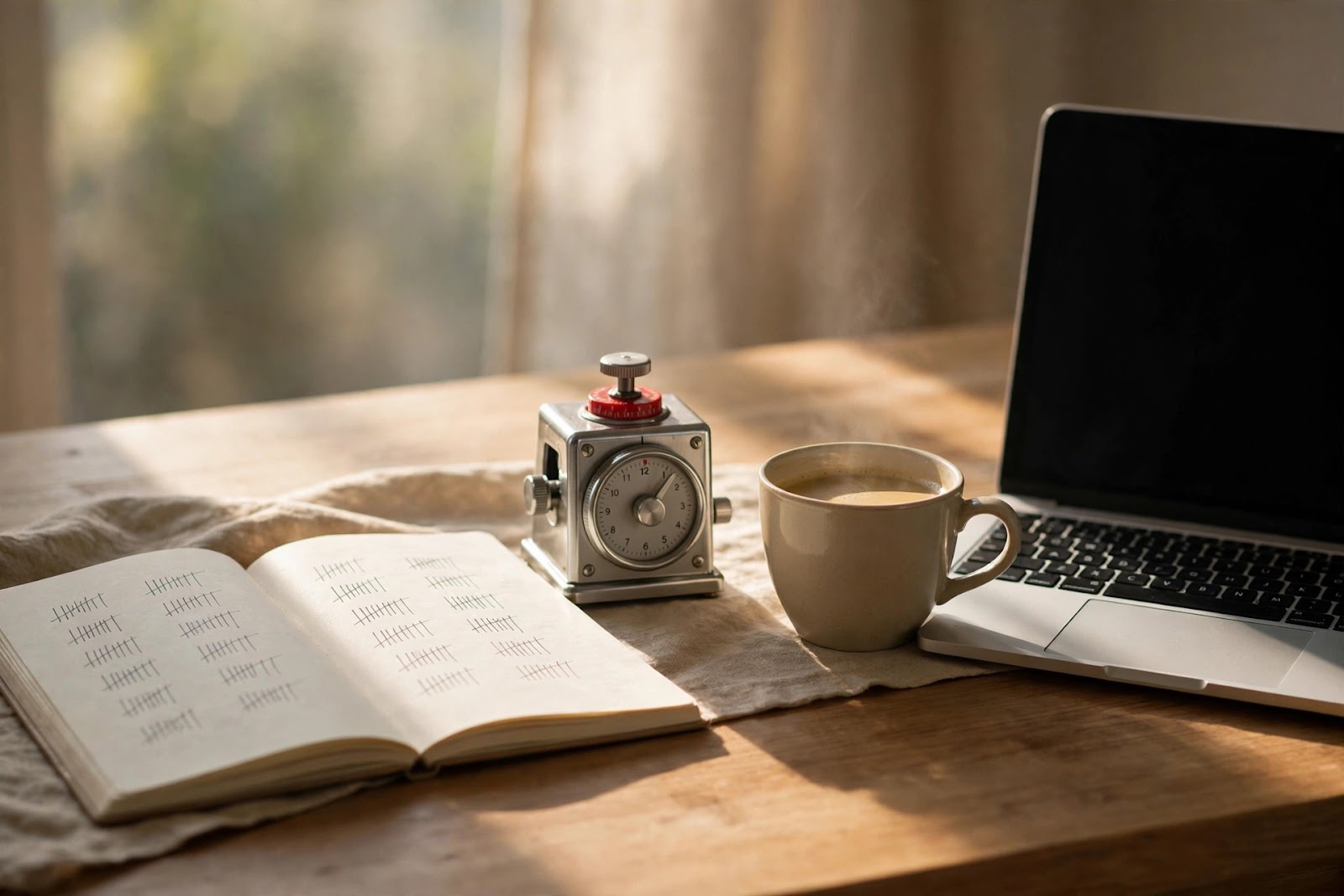
For a long time I told myself the problem was discipline. If I just tried harder, I'd stop checking. That worked for about a day and a half, every time. Then one Monday in September I did something different: instead of fighting the distraction, I decided to measure it. I put a little notebook next to my laptop and made a rule — every time I picked up my phone during work hours, I wrote down the time and what pulled me in. No judgment, just a tally. I figured I'd get maybe ten pickups a day. I was wrong by a lot.
The audit: one week, one notebook, ugly numbers
Day one, Monday: 47 pickups. I counted twice because I didn't believe it. Forty-seven times I reached for the phone between 8 a.m. and 5 p.m. Most of them lasted under a minute — a glance at a notification, a quick scroll, a check of nothing in particular. But the minutes added up. My phone's own screen-time report said 3 hours and 12 minutes that day, and 2 hours and 40 of it happened before lunch.
By Wednesday the pattern was obvious, and it wasn't what I expected. I assumed social media was the villain. It wasn't, or at least not the main one. The biggest category in my notebook was "checked for no reason" — 19 times on Monday alone. No notification, no buzz, nothing. My hand just went to the phone the way you check a fridge you already know is empty. The second biggest was messaging apps: group chats that ping all day about nothing urgent. Actual important stuff — a call from my manager, a message from a client — was maybe three pickups out of 47.
Thursday gave me the detail that changed everything. I wrote down what I was doing right before each pickup. Twenty-six of the 41 pickups that day happened within two minutes of hitting something hard — a tricky paragraph, a spreadsheet that didn't add up, a decision I didn't want to make. My phone wasn't interrupting my work. I was using my phone to escape my work. That's an uncomfortable thing to write in a notebook about yourself, but once I saw it, I couldn't unsee it.
Friday's total was 38 pickups, and my screen time was still over three hours. But the audit had done its job. I knew exactly what I was dealing with: not a phone problem, really, but a habit loop with a trigger (hard moment), an action (reach for phone), and a reward (a little hit of something easy). And habits with a visible trigger can be redesigned. Willpower hadn't worked for months. Changing the setup might.
The move: my phone lives in the hallway now
On Saturday I bought a ten-dollar kitchen timer — the wind-up kind, with a bell — and on Monday morning I put my phone on the hallway shelf, plugged into its charger, and closed my office door. Not in a drawer. Not face-down on the desk, which I'd tried before and which lasted about an hour. In another room, behind a closed door, far enough that checking it meant standing up, walking, and making a deliberate decision.

That distance is the whole trick. A phone on your desk is a one-second decision. A phone in another room is a ten-second decision, and ten seconds is long enough for the sensible part of your brain to catch up and ask, "Do you actually need this right now?" Most of the time the answer was no, and I'd sit back down. The first morning I reached for the empty spot on my desk four times before 9 a.m. — my hand literally closed on air. By the third day, the reaching had mostly stopped.
I won't pretend the first week was peaceful. Monday felt weird and slightly anxious, like I'd left the house without my wallet. I kept inventing reasons the phone needed to be near me. What if someone needs me? What if there's an emergency? Here's the honest answer to that, after two months of doing this: nobody needed me urgently during those morning hours, not once. My manager messages me on my laptop anyway. My family knows to call twice in a row if it's truly urgent — and I'll explain the one exception in a minute.
App limits: the second lock on the door
Moving the phone fixed the mornings, but the phone still came back at lunch and in the evenings, and the old habits came back with it. So I added a second layer, and this one lives inside the phone itself. I set app limits: 30 minutes a day for social apps, 20 minutes for news, and the messaging apps get an hour, because group chats are also how I talk to my actual friends.
The limits aren't magic. You can tap "ignore limit" and keep scrolling, and I did, plenty of times in the first week. What the limits do is put a speed bump in front of the mindless part. The first time the grey screen pops up and says "You've reached your limit," it breaks the trance. Sometimes I hit ignore anyway — I'm not going to pretend otherwise. But more often than not, that little interruption is enough for me to think, "Okay, that's enough," and put the phone down. The limit doesn't have to be unbreakable. It just has to be annoying enough to wake you up.
I also turned off every notification except the ones I chose on purpose, which brings me to the part people always ask about. I deleted the news apps from my home screen entirely — not the accounts, just the icons. If I want the news, I have to search for it. That one change cut my news scrolling from about 40 minutes a day to almost nothing, because news was never something I sought out. It was something that found me, fifty times a day, through little red badges.
The one notification I still allow
People assume I went fully unreachable, and I didn't. I allow exactly one notification through during deep-work hours: phone calls. Not messages, not emails, not app alerts — calls. And really, calls from anyone, because a call is already a high-effort thing. Nobody calls you casually at 9 in the morning to send a meme. If someone is calling, something is happening, and I want to know.
Everything else waits. Messages, email, all of it — silent until my admin block at 1 o'clock. The first time I told my team this, I expected pushback. What I got was a shrug and one colleague saying, "Honestly, I wish I could do that." The world did not end. Nobody's project collapsed because I answered their message at 1 p.m. instead of 9:04 a.m. Most messages, it turns out, are not emergencies. They're just messages that feel urgent because they arrived with a buzz.
There's a small detail that makes this work: my phone stays on loud in the hallway, not on silent. If it rings, I hear it through the door, and I go get it. The rule is that a call is the only thing allowed to interrupt me, and a ringing phone in another room is easy to hear and easy to ignore if it's not a call — because it never buzzes for anything else. My mornings are quiet now in a way they haven't been in years, and quiet turns out to be the whole point.
What my mornings look like now
Here's a normal Tuesday now. I wake up, and the phone stays on the hallway shelf where I left it the night before. I make coffee, I sit at my desk, and I work on the one thing that matters until 9:30. No tally notebook anymore — I don't need it. My screen-time report for last week showed 1 hour and 20 minutes a day on average, down from over 3 hours, and most of that is in the evening when I'm actually choosing to scroll, not leaking attention all morning.
The part that surprised me most wasn't the extra time. It was the quality of the work. When I wasn't breaking my focus every eleven minutes to check a screen, the hard tasks stopped feeling so hard. That report that used to take me three scattered mornings now takes one focused one. I finish my most important task before 10 a.m. most days, and the rest of the day feels easier because the big rock is already moved.
I'm not going to claim my attention span is magically fixed forever. Some days I still walk to the hallway for no good reason. Some evenings I blow past my app limits and scroll for an hour. The system bends. But it doesn't break the way the old setup did, because the old setup had no friction at all — the phone was right there, and reaching for it cost nothing. Now reaching for it costs a walk, a decision, and a grey warning screen. That's usually enough.
Run your own audit this week
You don't need my exact setup. You need the data, and the data takes one week and one notebook. Here's the version I'd hand a friend:
- For five workdays, tally every phone pickup — time, and what pulled you in. No judgment while you do it. You're collecting evidence, not grading yourself.
- On day three, add one more column: what were you doing right before you picked it up? That column is where the real insight lives.
- On the weekend, look at the totals. Circle the top two triggers. For most people it's the same as mine: no-reason checks, and hard-task escapes.
- Move the phone out of arm's reach during your most important work block. Another room beats a drawer — distance is the feature.
- Set one app limit on your biggest time sink, and delete one news or social app from your home screen. Keep the account. Lose the icon.
- Pick your one allowed interruption and say it out loud: "Calls get through. Everything else waits until 1." Tell one person, so it's real.
Two months in, the hallway shelf is just where my phone lives in the mornings, the same way the coffee mug lives next to the machine. It stopped feeling like a rule a while ago. It just feels like the way my house is arranged — the distraction lives in the hallway, and my attention lives at my desk, where it belongs. If your mornings feel like they belong to someone else's notifications, try the notebook for a week. The numbers will tell you the truth faster than any amount of willpower ever will.


