Last month I caught myself answering a work email at 10:40 at night, sitting on the sofa in my pyjamas, with a film paused on the TV in front of me. My partner asked me what I wanted for breakfast the next morning and I answered with a sentence about a spreadsheet. That is when it hit me: my workday had no ending. It just faded out somewhere between dinner and midnight, and I carried it into bed every night like a bag I forgot to put down.
I work from home, so there was never a commute to draw the line for me. No train, no office door closing behind me, no walk to the car. I finished work when I got tired of working, which meant I never really finished at all. I would close my laptop at six, open it again at eight to check one thing, and suddenly it was ten and I was still in my head about a client who had not even replied yet.
So I built a shutdown ritual. Ten minutes, same steps, every workday. It sounded too small to matter. It turned out to be the one habit that gave me my evenings back.
The night my evening disappeared
Let me tell you about the Tuesday that pushed me over the edge. I had a perfectly ordinary day. Nothing went wrong. I finished my main task by four, answered the last emails by five, and told myself I was done. Then I left my laptop open on the kitchen table while I cooked dinner, and every time I walked past it I glanced at the screen. One glance became a reply. One reply became a quick check of tomorrow's calendar. By nine o'clock I had done another hour of work I never planned to do, and I felt cheated out of my own evening — by myself.
The worst part was that none of it was urgent. Not one of those messages needed an answer before morning. I was not being a hero. I was just unable to stop, because stopping had no ceremony. There was no moment where work officially ended, so it never did.
That night I wrote down the problem in plain words: I need an ending. Not more discipline. Not a better app. An ending I can see and feel, the way closing a shop door tells the shopkeeper the day is over.
What the ritual actually looks like
Here it is, exactly as I do it, in order. Ten minutes, start to finish, at the same time every day — for me that is 5:30, because my most honest work is done by then and anything after that is me pretending.
First, I close every tab and every app except the one I need for the next step. Not minimise. Close. It takes about a minute and it feels strangely final, which is the point. An open tab is an open loop, and my brain treats each one like a small debt.
Second, I write tomorrow's first task on a sticky note and stick it to the closed laptop lid. Just one task, the one I will start with in the morning. Not a list. A list is tomorrow's problem. One line is a doorway I can walk through without thinking. Mine this morning said: send the revised invoice to Priya. That was it.

Third, I clear the desk. Mug to the kitchen, papers into one pile, pen back in the drawer. Ninety seconds. I used to leave my desk looking like a crime scene and then wonder why I felt tense every time I walked past it in the evening. A clear desk is a closed shop. A messy desk is a shop with the lights still on.
Fourth, I shut the laptop lid and say, out loud, "Done for today." Yes, out loud. I felt ridiculous the first three times. Then I noticed something: the words gave my brain permission to let go. Without them, the lid closed but my thoughts kept running. With them, something actually switched off. Try it before you laugh at it.
Fifth, I change out of my work clothes. Not into pyjamas — into ordinary home clothes, a different jumper, different trousers. It takes two minutes and it is the strongest signal of the lot. My body learns the change the way it learns that a uniform means work. When the clothes change, the day changes.
Why the last step matters most
Here is what I got wrong for years: I thought ending work was a decision. It is not. It is a signal. Decisions fade the moment a notification arrives. Signals stick, because your brain reads them without asking your permission.
Think about how a restaurant kitchen works at closing time. Nobody stands around deciding whether the day is over. Someone turns off the fryers, someone wipes the counters, someone locks the door. The actions say it. My ritual does the same thing in a one-person home office. Lid shut, desk clear, clothes changed — the kitchen is closed.
The sticky note does a different job, and it might be the cleverest part. Most of my evening anxiety was never about today. It was about tomorrow — the vague worry that I would forget something important. Writing down the first task takes that worry out of my head and puts it on the lid, where it will be waiting in the morning. I stopped rehearsing tomorrow in the shower. That alone was worth the ten minutes.
The first week was messy
I will not pretend this worked perfectly from day one. The first week I skipped it twice. Once because a deadline genuinely ran over — fine, the ritual waits for real emergencies, it just does not wait for fake ones. Once because I forgot, which told me something useful: a ritual you forget is a ritual without a trigger. So I set a daily alarm for 5:30 labelled "Shut the shop". Problem solved. The alarm is the trigger; the ritual is the habit.
The other mistake I made was making it longer. On day four I added a tidy inbox review and a tomorrow-planning session, and the whole thing ballooned to twenty-five minutes. I started dreading it, which is how good habits die. I cut it back to the five steps. Ten minutes, no more. If something needs real planning, it gets its own time on Sunday, not a cameo in my shutdown.
The evening the ritual failed — and what it taught me
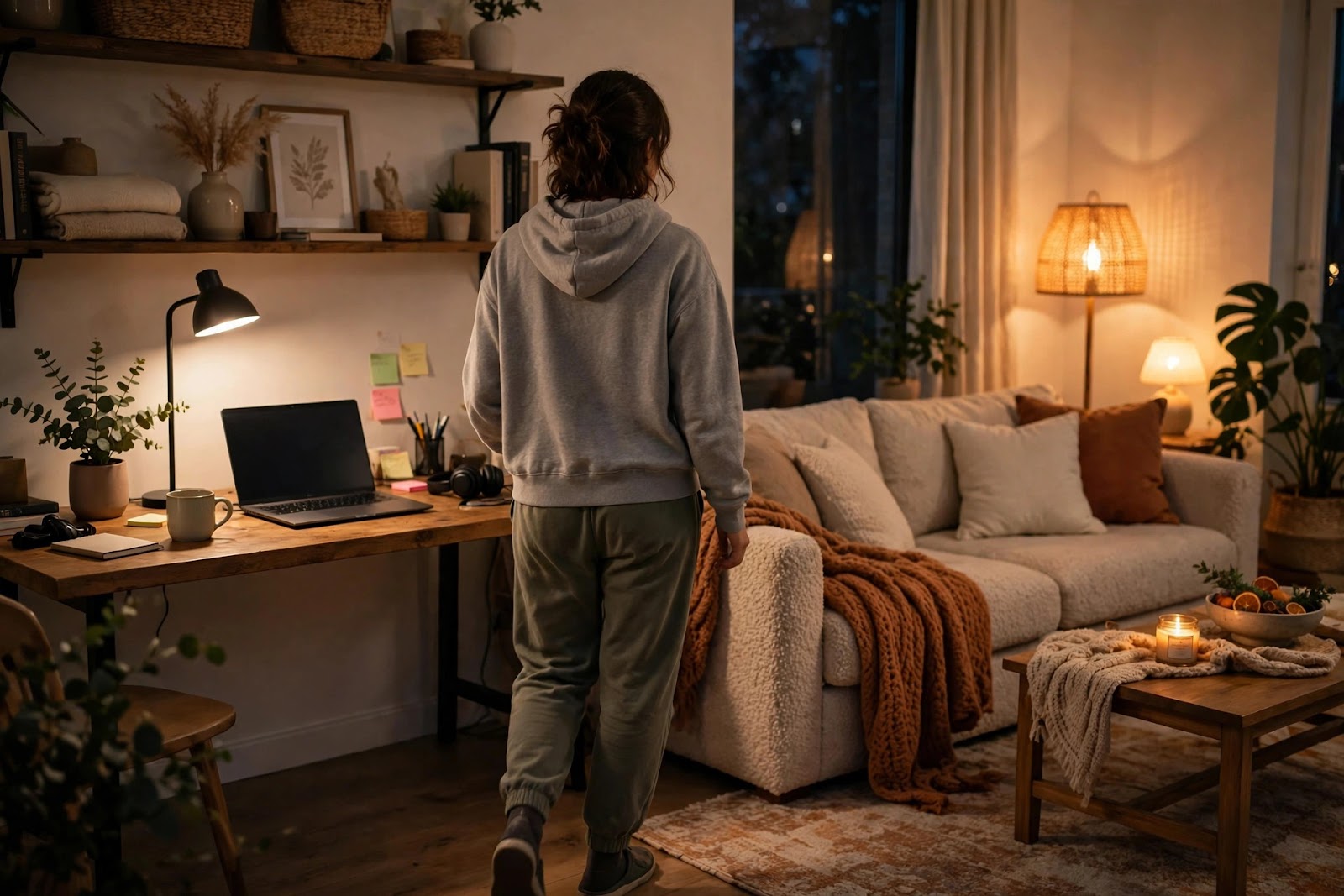
Three weeks in, a real emergency broke the ritual. A client rang at 5:45 with a genuine problem: a file I had sent that morning would not open on their system, and their presentation was at nine the next morning. I did the work. Of course I did. I opened the laptop, fixed the file, sent it back, and then — this is the part I am proud of — I did the ritual anyway, at 7:15 instead of 5:30.
That night taught me the difference between a rule and a ritual. A rule breaks and then you feel guilty and quit. A ritual bends. You do it late, you do it short, you do the lid and the line and skip the rest, but you still mark the ending. The emergency was real, and once it was handled, the day still deserved an ending. I think that is why the habit survived: it never asked me to be perfect, only to come back.
My partner noticed before I did. About two weeks in, she said I had stopped bringing my laptop to the sofa, which I had not even realised I was doing every night. Small things like that are the real measure. Not a productivity score, not an app streak — just a person in the next room noticing that you are actually there.
What changed after a month
Four weeks in, the changes were small and unglamorous, which is how I knew they were real. I stopped checking email after dinner — not by force of will, but because there was nothing to check for; the day had already been put away properly. I slept better, because I was not carrying half-finished thoughts into bed. And my mornings got easier, which surprised me most of all.
That sticky note is a gift to future me. I used to start every morning with ten minutes of staring at my screen, deciding what to do first, which usually meant answering whatever email shouted loudest. Now I sit down, read one line, and start. The first task is already chosen. The day begins with work instead of with dithering, and that difference compounds across a whole week.
Here is the honest trade-off, because there is one. Some evenings I still think of something I forgot. The difference is that now I write it on a scrap of paper by the sofa and deal with it tomorrow, instead of opening the laptop to fix it right now. The work still gets done. It just gets done in work hours, which is where it belongs.
Start tonight, keep it tiny
If you take one thing from this, take the lid and the line. Shut the laptop, write tomorrow's first task on a note, and walk away. You do not need all five steps on day one. You need one ending you can repeat, because repetition is what turns an action into a signal.
Pick a time and protect it like an appointment. Set an alarm if you have to — I did, and I am not embarrassed about it. Do it for two weeks before you judge it. The first three days will feel staged and slightly silly. Around day ten, you will notice the evening feels longer, which is a strange thing to say about a day that did not get any longer at all. It just finally belongs to you.
Close the lid, write the line, walk away — and let the evening be yours again.


