I Cleared 400 Unread Emails in 20 Minutes a Day — Without Chasing Inbox Zero
My inbox hit 412 unread emails on a Tuesday in March, and I remember the exact moment I stopped pretending it was fine. I was looking for one message — a reply from a colleague about a deadline that had moved — and after scrolling through three screens of newsletters, automated receipts, and threads I'd been cc'd on for no clear reason, I gave up and asked her in person instead. She laughed. "I sent it last Thursday," she said. It was right there, buried under a pile I'd been stepping over for months.
That night I did something I'd been avoiding for a year. I counted — actually counted. Four hundred and twelve unread, plus another 900 or so read-but-never-dealt-with messages underneath them. My inbox wasn't a communication tool anymore. It was a storage unit I'd stopped opening, and every time I did, I felt a little wave of guilt before I'd read a single word.
Here's the part that surprised me: I didn't fix it by becoming one of those inbox-zero people. I tried that first, obviously — a whole Saturday afternoon of archiving everything and setting up elaborate filters. By the following Wednesday I had 87 unread messages again. The system hadn't failed because I lacked discipline. It had failed because it asked for a kind of attention I don't actually have when real work is waiting.
What finally worked was much smaller and much dumber than a full productivity overhaul. Twenty minutes a day. A timer. Four buckets. No ambition beyond that. It took me about three weeks to get from 412 unread to a normal, boring inbox — and I've kept it there for four months now without thinking about it very much. That's the whole story, but the details matter, because the details are where every other system I'd tried quietly fell apart.
The number that finally made me act
I'd been telling myself the unread count didn't matter for a long time. "Email isn't my job," I'd say, which was true in the narrow sense and completely false in every way that counted. My actual job kept arriving by email. Approvals, questions, changes of plan — all of it landed in the same pile as the software update notices and the "just checking in!" messages from vendors I'd spoken to once in 2023.
The week before the count, two things went wrong in the same forty-eight hours. First, I missed a meeting time change because the update sat unread for two days, and I showed up to an empty room at the old time. Second — and this one stung more — a teammate had asked me a simple yes-or-no question on a Friday, and by Monday he'd gone ahead without my answer because he'd assumed my silence meant I didn't care. I did care. I'd just never seen the message.
So I counted, and the number was 412, and I wrote it on a sticky note and stuck it to the side of my monitor where I couldn't ignore it. Not as punishment. As a starting line. I wanted to know exactly how bad it was, and I wanted to watch the number move. That sticky note turned out to be one of the most useful things in the whole process, because progress you can see is progress you'll keep making.
Why "just check email less" never worked for me
Every piece of email advice I'd ever read boiled down to the same thing: check it less often. I tried all of it. I'd check at 11 and at 4, and by 4 o'clock there would be 40 new messages, and the sheer size of the pile would make me skim instead of decide. I'd mark things unread again "to deal with later" — the email equivalent of shoving clutter into a closet and calling the room clean.
The problem with checking less often is that it doesn't reduce the work. It just concentrates it into bigger, scarier sessions. A pile of 12 messages feels manageable. A pile of 47 feels like a chore you'll put off until tomorrow, and tomorrow it will be 63. I was optimizing for fewer interruptions and accidentally maximizing dread.
Notifications were the other half of the trap. I turned them off once, lasted six days, missed a same-day request from my manager, and turned them all straight back on. I fixed the urgent problem by restoring the exact mess that caused it.
What I actually needed wasn't fewer email sessions. It was shorter, dumber ones with a hard stop. A session so short I couldn't dread it, with a rule so simple I couldn't argue with it in the moment. Twenty minutes. That's shorter than a lunch break, shorter than one episode of anything, shorter than the time I used to spend just staring at the unread count and feeling bad about it.
The triage system, in plain English
Here's the whole system. It has four buckets, and I mean four — not seven, not a colour-coded matrix with subfolders. Four.
Bucket one is Act. If a message needs something from me and I can do it in under two minutes, I do it right there, in the triage session. Reply, confirm, send the file, whatever. If it needs more than two minutes, it goes on my task list with a one-line note — "Reply to Dana re: Thursday slides" — and the email gets filed, not left in the inbox. The inbox is not my task list. That sentence, once I actually believed it, changed everything.

Bucket two is Wait. Messages where I'm expecting something back from someone else, or where the ball is in their court and I just need to remember to follow up. These go into one folder called Waiting. One folder. I check it every Friday for ten minutes and nudge anything older than a week. Before this, those messages just sat in my inbox glowing at me, and I carried a low-grade anxiety about all of them at once. Now the anxiety lives in one folder I open on purpose, once a week, instead of leaking into every inbox visit.
Bucket three is File. Stuff I might need later but that needs nothing from me now: receipts, reference documents, the final version of a plan, the address for the offsite. One folder called Reference, with no subfolders. I know, I know — the subfolder people are already upset. I tried subfolders. I had 23 of them by month two of a previous attempt, and I spent more time deciding which folder a message belonged in than I spent reading it. Search works. Type two words and the message appears. The folders were theatre.
Bucket four is Delete. Or archive, if deleting feels too brave — but honestly, delete. Newsletters I signed up for during a moment of enthusiasm and never opened. Automated notifications for things I can check in the app. "Thanks!" threads with twelve people cc'd. Promotional emails from stores I bought one thing from in 2022. The first time I deleted a hundred messages in one sitting, my hand actually hesitated over the button. Nothing bad happened. Nobody emailed to ask where their newsletter went.
The rule that holds it together: during triage, I touch each message once and decide. Act, Wait, File, Delete. If I'm genuinely unsure, it goes in File — a filed message is findable, an inbox message is just noise.
The timer is the whole trick
I set a timer for twenty minutes, and when it goes off, I stop. Mid-message, mid-thought, doesn't matter — I stop. This is the part people argue with me about, and it's the part that makes the whole thing work.
On day one, twenty minutes cleared 63 messages. Sixty-three out of 412. My first thought was that this would take forever. My second thought was that 63 was still 63 fewer than yesterday, and yesterday I'd cleared zero. The timer didn't just limit the session — it made starting easy, because twenty minutes is a trivially small promise to keep.
I ran the session at the same time every day: 4:40 in the afternoon, right before I wrapped up work. Morning triage never stuck for me — mornings are when my brain is freshest, and spending that on email felt like burning good fuel on admin. Late afternoon worked because my deep-work energy was mostly spent anyway, and clearing email became a satisfying wind-down instead of a dreaded chore. Pick whatever time your brain is already half done for the day. That's your triage slot.
By day five, the count was under 300; by day nine, under 200. The oldest messages were the easiest — mostly newsletters I deleted in seconds. The last hundred were the real ones, the replies I'd been avoiding, and I cleared those on a Saturday morning with coffee in about ninety minutes. That was the only long session in the whole process.
Three weeks after I started, the unread count was zero for the first time in — honestly, I don't know how long. Years, probably.
The rules that keep a session under twenty minutes
Getting to zero was the easy part. Staying there is where most systems quietly die, usually in the third or fourth week when the novelty wears off. Four rules keep mine alive, and each one exists because I broke it and watched the pile grow back.
Rule one: the inbox is not a task list. I said it before and I'll say it again, because this is the rule I break most often and it costs me every time. The moment I leave a message in the inbox "because I need to do that thing," the inbox starts growing a second job. If it needs doing, it goes on the task list. If it doesn't, it gets filed or deleted. The inbox holds only messages I haven't decided about yet, and I decide about them daily, so it stays small.
Rule two: no composing during triage. This one sounds strange, but it saves the most time. If a reply needs more than two minutes of thought — a careful answer, a document attached, a decision I need to check with someone — I don't write it during the twenty minutes. I put it on the task list and write it in a proper work block later. Triage is sorting, not doing. The day I tried to write three real replies inside a triage session, the timer went off with eleven messages still untouched, and I learned my lesson.
Rule three: unsubscribe beats delete, eventually. Deleting the same newsletter every day is a tax you pay forever. After the third time I deleted a message from the same sender, I unsubscribed instead. It took about ten seconds, and that sender has never appeared again. I unsubscribed from eleven lists in the first month. My daily incoming mail dropped from around 45 messages a day to about 28, and honestly, I haven't missed a single one of those eleven.
Rule four: one inbox, checked twice. Triage at 4:40, plus a five-minute skim at 11 for anything genuinely urgent — no filing, no replying, just a scan for fires. Most days there are none. The skim exists to kill the "but what if something urgent comes in?" anxiety that used to keep my inbox open all day.
What I do with newsletters now
Newsletters were about a third of my 412 unread messages, which is embarrassing to admit, because I chose every single one of them. I signed up in moments of optimism — "I'll read this every week, it'll keep me sharp" — and then never opened them, because the moment they arrived I was always in the middle of something else. They piled up as a monument to the person I imagined I'd be.
I keep five newsletters now. Each one passed a simple test: did I actually open and read the last three issues? If not, it got unsubscribed. The survivors are ones I read the morning they arrive, usually with coffee, in about four minutes each. They live in a folder called Reading, which I open on purpose instead of letting them queue up in the inbox pretending to be work.
The honest truth is that I get almost all my useful reading from three of those five. The other two are habit and pleasure, and that's fine — five is a small enough number that it never becomes a pile. If a new newsletter catches my eye, something old has to go. One in, one out. It's the only way the number stays at five instead of creeping back to thirty while I'm not looking.
And the "read later" instinct — saving articles to read someday — I killed that too, at least in email. Articles I actually want to read go to a reading app, not my inbox. The inbox is for messages from people, not for content. That distinction sounds obvious written down. It took me two years of a 400-message pile to actually live by it.
What didn't work (so you can skip it)
I've tried enough email systems to have a small graveyard of them, and each one taught me something, mostly by failing in a specific and instructive way.
The elaborate folder system failed because sorting became the work. I had folders for projects, for people, for "someday," for receipts, for travel — and every message required a small decision about where it belonged. Decision fatigue is real, and I was spending mine on filing. One Reference folder and one Waiting folder is all the structure email needs. Search does the rest.
The aggressive filters failed because they hid things I actually needed. I set up a filter that auto-archived anything with the word "update" in the subject, feeling very clever, and then missed a project update that — yes — had "update" in the subject. Filters are fine for the obvious junk, the automated stuff you never need to see. The moment a filter touches anything a human wrote, you're gambling.
The "no email before noon" rule failed because it made mornings anxious instead of focused. I'd sit there doing deep work while a small voice in my head wondered whether something urgent had come in. The five-minute morning skim fixed that completely. Knowing there's a skim coming at 11 lets me ignore the inbox until then without the background worry.
The part nobody warns you about
Here's the strange side effect I didn't expect: once my inbox was under control, people started getting faster answers from me, and then they started sending me more email. Not a flood — but noticeably more. When you reply quickly and reliably, you become the person people go to first. That's a compliment with a cost attached, and I had to learn to protect the system from its own success.
The protection is simple and slightly uncomfortable: I don't reply instantly just because I can. During the morning skim, I note what's urgent and reply to that. Everything else waits for the 4:40 triage, even if I saw it at 11 and could answer it in thirty seconds. If I reply instantly to everything, I'm training people to expect instant replies, and then I'm back to living inside my inbox all day — just with a lower unread count.
There's a subtler thing too. A clean inbox makes the remaining messages feel louder — when there are nine, each one feels like it demands something. Most of them demand nothing. I had to learn to sit with that feeling instead of answering everything immediately just to make it go away.
One more honest note: my system works for the volume of email I get — roughly 25 to 30 messages a day. If you get 200 a day, twenty minutes won't cut it, and you'd need something more aggressive, probably involving your team agreeing on different channels for different kinds of messages. Don't copy my numbers. Copy the shape: a short daily session, a hard stop, four buckets, and a rule that the inbox never doubles as a task list.
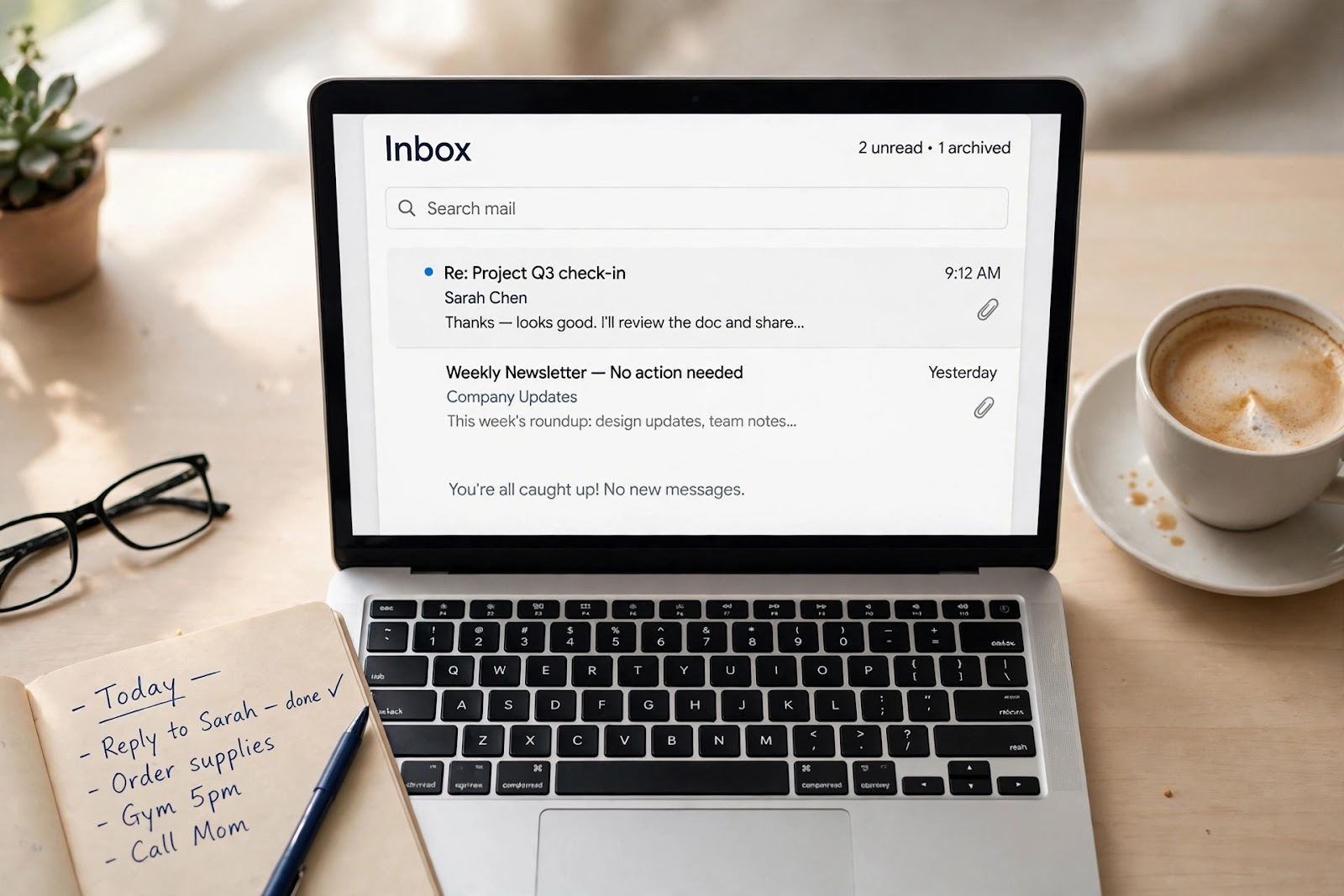
What my inbox looks like now
Four months in, my inbox at 4:40 most days holds between six and fifteen messages, and triage takes ten to fifteen minutes — the unsubscribes did their quiet work, and most of what arrives now is actual mail from actual people. Some days it's five minutes.
The sticky note came down after the first month. I didn't need the starting line anymore. But I kept it in my desk drawer, because 412 is a number I want to remember — not as a shame trophy, but as proof that a problem I'd been carrying for years turned out to be a twenty-minutes-a-day problem. I'd been treating it like a personality flaw. It was just an unbuilt habit.
If your unread count is sitting somewhere embarrassing right now, here's the part I'd actually want someone to have told me back in March: you don't need a better system. You need a smaller one you'll actually do. Set a timer for twenty minutes, sort what you can into four buckets, and stop when the timer rings. Do it again tomorrow. The pile will move. Slowly at first, then faster than you expect. And one ordinary afternoon, you'll open your inbox and find nine messages in it, and you'll wonder why you waited so long to start.
Start today, at whatever time your brain is already half done. Twenty minutes. Four buckets. That's the whole system, and it's the only one that ever worked for me.


