I always thought I was pretty good at focusing. Not perfect, obviously — nobody is — but decent. I'd sit down, open my laptop, and get to work. Sure, I'd check my phone now and then. Sure, I'd wander off to make tea or answer a message. But that was normal, right? Everyone does that. It wasn't costing me much.
That was the story I told myself for years. Then one Tuesday morning, after losing an entire hour to what I can only describe as "researching desk lamps I will never buy," I decided to find out the truth. Not guess. Not estimate. Actually track every single distraction for a full week and look at the numbers.
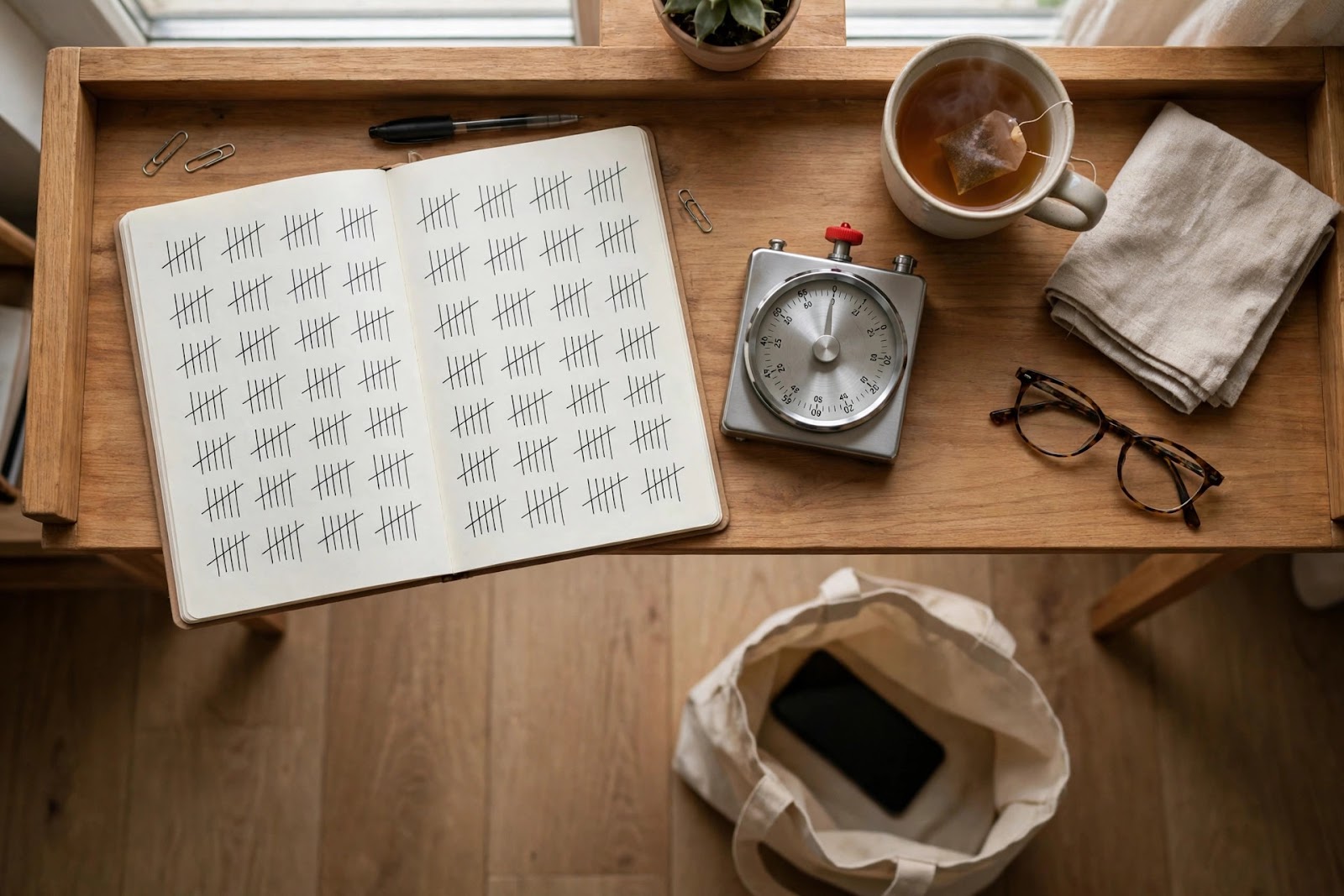
I grabbed a cheap notebook — the same one I use for grocery lists — and made a simple rule: every time my attention left the task I was supposed to be doing, I wrote it down. The time, what pulled me away, and how long it took before I was working again. No judgment while writing. Just the facts.
By Wednesday evening I already wished I hadn't started.
The Rules I Set (and Almost Broke on Day One)
I kept the system deliberately simple, because I knew myself well enough to know that a complicated tracking system would become its own distraction. Here's what I did:
Every distraction got one line. Time, trigger, minutes lost. That's it. If I caught myself mid-scroll, I wrote it down the moment I noticed. If I only realized twenty minutes later that I'd drifted, I wrote it down anyway and guessed the time honestly — I marked those with a little star so I'd know they were estimates.
I tracked only work hours, roughly 9 a.m. to 6 p.m., Monday through Friday, plus a couple of hours on Saturday morning when I was finishing a report. I didn't track evenings. I didn't want the experiment to take over my life, and honestly, evening scrolling is my own business.
The hardest rule? I had to write down the embarrassing ones too. The "just checking one notification" that turned into a 40-minute dive. The "quick question" to a colleague that became a 25-minute chat about nothing. No skipping, no rounding down to make myself feel better.
What Nobody Tells You About Tracking Distractions
Here's the first thing I learned, and it happened within about two hours of starting: the act of tracking changes your behavior immediately. On Monday morning I reached for my phone out of pure habit — thumb already moving toward the screen — and stopped halfway. Because I knew I'd have to write it down. That little pause was enough.
By lunchtime on day one, I'd only logged four distractions. I felt smug. See? I thought. I'm not that bad after all.
Then the afternoon hit. That's when my focus always frays, somewhere around 2:30, and the notebook started filling up fast. A message from a friend. A news headline. An email that wasn't urgent but felt urgent. A sudden, overwhelming need to reorganize my desktop folders — because apparently that was the most important thing in the world at 3:12 p.m.
The tracking itself became a mirror, and the mirror was not flattering.
Day One: The Numbers Start Talking
Monday's total: 23 distractions. Twenty-three. In about eight hours of work.
Total time lost: 2 hours and 41 minutes. That's a third of my working day, gone. Not to meetings. Not to lunch. To drift.
The biggest single thief was my phone, which accounted for 11 of the 23 interruptions and nearly half the lost time. But here's the part that surprised me: the phone wasn't even the worst of it in terms of damage. The worst distractions were the ones that looked like work.
You know the kind. Checking email "just in case." Opening a document to "quickly check something" and ending up rewriting a paragraph that didn't need rewriting. Asking a colleague a question that could have waited until tomorrow. Each one felt productive in the moment. Each one cost me 10 to 20 minutes of real focus, plus the time it took to get back into the task I'd left. And getting back in — that re-entry time — was the hidden cost I hadn't expected at all.
There's a reason it takes a while to refocus after an interruption. I'd read the same paragraph three times before the words started making sense again. I'd forget where I was in a spreadsheet and have to retrace my steps. On Monday alone, I counted at least 40 minutes of pure re-entry fog — time spent neither distracted nor working, just... warming back up.
Tuesday: The Day My Phone Won
Tuesday was worse. Much worse. And I know exactly why: I had a difficult report to write, the kind that requires actual thinking, and my brain did everything it could to escape.
I logged 31 distractions on Tuesday. Thirty-one. The notebook page was a mess of scribbles. Total time lost: 3 hours and 26 minutes. I spent more time distracted than I spent in a solid flow state, and I only finished about half the report.

The pattern was almost funny once I saw it written down. Every time I hit a hard part of the report — a section where I needed to make a decision, or a paragraph I couldn't quite phrase right — within about ninety seconds I'd be doing something else. Checking the weather. Reading a newsletter I'd already read. Scrolling through photos of a holiday I took two years ago. My brain had a deal with itself: hard bit equals escape, immediately.
That was the most embarrassing discovery of the whole week.
Wednesday: The Sneaky Ones
By Wednesday I'd started noticing the distractions that don't look like distractions at all. These were the ones that embarrassed me the most, because I'd been proudly counting them as "work" for years.
Email was the biggest. I checked it 19 times on Wednesday. Nineteen. And here's the kicker: only two of those checks contained anything that needed me that day. The other seventeen were just... looking. The inbox had become a slot machine I pulled every twenty minutes, hoping for a small hit of novelty.
Then there was what I started calling "productive procrastination." Rearranging my task list. Color-coding my calendar. Reading articles about productivity (yes, the irony is not lost on me). Updating my notes app. All of it felt like work. None of it moved a single real task forward. On Wednesday, productive procrastination ate 52 minutes. Fifty-two minutes of organizing my work instead of doing my work.
What the Midweek Total Looked Like
By Wednesday night, three days in, the totals were sobering enough that I sat down and added them up properly:
Monday: 23 distractions, 2h 41m lost.
Tuesday: 31 distractions, 3h 26m lost.
Wednesday: 27 distractions, 3h 04m lost.
Three-day total: 81 distractions, 9 hours and 11 minutes lost. That's more than a full working day, evaporated in three days, while I sat at my desk believing I was working hard.
My first reaction wasn't motivation. It was defensiveness — maybe this was an unusually bad week, maybe the report made Tuesday unfair. But the numbers didn't care about my excuses. They were just sitting there in the notebook, in my own handwriting.
Thursday: I Started Fighting Back (A Little)
On Thursday I did something I'd been resisting all week: I changed a few things based on what the log was telling me. Not a grand overhaul — I didn't trust myself to stick to one — just three small experiments.
First, the phone went into my bag, in the other room, on silent. Not face-down on the desk (I'd tried that before — it doesn't work, the phone might as well be shouting). In another room. The first hour felt strange, like I'd forgotten something. I kept reaching for a pocket that was empty. By the second hour, I'd forgotten about it entirely — which tells you everything about how much of phone-checking is pure muscle memory.
Second, I checked email only three times: 10 a.m., 1 p.m., and 4:30 p.m. I told my closest colleagues I was doing this, so nobody would panic. Nothing caught fire. Two emails that arrived at 11 a.m. waited until 1 p.m. and the world kept turning.
Third, I set a timer for the hard parts. When I hit a difficult section of a task, instead of letting my brain bail, I set a 15-minute timer and made a deal with myself: just 15 minutes on this one hard bit, then I can take a proper break. It sounds too simple to work. It worked, mostly because it gave my brain an end point. "Forever" is terrifying. "Fifteen minutes" is manageable.
Thursday's result: 14 distractions, 1 hour and 22 minutes lost. Less than half of Tuesday's damage. And I finished the report — the same report that had beaten me up on Tuesday — by 4 p.m.
Friday: The Pattern That Matters Most
Friday was my last full tracking day, and I kept the three experiments going. The numbers: 16 distractions, 1 hour and 31 minutes lost. Slightly worse than Thursday (a long lunch with a friend ran over, and I counted it honestly), but still less than half of my Monday-to-Wednesday average.
But the real discovery of Friday wasn't the total. It was the pattern that finally became obvious once I had a full week of data to look at.
My distractions were not random. They clustered in three places: the first 20 minutes after starting work (my brain resisting the transition), the hour after lunch (the classic slump), and — most importantly — the exact moment a task got hard. Those three windows accounted for about 70% of all my lost time across the whole week.
That changed how I think about the problem entirely. I used to believe focus was about willpower — about being the kind of person who just concentrates. The week taught me it's mostly about structure. If I know my danger windows, I can plan for them instead of being ambushed by them.
So now: I never start a hard task cold. I warm up with something easy for 10 minutes first, like answering a simple email or tidying my notes. After lunch, I deliberately do low-focus work for half an hour — admin, filing, the stuff that doesn't need my best brain — instead of pretending I'll be sharp at 1:05 p.m. And when a task gets hard, I reach for the 15-minute timer instead of my phone.
The Full Week's Tally
Here it is, the whole embarrassing picture:
Total distractions logged: 111.
Total time lost: 11 hours and 54 minutes across five and a half days of work.
Phone: 43% of all distractions, and the single biggest time thief.
Email checking: 19 checks on the worst day, only a handful ever urgent.
Productive procrastination: over 3 hours across the week.
Re-entry time: roughly 3 hours of the total was just getting back into tasks after interruptions.
Almost twelve hours. In one week. That's a day and a half of work, gone, while I sat at my desk feeling busy. And here's the part that still stings: before this experiment, if you'd asked me how much time I lost to distractions, I'd have guessed maybe 30 minutes a day. The real number was more than double that — over two hours a day on the bad days.
What I Actually Changed (and What I Didn't)
I didn't become a monk. I didn't delete every app or buy a lockbox for my phone. That kind of all-or-nothing overhaul lasts about four days and then collapses, and I knew it.
What I did change, permanently:
My phone lives in another room during deep work. Not on silent, not face down — in another room. This one change alone cut my worst distraction by more than half.
Email gets three windows a day. I told people about it, which made it stick. Nobody has complained. Most people, it turns out, don't expect instant replies — that expectation was mostly in my head.
I track my danger windows instead of fighting them. Hard task? Timer. After lunch? Easy work first. First thing in the morning? Warm-up task, then the real thing.
And once a month, for one week, I do the notebook again. Not forever — a week a month is enough to keep me honest. Because the most dangerous thing about distractions isn't the time they steal. It's how invisible they are while they're stealing it. You feel busy. You feel like you're working. And then Friday arrives and the important thing isn't done and you can't quite explain why.
If You Try This, Steal My Setup
You don't need an app. Honestly, I'd avoid one — another app is just another thing to fiddle with. A notebook and a pen work better, because writing it down by hand makes it real in a way a tap doesn't.
One line per distraction. Time, trigger, minutes. No judgment while you write — judgment comes later, when you read the week back. Track at least three full workdays; one day isn't enough because every day has its own flavor. And count the re-entry time honestly, because that's where the real damage hides.
Expect to feel embarrassed. That's the point. The embarrassment is the data doing its job. My week embarrassed me into changing three small things, and those three small things gave me back about an hour a day. Over a working year, that's roughly 200 hours. That's five full working weeks.
I spent a week tracking my distractions because I thought I was pretty good at focusing. Turns out I was pretty good at looking busy while my attention leaked out of a dozen small holes. The notebook didn't fix my focus. It just showed me where it was going — and once I could see it, I could finally do something about it.


