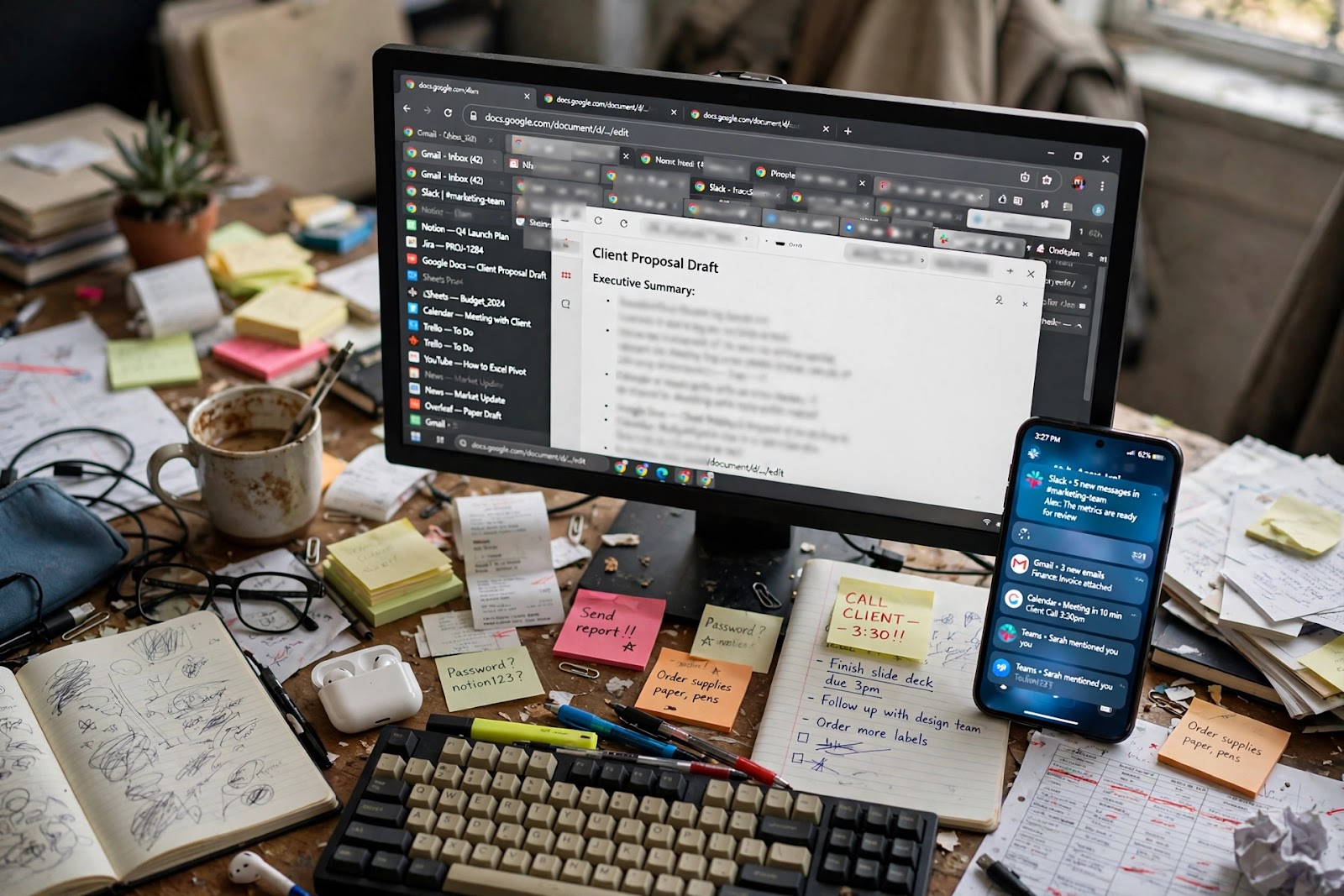
For years I wore multitasking like a badge. I'd have a spreadsheet open, a chat window blinking, a podcast playing, and a coffee going cold — and I'd tell myself this was what being good at my job looked like. If someone asked how my day went, I'd say "busy," and busy felt like productive. Then one Thursday I caught myself re-reading the same paragraph for the fourth time because I'd been answering messages between sentences, and I had a thought I didn't like: maybe I wasn't doing three things at once. Maybe I was doing three things badly, in rotation.
I'd read plenty of articles telling me multitasking was a myth. They all said the same thing — your brain switches, it doesn't parallel-process — and I believed them in theory while ignoring them in practice, because my way felt faster. So I decided to stop arguing with the articles and run the test myself. Two weeks, same kind of work, one stopwatch. Week one: multitasking, exactly the way I normally worked. Week two: one thing at a time, no exceptions. Same hours, same type of tasks, and I'd time everything and count the mistakes. No theory, just numbers. I was genuinely curious which week would win, and I was quietly rooting for multitasking, because changing my habits sounded like a lot of effort.
How I set up the test (so the numbers mean something)
A fair test needs the same work both weeks, so I picked three recurring tasks that show up in my job constantly: drafting a one-page report from raw notes, clearing a batch of emails that need real replies (not one-liners), and updating a spreadsheet with figures from three different sources. I did each task type at least three times per week, at roughly the same time of day, and I timed each one with the stopwatch on my phone — start when I opened the file, stop when it was done and checked.
I also counted two things the stopwatch can't see: errors and rework. Every time I had to fix a wrong figure, re-read a paragraph I'd already written, or send a follow-up correction, I marked it down. And I kept a simple 1-to-10 note at the end of each day for how drained I felt, because I had a suspicion the two weeks would feel different even if the numbers looked the same.
One rule for both weeks, to keep it honest: no podcasts, no music with lyrics, no YouTube in a side tab. That was the same in both weeks, so it couldn't skew the result. The only difference was whether I was doing one thing or several at once.
Week one: multitasking, business as usual
Week one was my normal week, and I didn't have to act — I just worked the way I always had. A report draft with the group chat open. Emails answered in between bites of the spreadsheet. Phone face-up on the desk, buzzing away. Every time a notification arrived, I checked it, because that's what I'd always done, and because each check felt like twelve seconds, which felt like nothing.
The numbers, though, were not nothing. The one-page report took me an average of 58 minutes across three attempts — and that included two sessions where I had to re-read whole sections because I'd lost my place after switching away. The email batches averaged 47 minutes for about fifteen replies. The spreadsheet updates averaged 41 minutes each, and here's the ugly part: I made eleven errors across the week that I had to go back and fix. Wrong figures copied into the wrong column, a reply sent to the wrong thread, a paragraph in the report that repeated itself because I'd written it, forgotten, and written it again in different words.
The worst moment of week one happened on Wednesday. I was halfway through a spreadsheet update when a colleague messaged me about a meeting time. I answered, then answered a second message from someone else, then checked an email that had just arrived, and when I came back to the spreadsheet I couldn't remember which of the three sources I'd already entered. I spent nine minutes reconstructing it — checking the source documents, re-reading my own half-finished row, figuring out where I'd stopped. Nine minutes, gone, because of a thirty-second interruption. And I did that to myself, voluntarily, about a dozen times a day.

By Friday my energy score averaged 4 out of 10, and the day felt long in the bad way — the way where you're tired but you can't point to much finished work. My to-do list at the end of the week had the same three big items on it that it started with, just with more small things ticked off around the edges. I had been busy all week. I had not been productive all week. Those are different things, and the stopwatch had just shown me the receipt.
Week two: one thing at a time, no exceptions
Week two had rules, and I wrote them on a sticky note on my monitor so I couldn't negotiate with myself. One task at a time. Phone in the hallway — I'd learned that trick from an earlier experiment and it still worked. Chat closed while I worked on a report. Email in a single block, not sprinkled through the day. When a thought about another task popped up, I wrote it on a scrap of paper next to my keyboard and went back to what I was doing. The scrap of paper was the key, honestly. Without it, the "oh, I should also..." thoughts just circled until I gave in.
The first day felt strange. Slow, almost. I sat down to draft the report with nothing else open, and for the first ten minutes my hands kept reaching for things that weren't there — the phone, the chat tab, the email. It was like quitting a habit, because that's what it was. But somewhere around the twenty-minute mark, something shifted. The paragraph I was writing started to actually flow. I wasn't re-reading sentences. I wasn't losing my place. I finished the first report in 39 minutes, and I read it back once, found one small typo, fixed it, and sent it. Thirty-nine minutes against week one's 58. I actually checked the stopwatch twice because I didn't believe it.
The email batches came in at 31 minutes on average, down from 47. The spreadsheet updates averaged 27 minutes, down from 41 — and the error count for the whole week was two, both tiny, both caught in my own check before anything went out. Two errors against eleven. I want to be careful here, because these are my numbers from my job, not a laboratory study. But the direction was so clear, and so consistent across all three task types, that I stopped doubting it by Wednesday.
By Friday my energy score averaged 7 out of 10. Same hours, same workload, same desk — but I finished the week with the three big items actually done, and I left on Friday feeling like I'd had a good week instead of a busy one. The difference in how the week felt was bigger than the difference in the numbers, and the numbers were already big.
The errors were the real story
If I'd only timed the tasks, the story would be simple: single-tasking was about a third faster. But the error count is the part that changed my mind permanently, because errors have a cost the stopwatch doesn't measure. Every error in week one meant rework — going back, finding the mistake, fixing it, sometimes apologising for it. One wrong figure in a spreadsheet went out to a colleague before I caught it, and I had to send a correction email, which took six minutes and a small piece of my credibility. A correction email never feels good to send.
Here's why multitasking makes errors, and it's not because I'm careless. When you switch tasks, your brain doesn't just pick up where it left off — it has to reload the context. What was I doing? Where was I in this spreadsheet? Which source was I copying from? That reloading takes seconds, and during those seconds you're guessing. Most of the time the guess is right. Sometimes it's not, and the wrong guess becomes a wrong figure, a repeated paragraph, a reply to the wrong person. Week two had almost no reloading, because I almost never left a task halfway. The context stayed loaded. The errors mostly vanished with it.
There's also a sneakier cost: the errors you never catch. I can't count those, obviously, which is exactly the problem. In week one I caught eleven errors. How many did I miss? I don't know, and I don't love thinking about it. A report with a repeated paragraph looks sloppy. A spreadsheet with a wrong figure looks worse. Single-tasking didn't make me smarter — it just stopped me from giving my brain a dozen chances a day to drop something.
What the timer couldn't measure
Numbers aside, the two weeks felt completely different to live through, and I think this is the part the productivity articles undersell. Week one felt like being pulled in six directions by six different people, and one of those people was me — I was interrupting myself as often as anyone else did. Every switch came with a tiny jolt of urgency. Everything felt important because everything was happening at the same time. That's not focus. That's panic with a to-do list.
Week two felt quieter. Not easier — the work was just as hard, and some of it was boring in exactly the same way. But it felt like I was driving instead of being driven. When I finished the report, I knew I'd finished it, because I'd actually been there for all of it. There's a satisfaction in that which is hard to describe and easy to miss when you haven't felt it in a while. I caught myself smiling at my own screen on Thursday afternoon, which is not something I normally do at work, and I think it was just relief — relief at not being yanked around by my own habits.
There's one more thing the timer couldn't measure: the work got better, not just faster. The week-two report was clearer. I could tell when I read it back. The sentences connected. The argument actually built, paragraph to paragraph, instead of wandering off every time I switched away. When you write something in one sitting, it sounds like one person wrote it. When you write it in twelve sittings between other tasks, it sounds like twelve people wrote it, and none of them talked to each other.
Where multitasking still wins (I'm not a purist)
None of this means I never multitask now, because that would be dishonest and also impractical. Some things genuinely pair well. I still listen to a podcast while I do routine admin — filing, renaming documents, the kind of work my hands can do while my ears are elsewhere. I still keep an eye on the group chat during slow stretches when I'm waiting for someone else. And if I'm on hold on a phone call, I'm absolutely going to tidy my desk.
The line I've drawn is simple: if a task needs my thinking, it gets my thinking, alone. Writing, calculating, deciding, drafting — one at a time, everything else closed. If a task needs only my hands, it can share the room with something else. That distinction has held up for a month now, and it's the version of this experiment that survived contact with real life.
Here's what I'd say to anyone who, like me, secretly suspects their multitasking is fine and the articles are exaggerating: run your own test. Pick one recurring task. Time it your normal way for three days, then time it with everything else closed for three days. Count the mistakes. Don't take my word for it, and don't take the articles' word for it either. The stopwatch is the only honest referee here, and mine told me something I didn't want to hear: I wasn't doing three things at once. I was doing one thing at a time, badly, with expensive gaps in between. Single-tasking didn't just save me time. It gave me my work back.


