My mornings used to belong to someone else. I'd wake up, reach for my phone before my eyes were properly open, and hand the first hour of my day to a feed I didn't choose. News I didn't need, arguments between strangers, someone else's highlight reel, a work message that could absolutely have waited. By the time I put the phone down to make breakfast, my head was already crowded, my mood was already set by strangers, and I hadn't had a single thought of my own yet. That was normal for years. It took one deliberately phone-free week to show me how strange normal had become.
The rule I set was narrow on purpose: no phone before breakfast. Not no phone all day, not a digital detox, not a heroic month offline. Just the stretch between waking up and sitting down to eat. Phone stays on the kitchen counter, face down, on silent. I can use it after breakfast, as much as I want. The narrowness was the point — I wanted to test one specific thing, not overhaul my life. If the test failed, I'd know exactly what failed.
Day one: the itch is physical
I won't pretend day one was peaceful. It was irritating in a way that surprised me, because I thought of myself as someone with decent self-control. I woke at 6:40, reached for the phone out of pure habit, and found the counter empty where it usually sat. My hand actually hovered for a second, confused. Then I remembered the rule, and the next forty minutes felt like waiting for something.
That's the word for it: waiting. I made coffee, and instead of scrolling while it brewed, I stood there watching it brew, which felt absurd. I got dressed without a podcast. I sat at the table with my food and a window, and no screen, and I could feel my brain looking for input the way a tongue looks for a missing tooth. I kept thinking of things I "needed" to check — a message, a headline, the weather — and every single one of them turned out, later, to have been perfectly fine waiting until after breakfast.
What I noticed, even on day one, was the quiet underneath the itch. Once the initial restlessness passed, somewhere around the second cup of coffee, my mind started doing something it hadn't done in a morning for years: it wandered to my own life. I thought about the day ahead, not as a list of notifications but as actual plans. I remembered a call I wanted to make. I decided what my first task would be. None of this was profound. It was just mine, which is more than I could say for most of my recent mornings.
Days two to four: the feed fights back
Days two and three were harder than day one, and I think I know why. Day one had novelty on its side. By day three, the habit was pushing back properly. I caught myself picking up the phone "just to check the time" — I have a clock on the wall, I did not need the phone for the time — and once, embarrassingly, I opened the fridge and stood there, because standing in front of an open fridge is apparently what my brain does when it can't scroll. I laughed at myself, closed the fridge, and went back to my coffee.
The most revealing moment came on day four. I woke up anxious about something — a work message I was half-expecting — and my first instinct was to check immediately, to resolve the uncertainty. Under the old routine I would have, and the anxiety would have set the tone for the morning either way: bad news would have ruined breakfast, and no news would have left me checking again at 7:15, 7:30, 7:45. Instead, I sat with the uncertainty through breakfast, and here's what happened: nothing. The world didn't end. I ate, I got ready, and when I finally checked at 8:20, the message was there, and it was fine. The anxiety had been about not knowing, not about anything real, and the phone had been feeding it, not fixing it.
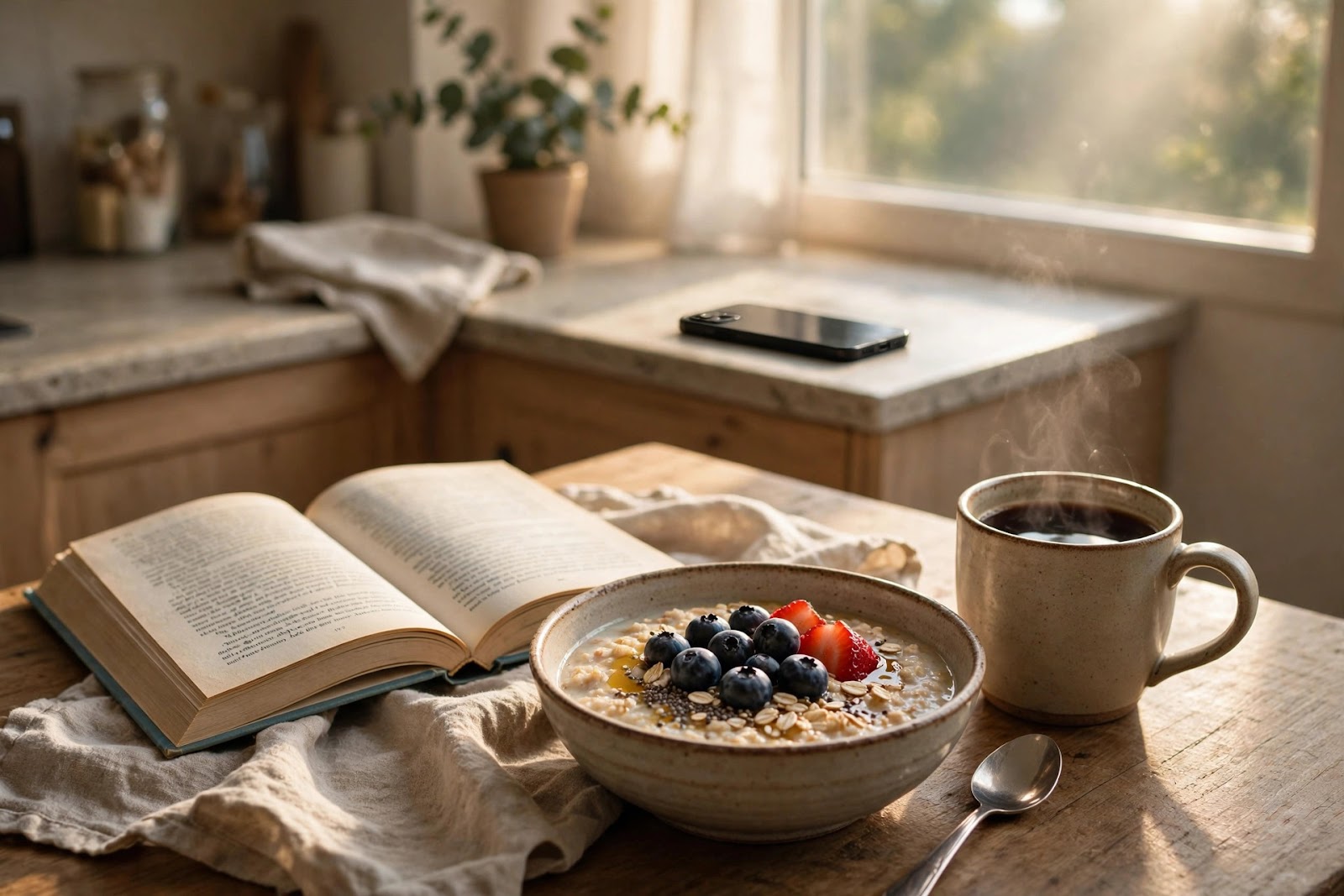
By day four I also noticed something I hadn't expected: my mornings got longer. Not in clock time — I still left the house at the same time — but in felt time. When every minute isn't filled with other people's content, an hour has room in it. I read ten pages of a paperback before work on day four, something I hadn't done on a weekday morning in years. I noticed the light in my kitchen. I know how that sounds. But when your mornings have been a blur of scrolling for years, noticing the light feels like news.
Days five to seven: the shift I didn't expect
Days five through seven were when the experiment stopped feeling like a restriction and started feeling like a gift. The itch faded. Not gone — I still reached for the phone once on day six, out of habit, and laughed — but quieter, easier to ignore. My morning routine settled into something I actually liked: coffee, breakfast, a few pages of a book or a few lines in a journal, then phone, then work. The order matters. Phone after breakfast means the day starts with me, and the feed joins later as a guest, not as the host.
The biggest surprise was what happened to the rest of the day. I expected the benefit to end at breakfast, when the phone came back. It didn't. On the phone-free mornings, I checked my phone less all day — not because of a rule, but because the morning had broken the autopilot. Once you've spent an hour not reaching for it, reaching for it at 11am feels like a choice again instead of a reflex. My screen-time report at the end of the week showed my morning usage down, obviously, but my total daily usage down by about forty minutes too. One narrow rule had leaked into the whole day, in a good direction.
My evenings changed as well, in a smaller way. Because my mornings were calmer, I went to bed less wired, and because I went to bed less wired, I woke up calmer. It was a loop, but a kind one for once. I'm not claiming a week of phone-free breakfasts fixed my sleep or my life. I'm saying the mornings stopped being something that happened to me, and that change rippled further than the hour it took place in.
What I got wrong the first time
I tried a version of this two years ago and it failed in three days, and it's worth saying why, because the difference matters. Last time, the rule was "no phone in the morning," which is vague, and vague rules die. Morning ends when? When does the ban lift? I kept negotiating with myself — is 9am morning? Is checking one message breaking it? — and negotiation is just permission wearing a suit. This time the rule had a finish line I could see: breakfast. Sit down, eat, done, phone back. A rule with a clear end is a rule you can keep.
Last time I also tried to replace the phone with something virtuous — meditation, journaling, a whole morning routine from the internet. It felt like homework, and I resented it. This time I replaced it with nothing. Coffee, food, window. Boredom was allowed. Boredom, it turns out, is where your own thoughts live, and you can't meet them if you schedule over them with a replacement activity. If you try this, don't fill the gap. Let it be empty for a few days and see what shows up.
The other mistake last time: I told people about it, and then I was performing a detox instead of running an experiment. This time I told no one until the week was over. Privacy made it honest. I could fail quietly, adjust quietly, and keep only what worked.
What my mornings look like now
Two months on, a normal weekday morning in my house looks like this, and I'm describing it because it sounds so ordinary that it might be hard to believe it was ever different. I wake up, and the phone is in the kitchen, so there's nothing to reach for. I shower, get dressed, make coffee. I eat breakfast at the table, usually with a few pages of whatever paperback is going, sometimes with nothing but the window. Then I pick up the phone, check what came in overnight, and start work. The whole thing takes about an hour, and it belongs to me in a way my old mornings never did.

The paperback detail matters more than it sounds. Before the experiment, I told myself I didn't have time to read. I had time — I was spending it on the feed before breakfast and calling it "catching up." Reading ten pages a morning adds up to a book every couple of weeks, which means the phone-free hour didn't just give me calmer mornings, it gave me back a hobby I'd mourned as lost. Check what your own mornings are quietly funding. You might find a hobby in there too, hiding under the scroll.
One practical detail that makes the whole thing easier: charge the phone in the kitchen overnight, not beside the bed. If the phone sleeps in another room, the morning rule enforces itself — you'd have to walk to get it, and by the time you're in the kitchen, you're already making coffee and the rule has done its job. I tried keeping it on the nightstand with the alarm on, and willpower lost every time. Distance beats discipline. Put the charger where breakfast happens, and let the layout of your house do the work your willpower can't do at 6:40 in the morning.
The weekend problem (and the compromise I made)
Weekends nearly broke the rule, because weekends have no structure to hold it. On a Saturday there's no "before work" and breakfast slides to whenever, and twice I woke up, grabbed the phone out of habit, and was twenty minutes into the feed before I remembered the experiment. I don't count those as failures — I count them as information. The rule works best when it's attached to something fixed, and breakfast is fixed on weekdays but wobbly on weekends.
My compromise is simple: on weekends, the rule is "no phone before coffee," which is shorter but still creates a gap. Coffee first, phone second. It's a smaller boundary, but it holds on Saturdays, and a small boundary that holds beats a big one that collapses. If your own version of this keeps failing on weekends, shrink it until it holds. The size of the gap matters less than the fact that there is one.
One more thing worth naming: other people in your house. My partner noticed the change within days, and not just because I was quieter at breakfast. She said I seemed "more here" in the mornings, which is a strange compliment until you realize what it implies about before. If you live with someone, the phone-free hour changes their morning too — breakfast becomes a conversation instead of two people scrolling in the same room. That alone might be worth the week, even if nothing else in this article convinces you.
The honest verdict (and what I kept)
After the week ended, I didn't keep the rule perfectly, because I'm not a monk and my life isn't a lab. But I kept most of it, most days, and that "most" has held for two months now. My phone charges in the kitchen overnight. Breakfast is phone-free. The first thing I look at in the morning is usually a book, or the window, or my own to-do list on paper. Some days — travel days, bad-news days, days when I'm expecting an early call — I break it, and I don't beat myself up. A rule that survives being broken is a rule worth having.
What I kept most isn't even the rule itself. It's the realization that the first hour of the day is the only hour nobody else has a claim on, and I'd been giving it away for free to the loudest strangers on earth. The feed will always be there after breakfast. It doesn't need my mornings. My mornings need me in them.
If you try one thing from this article, make it one week, one rule, one finish line: no phone before breakfast. Phone on the counter, face down, silent. Eat first. Then check. Notice the itch on day one, the negotiation on day three, and the quiet underneath both of them. You might find, like I did, that the hardest part isn't the week. It's admitting how much of your morning you'd handed over — and how good it feels to take it back. And if you slip on day two, or day five, or on a lazy Saturday, don't declare the experiment dead. Just put the phone back on the counter the next morning and start the day again. The rule doesn't need a perfect week to work. It just needs to outnumber the mornings the feed wins, and over a month, it will.


