I turned my phone screen grey on a Sunday night, and I did it out of spite more than self-improvement. It was 1:12 in the morning, I was still awake, and I had just spent 47 minutes scrolling through short videos I could not remember five minutes later. I had picked the phone up to check one thing, a reply from a friend about lunch on Tuesday, and somewhere between that message and the glow of the screen I lost the whole evening. My eyes hurt. My brain felt buzzy, the way it does after too much sugar. I put the phone down, stared at the ceiling, and thought, fine, let's see what happens if I make this thing ugly.
I'd read about grayscale mode a few times before and always dismissed it. It sounded like one of those tricks people recommend and nobody actually keeps doing. A black-and-white phone felt like a punishment, not a solution. But that night I was annoyed enough to try anything that didn't involve deleting apps I actually need for work. Two minutes later my home screen looked like an old newspaper. My wallpaper, a photo of a lake at sunset that I'd liked for months, turned into a flat grey smudge. I laughed, which was not the reaction I expected, and then I went to sleep.
How I actually switched it on
On my Android phone, the setting lives inside Digital Wellbeing. I opened Settings, tapped Digital Wellbeing, then Bedtime mode, and switched on the grayscale option there. It took under a minute once I knew where to look. The first time I hunted for it, though, I spent a solid ten minutes tapping through menus, because on my phone it's buried under a feature I had never opened. If you use an iPhone, the route is different: Settings, then Accessibility, then Display and Text Size, then Colour Filters, and you pick Grayscale. Same result, different maze.
That detail matters because the friction of finding the setting is the first test. If turning it on feels like a chore, you'll talk yourself out of it before you start. So here's my practical advice: set it up on a Sunday evening, when you're already annoyed at your own screen time, and don't try to be clever about it. Just flip the switch. You can always flip it back. Nothing about this is permanent, and knowing that made it much easier for me to commit to a full week.
I also made one decision before the experiment started, and I'm glad I did. I wrote down my baseline numbers on a sticky note and stuck it to my monitor. The week before, my average daily screen time was 3 hours and 41 minutes, with 112 pickups a day. My worst habit, and the one I most wanted to break, was evening scrolling: an average of 58 minutes between 9 pm and midnight, mostly on two apps I don't even enjoy that much. I didn't write these numbers down to impress anyone. I wrote them down because without them, a week later, I would have relied on vibes instead of facts, and vibes are a terrible measuring tool.
Days one and two: everything looked broken
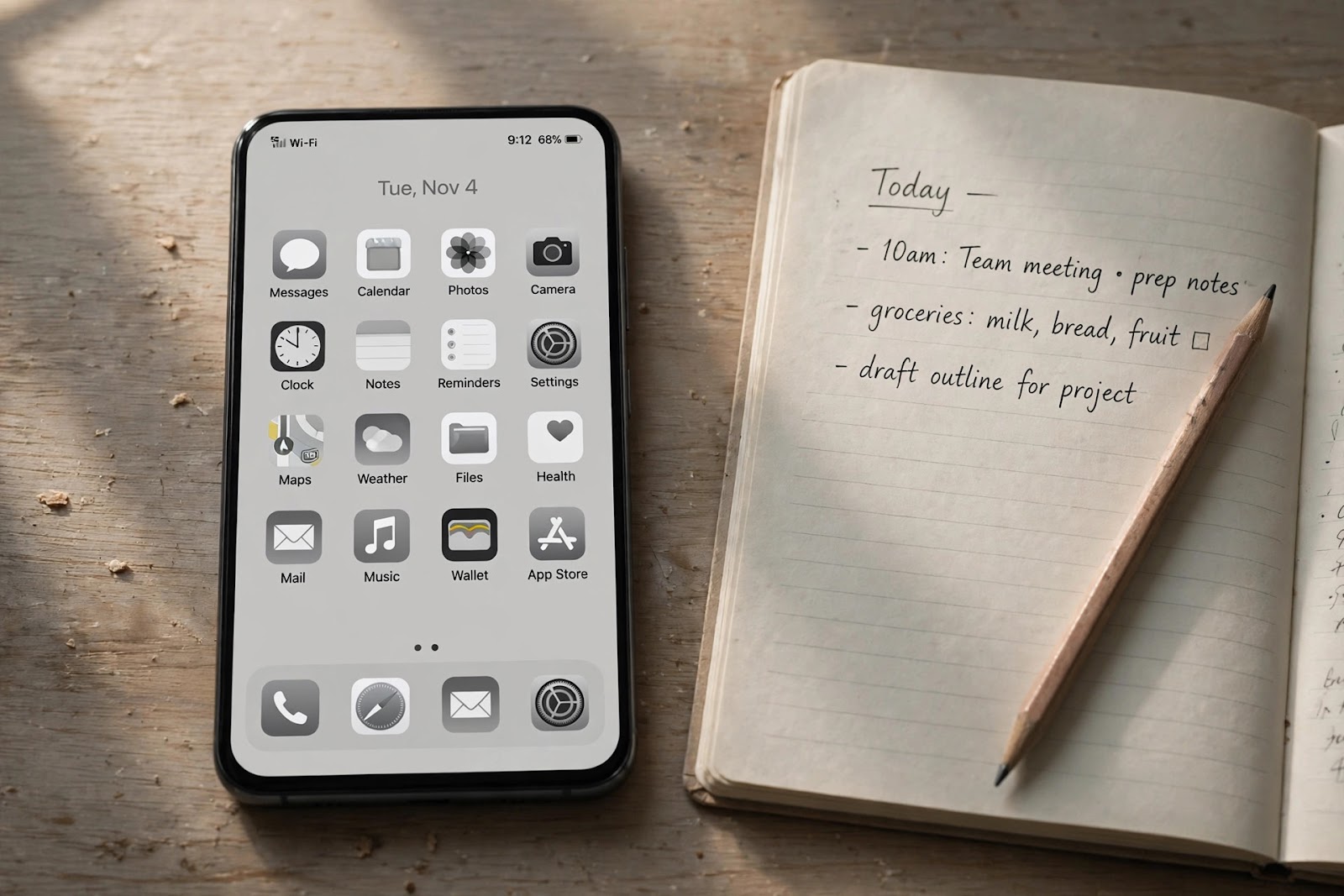
Monday morning was genuinely weird. I unlocked my phone to check the weather and for a half-second I thought the screen was damaged. The blue sky in the forecast icon was grey. My chat app, normally a riot of coloured bubbles and profile pictures, looked like a photocopy. I caught myself squinting at it, as if squinting would bring the colour back. It doesn't. That's the whole point, and it's disorienting for about a day.
Photos were the hardest part. A friend sent pictures from a weekend trip, mountains and a lake, and on my grey screen they looked flat and dull. I felt a small, ridiculous pang of loss, like someone had turned down the volume on a song I liked. Videos were worse. I opened one short clip out of habit, watched three seconds of grey faces talking, and closed it. Not because I was being disciplined. Because it was boring. That, right there, is the entire mechanism of grayscale, and understanding it changed how I thought about the rest of the week.
Here's what I mean. Most of the apps that eat our time are designed to be visually delicious. The red notification badge, the bright thumbnail, the saturated photo of food or a holiday — all of it is engineered to make your thumb stop and your brain ask for more. Take the colour away and the design loses half its power. The content is exactly the same. The joke in the video is the same joke. But without colour, my brain stopped treating the feed like a sweet shop window and started treating it like a waiting room. I still looked, but I didn't linger.
By Tuesday afternoon the novelty had worn off and a different problem showed up: I kept forgetting the phone was grey, then remembering with a little jolt every time I unlocked it. Maps still worked fine, which surprised me. Roads and street names were perfectly readable, and I actually found the grey map calmer to follow while walking. Messages were fine too. Text doesn't need colour. What suffered was anything where colour carries information — a chart a colleague sent, a photo of a paint sample, a screenshot of a graph. Twice that week I had to ask someone what colour something was in a picture they'd sent me, which felt absurd and also proved the point.
What happened to my scrolling
By Wednesday I noticed the first real change, and it wasn't willpower. It was apathy, in the best sense. I opened my usual feed app while waiting for a kettle to boil, scrolled for maybe two minutes, and put the phone down because nothing grabbed me. Before the experiment, that same kettle wait would have turned into a ten-minute scroll without me noticing. The grey screen didn't make me a better person. It made the app a worse product, and my attention quietly went elsewhere.
The numbers at the end of the week backed up what I felt. My average daily screen time dropped from 3 hours and 41 minutes to 2 hours and 18 minutes. Pickups fell from 112 a day to 68. Evening scrolling, the habit I cared about most, fell from 58 minutes to 21 minutes a night. I want to be honest about these numbers: they're from one person, one week, with no control group and no lab coat. I also knew I was being measured, even if only by myself, and that alone changes behaviour. But a 37-minute nightly drop in the exact habit I targeted is not nothing, and it matched what my evenings actually felt like.
Something subtler happened too. My sessions got shorter, but I also stopped opening the phone "just to check." That phrase, just to check, was doing a lot of heavy lifting in my life. Just to check the time became a scroll. Just to check a message became a feed. On the grey screen, checking stayed checking. I'd look, see the thing, and leave, because there was no colourful trail of breadcrumbs leading me deeper. I hadn't realised how much of my scrolling was never a decision at all. It was a chain reaction started by colour.
The surprise was my focus, not just my screen time
I expected to scroll less. I did not expect to write better. On Thursday I sat down to draft a long piece I'd been avoiding, the kind of writing that needs a clear head and about ninety uninterrupted minutes. Normally I'd get twenty minutes in, feel a tug toward my phone, check it, and lose the thread. That Thursday I worked for a full hour before I even thought about the phone, and when I finally picked it up, the grey screen gave me nothing to stay for. I put it down and went back to the draft. It sounds small. It felt enormous.
I think what happened is simple, and it has a boring name: attention residue. Every time you glance at a bright, interesting feed, a piece of your mind stays there after you look away. You return to your work, but part of your brain is still processing the video you just saw. Cut the brightness and the novelty, and the glance costs less. My phone checks became cheaper, mentally speaking, so my work sessions recovered faster. I'm not claiming grayscale made me smarter. I'm saying it made my interruptions lighter, and lighter interruptions add up across a week.
Reading changed too. I read two long articles on my phone that week, the kind I'd usually save and never open, and I finished both. On a colour screen, every link inside an article is a little coloured temptation, and every pull-to-refresh promises something newer. On grey, the article was just text, and text is what I was there for. I also noticed I stopped taking screenshots of things I didn't need. The screenshot habit, for me, was really a saving habit: save it, forget it, never look again. Grey screenshots look so unappealing that I only saved things I genuinely wanted, which turned out to be almost nothing.
My evenings changed the most
If the workday improvement was a pleasant surprise, the evenings were the real prize. By Friday night, my usual 9 pm scroll session just didn't happen. I picked up the phone at around 9:30, saw the grey feed, felt nothing, and put it down. Then I did something I hadn't done on a weeknight in months: I finished a chapter of a paperback book. A paperback! It had been sitting on my bedside table since August with a bookmark stuck a third of the way through, silently judging me.
Saturday was even better, and this is the anecdote that sold me on keeping the habit in some form. My partner and I went for a walk after dinner, and for once I didn't take my phone out at every interesting view to photograph it. Normally I'd snap a picture, check how it looked, maybe post it, and miss the actual walk. This time the phone stayed in my pocket, because I knew the photo would look grey and disappointing on the screen anyway. We talked the whole way round the park, about nothing important — a neighbour's dog, a recipe we wanted to try, a trip we might take next year. It was an ordinary conversation, and it was the best part of my week. I came home and realised I hadn't thought about my phone for over an hour. That had not happened in a very long time.
Sleep improved a little too, though I'll keep this claim modest. I fell asleep faster on four of the seven nights, and I woke up once in the night without reaching for the phone, which almost never happens. Was that the grayscale, or the fact that I was less stimulated in general, or just a good week? Probably a mix. I don't want to oversell this. But the chain is easy to see: less evening scrolling meant a quieter brain at bedtime, and a quieter brain falls asleep faster. Nothing mysterious about it.
What grayscale did not fix
Honesty time, because this experiment has limits and you should know them before you try it. Grayscale did nothing for my laptop. On Wednesday evening, after a virtuous grey-phone day, I sat at my computer and watched videos in full glorious colour for forty minutes. The phone was fixed. The habit wasn't, not entirely. If your main time sink is a computer, greying your phone will help less than it helped me, because the leak will just move to the bigger screen.
It also didn't fix boredom. Twice that week I caught myself opening the grey feed repeatedly, like a person opening a fridge they know is empty, hoping something new had appeared. The colour was gone but the reflex was still there. Grayscale weakens the pull; it doesn't delete the habit loop. Breaking the loop still took a decision: put the phone in another room, or pick up the book instead. The grey screen made that decision easier, but I still had to make it.
And then there were the genuinely annoying moments. Online shopping was a mess — I couldn't tell the colour of a shirt I was considering, which is a fairly important detail when buying a shirt. A colleague's colour-coded spreadsheet was unreadable in any useful sense. Video calls looked strange, like a 1950s television broadcast, and my family laughed at me on the first call. None of this ruined my week, but all of it is a reason not to keep grayscale on permanently, at least for me.
What I kept after the week ended
On the following Sunday night, I turned the colour back on. My wallpaper burst back into sunset oranges and I felt a ridiculous little rush of delight, which told me something important: colour is genuinely pleasurable, and I don't want to live without it forever. But I also didn't want to go back to 58-minute evening scrolls. So I made a compromise, and it's the one I'd recommend.
Now my phone switches to grayscale automatically at 9 pm and back to colour at 7 am. On Android, that's a Bedtime mode schedule; on iPhone, you can build the same thing with a simple automation. My evenings stay grey and calm, my daytime phone stays normal for photos, maps, and work. I also keep one extra rule from the experiment week: no feed apps after 9 pm, grey screen or not. The schedule handles the temptation; the rule handles the laptop-shaped loophole, mostly.
Three weeks on, my evening scrolling averages around 25 minutes, not quite the experiment week's 21, but nowhere near the old 58. That's a trade I'll take. The week taught me that my problem was never a lack of discipline in some grand moral sense. It was a design problem. My phone was designed to be irresistible, and for one week I made it resistible. Everything else — the reading, the writing, the walk in the park — followed from that one small change.
If you want to try it yourself
Give it seven full days, not one afternoon. Day one is mostly confusion, and judging the experiment on day one is like judging a haircut while you're still in the chair. Write down your baseline first: average screen time, pickups, and your worst hour of the day. You can find all three in your phone's built-in screen time report, no extra app needed. Then switch it on, and keep a one-line note each night about when you scrolled and why. That note is where the real insight lives.
Expect two things. First, expect to hate your photos for a few days, and expect to keep toggling the setting off to "just check" a colour, especially for shopping or pictures friends send. That's normal. Second, expect the biggest change in the evening, not the morning. Mornings are full of purpose; evenings are full of tiredness, and tiredness is when colour does its best work on you. If grayscale helps anywhere, it helps there first.
Would I recommend it? Yes, with one condition: try it as a scheduled habit, not a permanent vow. Permanent grayscale sounds virtuous and gets abandoned by Thursday. A 9 pm grey switch is a small, keepable rule, and keepable rules beat heroic ones every time. My phone is still the same phone, with the same apps and the same temptations. It just stops glowing like a sweet shop window after dark, and my evenings have been quieter ever since. That, for me, was worth a week of looking at the world in black and white.


