My brain has too many tabs open. That's not a metaphor I chose for effect; it's literally how my days used to feel. I'd open my laptop to do one thing, see seven reminders, three half-finished lists, and a notification about something I forgot yesterday, and by noon I'd forgotten what I sat down to do in the first place.
Apps were supposed to fix that. I tried four different task managers in one year. Each one worked for about two weeks, then became another place I avoided opening. The lists got longer, the red badges got scarier, and I started writing tasks on sticky notes instead, which then got lost under coffee cups.
Then, last spring, a friend showed me her paper notebook. Nothing fancy, just a plain A5 notebook with her day laid out in her own handwriting. She crossed things off with a thick line and a little satisfied sigh. I laughed at the time. Two months later, I bought the same kind of notebook. I haven't looked back.
Why Paper Won When Apps Didn't
The difference, for me, came down to friction, but in the opposite direction than you'd expect. Apps made it too easy to add tasks. One tap and something was on the list forever, silently judging me. Paper made me slow down. Writing a task by hand takes a few seconds, and those seconds force a tiny decision: is this actually worth doing, or am I just collecting things to feel busy?
There's also the matter of what I see. When I open my notebook in the morning, I see today's page and nothing else. No inbox count, no red badge, no other project's list peeking at me from a sidebar. My attention has one place to land. For someone whose mind scatters at the sight of options, that narrow view is a kindness.
And crossing something off on paper feels different. Tapping a checkbox gives a tiny animation and then the task vanishes. Drawing a line through a handwritten task leaves a record. At the end of the day I can see what I did, not just what's left. On bad days, that visible proof matters more than I'd like to admit.
How My System Actually Works
Here's the setup I use now, after a lot of trial and error. Every evening, or first thing in the morning if the evening got away from me, I open a fresh page and write the date at the top. Then I write no more than three main tasks for the day. Three. Not ten, not "as many as fit." Three tasks that, if I finish them, mean the day counts.
Under those, I leave a smaller section for quick jobs: the two-minute things like replying to a message, booking an appointment, or sending a file. Those get done in one batch, usually after lunch, instead of interrupting real work all morning.
The right-hand page is my capture zone. Anything that pops into my head during the day, an idea, a reminder, a question I need to ask someone, goes there immediately, in messy handwriting, no sorting. That's the trick that replaced my old habit of opening a new tab "just to note something down" and losing half an hour. The thought is parked on paper, and I can get back to work in seconds.
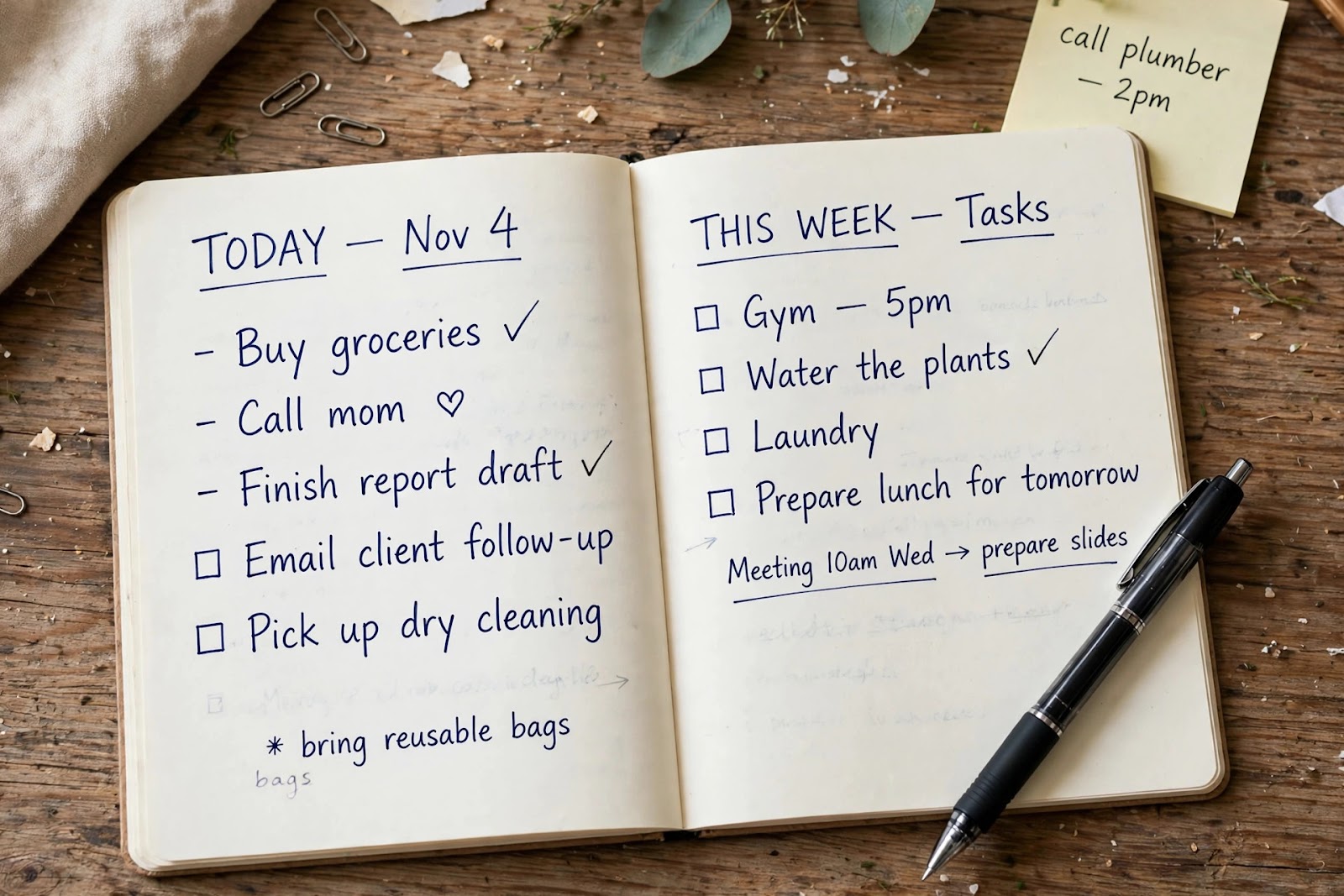
At the bottom of the left page, I keep one line for tomorrow's first task. Writing it the night before means I never start a morning staring blankly at a screen wondering where to begin.
The Mistakes That Taught Me the Rules
I did not arrive at this system cleanly. My first notebook was a disaster of good intentions. I wrote beautiful, detailed plans for entire weeks, color-coded them, and then abandoned the whole thing by Thursday because keeping it up felt like a second job.
Mistake one was over-planning. A system you have to maintain is a system you'll quit. Now, if a page takes more than five minutes to set up, I'm doing it wrong.
Mistake two was carrying everything forward. Every unfinished task got rewritten the next day, and after a week my list was a wall of guilt. Now I have a rule: if a task gets carried forward three times, it either gets done that day, gets scheduled properly, or gets dropped. Most of the time, honestly, it gets dropped, and nothing bad happens. That taught me how many of my "urgent" tasks were never urgent at all.
Mistake three was buying a fancy notebook first. I spent good money on a leather-bound journal with thick paper, then felt too guilty to mess it up with messy handwriting. The notebook I actually use cost very little and has plain pages. It's a tool, not a treasure. Scribbles are allowed. Crossed-out lines are allowed. That's the whole point.
Making It Stick When Life Gets Messy
Systems are easy on quiet days. The test is what happens when life gets loud. Two months into using the notebook, I had a week where everything piled up at once: a deadline moved, family needed me, and my sleep fell apart. The notebook nearly went out the window.
What saved it was lowering the bar instead of raising it. On the worst day that week, my three tasks were: answer one email, buy groceries, and rest. That's it. I wrote them down, did them, crossed them off, and closed the book. It felt silly at the time, but it kept the habit alive through a week that would otherwise have broken it.
That's my biggest piece of advice for anyone trying this: on a hard day, shrink the system, don't skip it. One task on a page still counts as using the notebook. A blank page is how a habit dies.
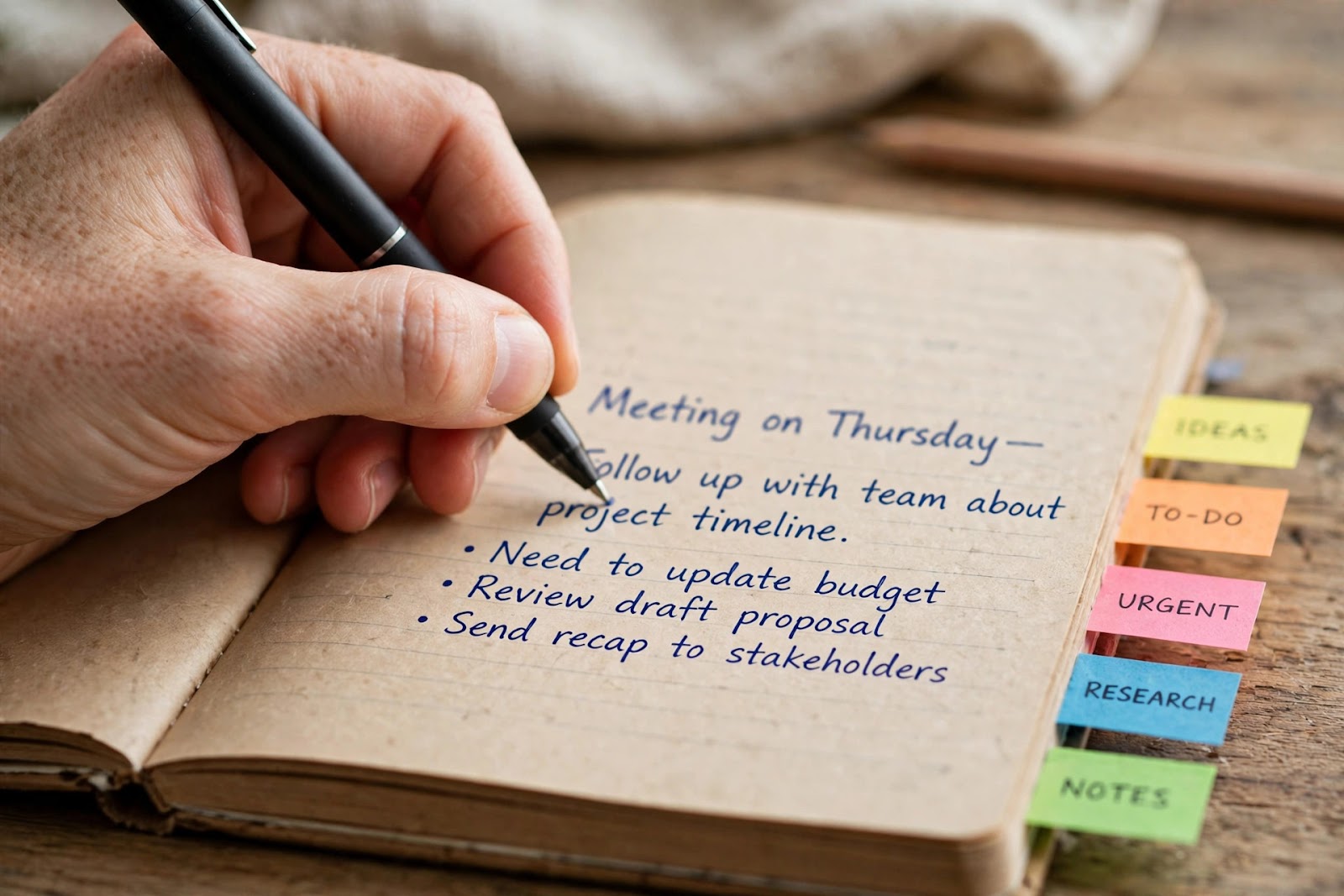
I also keep the notebook in the same spot every night, next to my keys. If it's buried in a bag or left in another room, I won't reach for it in the morning. Boring logistics like that matter more than motivation, which shows up when it feels like it and vanishes when you need it most.
The Weekly Review I Actually Do
Once a week, usually on Sunday evening with a cup of tea, I flip back through the past seven days of pages. It takes about ten minutes, and I only look for three things: what kept getting carried forward, what I finished that I'm glad about, and what I should stop agreeing to.
That little review has caught patterns I'd never have spotted otherwise. Last month I noticed the same admin task appearing on four different days, so I finally blocked a proper hour for it on a Friday and cleared it for good. Another week showed me I'd said yes to three favors that all landed on the same day, which explained why that day felt impossible. Seeing it on paper made the fix obvious: spread them out, or say no to one.
I don't score myself or grade the week. The review is just a look back, not a judgment. Some weeks are full of crossed-off lines, and some are mostly carried-forward tasks and honest notes about a hard few days. Both kinds of weeks teach me something, as long as I actually look.
What Changed After Six Months
Six months in, the change is quieter than I expected, but it's real. I forget fewer commitments, because everything lands in one place instead of five apps and my head. I start work faster in the morning, because tomorrow's first task is already written down. And I end most days with a page that shows what I actually did, which has done more for my confidence than any productivity hack I tried before.
I'm not anti-technology now, by the way. My calendar still lives on my phone, and I still use apps for things that genuinely need them, like shared projects and reminders with alarms. Paper just handles the daily thinking part, the part where I decide what matters today. That decision deserves a slower, quieter space than a screen full of notifications.
If your brain feels scattered, you don't need a perfect system. You need a notebook, a pen, and ten minutes tonight. Write tomorrow's date, pick three tasks, and leave the rest of the page blank on purpose. Try it for two weeks, messily, and see what happens. Mine saved my scattered brain one page at a time, and I suspect yours might like the quiet too.


