For months my evenings had the same shape. I'd finish work around six, sit down on the sofa with a cup of tea, and feel... not relaxed. Not tired, exactly. Just unfinished. There was always something small nagging at me — an email I meant to answer, a form I meant to file, a mug sitting in the sink, a bag I meant to unpack. None of it was big. All of it was loud. I'd tell myself I'd deal with it tomorrow, and then I'd spend the whole evening half-thinking about it anyway.
The worst night was a Tuesday in October. I remember it because I'd actually had a good day — finished a report early, had a decent lunch, even went for a walk. And then at 9:40 p.m., just as I was about to go to bed, I remembered the expense receipt I hadn't photographed, the reply I owed a colleague about Thursday's meeting, and the fact that my gym bag had been sitting by the door since Sunday, still packed, still smelling faintly of damp towel. Three tiny things. I did none of them. I went to bed annoyed at myself instead, and I lay there for twenty minutes mentally listing all the other tiny things I'd been putting off. That's when it hit me: my evenings weren't being ruined by big problems. They were being nibbled to death by small ones.
I'd heard of the two-minute rule before — if something takes less than two minutes, do it now instead of writing it down. I'd even tried it during work hours a couple of times, and it fizzled out the way most productivity tricks do when you apply them everywhere at once. This time I decided to try it in one place only: after 6 p.m. Evenings only. No rules for the workday, no new system, no app. Just one question after dinner: is there a tiny thing I can finish in two minutes? If yes, I do it right then. If no, it waits until tomorrow's proper to-do list, and — this was the important part — I stop thinking about it for the night.
What counted as two minutes (and what didn't)
The first thing I had to get honest about was what "two minutes" actually meant. My brain is very good at lying about this. It will tell me that replying to an email takes two minutes when the email actually needs a twenty-minute think and a spreadsheet. So I made a hard test: if I couldn't see the finish line from where I was standing, it didn't count. Replying "yes, Thursday works" to a meeting invite? Two minutes. Drafting the agenda for Thursday's meeting? Not two minutes — that goes on tomorrow's list.
Here's what qualified in that first week: answering a one-line email, photographing a receipt and uploading it, putting the clean dishes away, hanging up a jacket instead of dropping it on a chair, texting my mum back, booking a dentist appointment through the app (three taps, done), emptying the small bin in my office, putting my keys and wallet in the tray by the door, watering the plant on the windowsill, and — my favourite — replying to the group chat message I'd been ignoring since lunch with an actual answer instead of a thumbs-up I'd feel guilty about later.
What didn't qualify, and this matters more: anything that needed a decision I hadn't made yet, anything that involved another person waiting on me for more than a sentence, and anything that was really a task disguised as a tiny task. "Sort out the car insurance" is not a two-minute task. It never was. It was a phone call, a comparison, and a decision, and pretending otherwise was exactly how it had been sitting on my mental shelf for six weeks. The rule only works when you're strict about the boundary. Two minutes means two minutes, timed in your head honestly, not two minutes plus "well, while I'm here."
The week, evening by evening
I kept a little tally on the fridge — a scrap of paper, nothing fancy — just to see what was actually happening. Monday evening I cleared nine tiny things in about fourteen minutes total, spread across the evening. Not fourteen minutes in a row; two minutes here, ninety seconds there, in the gaps between cooking and sitting down. The receipt photo. The email reply. The gym bag, finally unpacked and the towel in the wash. The jacket hung up. It felt almost suspiciously easy, and I went to bed thinking, well, that was Monday. Let's see if it holds.
Tuesday was the real test, because Tuesday was a bad day. A meeting ran long, I got home late, and I was in no mood for self-improvement. I cleared four things. Four. The dishes, one text, the bin, and my keys in the tray. It took maybe six minutes. And here's the thing I didn't expect: those four tiny finishes changed the whole evening. Normally on a bad day I'd sit down feeling behind, and that feeling would colour everything — the tea tasted like a consolation prize, the TV felt like avoidance. That Tuesday, the flat was just... done. Nothing was waiting for me. I watched two episodes of a show I like and actually enjoyed them, instead of half-watching them while mentally apologising to my future self.
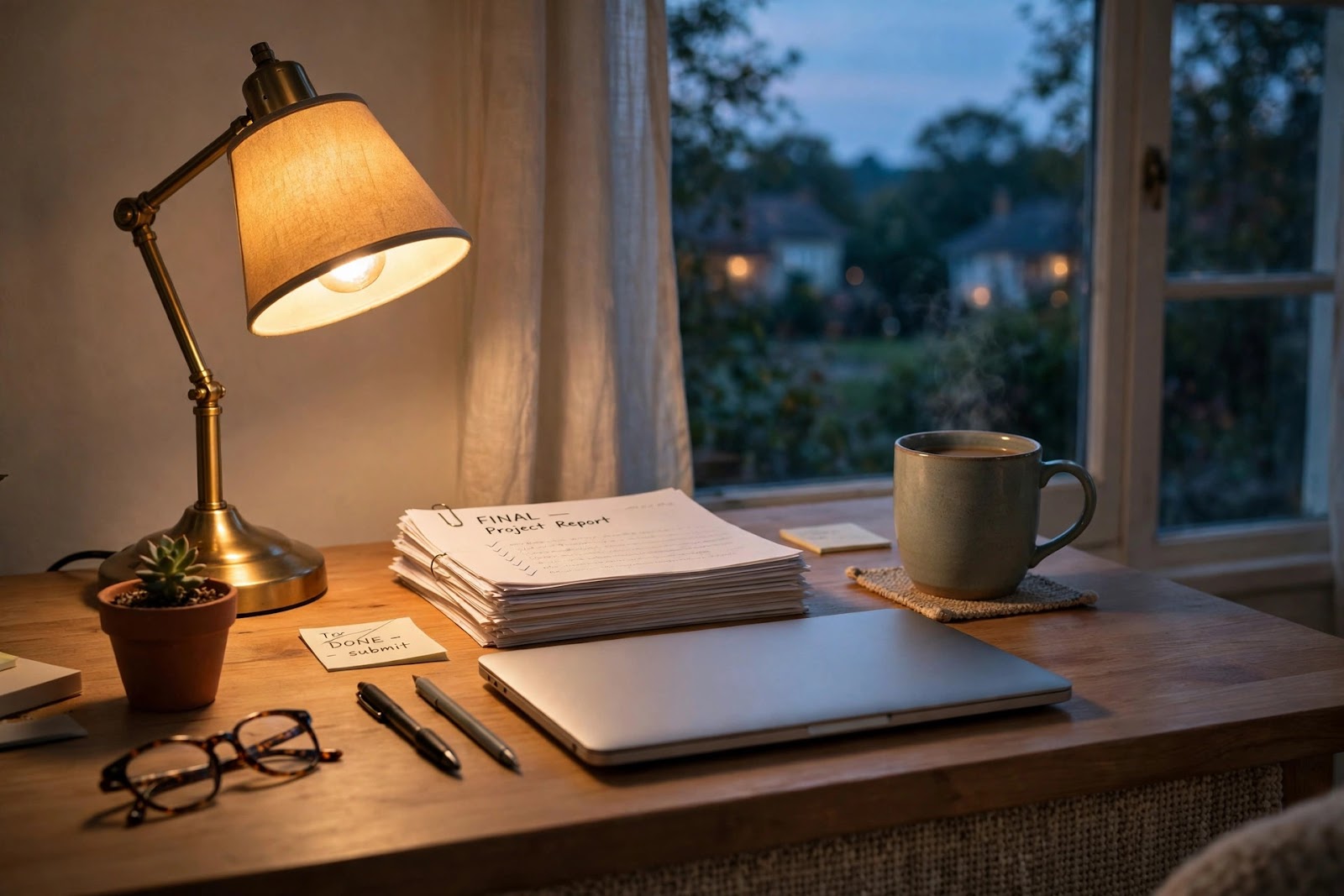
Wednesday I cleared eleven things, my highest count, and most of them weren't even on my mental list — they were things I noticed while doing other things. The plant needed water. The hallway light had a dead bulb and there was a spare in the cupboard. My work bag needed repacking for Thursday. Small stuff, but each one was a tiny loop closing with a little click. By Thursday the tally dropped to five, and that told me something important: the pile was shrinking. I wasn't finding eleven things anymore because there weren't eleven things to find. The backlog was clearing.
Friday I cleared three. Saturday, two — a birthday card I'd meant to send (ordered online, two minutes, done) and a library book renewal. Sunday evening I cleared one thing, and then I stood in my kitchen and realised there was nothing left to clear. The flat was tidy. The inbox had no one-line replies waiting. The bag was packed for Monday. I had an entire Sunday evening with nothing nagging at me, and I honestly didn't know what to do with myself for about ten minutes. I made tea and sat down and did nothing, and it felt like a holiday.
What it did to my evenings
The numbers were small — 34 tiny tasks across the week, maybe an hour of total effort spread over seven evenings. But the effect on my evenings was completely out of proportion to the effort, and I want to be precise about why, because it's not really about the tasks.
The first change was the feeling of a finished day. Before that week, my workday ended at six but my head didn't clock out until bedtime, because there was always an open loop buzzing somewhere. Once the tiny loops were closed each evening, the day had an actual ending. I could feel the difference in my shoulders, which sounds dramatic until you've lived it. Sitting on the sofa stopped feeling like sitting in a waiting room.
The second change was sleep. I'm not going to claim a productivity trick cured my sleep, because that's the kind of claim that makes me roll my eyes. But I stopped doing the thing where I lie in bed listing tomorrow's small chores, because there were fewer of them. The 9:40 p.m. panic — the sudden memory of the unphotographed receipt — stopped happening, because the receipt was photographed at 6:15. My bedtime routine got shorter and quieter. I fell asleep faster most nights that week, and I woke up without the little jolt of "oh no, I forgot to..."
The third change was the mornings. This one surprised me most. When the evening's tiny tasks are done, the morning starts clean. My keys are in the tray. My bag is packed. There's no email I owe from yesterday hanging over breakfast. I didn't set out to fix my mornings — I set out to fix my evenings — but the two are the same day wearing different clothes. A finished evening is a head start on tomorrow, and I hadn't understood that until I felt it.
Where it went wrong (because it did)

It wasn't all smooth, and I'd be lying if I said the rule worked perfectly from day one. The biggest trap was the "while I'm here" creep. On Wednesday I went to put the dishes away — a genuine two-minute task — and noticed the cupboard was messy, and suddenly I was reorganising a cupboard at 7:30 p.m., which is the opposite of a relaxing evening. I caught myself twenty minutes in, surrounded by spice jars, and I had to laugh. The rule had turned into an excuse to do a chore I'd been avoiding, and it had eaten the evening it was supposed to protect.
So I added a second rule: one task, then stop. Do the tiny thing, then go back to what you were doing. No chaining. No "well, since I'm in the kitchen." The moment a two-minute task reveals a bigger job behind it, you stop, you write the bigger job down for tomorrow, and you walk away. That boundary is the whole system, really. Without it, the two-minute rule is just a fancy way of never sitting down.
The other trap was using the rule as procrastination in reverse. On Thursday I caught myself doing tiny tasks to avoid a phone call I didn't want to make — a call that would have taken five minutes and that I'd been dodging for days. Tidying is a wonderful way to feel productive while avoiding the one thing that matters. The tiny tasks are supposed to clear the decks, not become the deck. If I notice I'm doing my fourth two-minute task in a row while a real task waits, I stop and do the real thing, or I admit I'm avoiding it and put it on tomorrow's list with a time attached.
The version I kept
It's been about a month now, and here's the version that survived. Every evening after dinner, I do one quick sweep — not a list, not a system, just a look around and a question: is there anything here that takes less than two minutes? Usually there are two or three things. I do them, one at a time, no chaining. Then I stop. The whole thing takes five to ten minutes, most evenings less.
I don't keep the tally anymore. The fridge paper came down after the first week, because the point was never the count. The point was the feeling of a day that ends properly. Some evenings there are no tiny tasks at all, and that's the best outcome — it means yesterday's sweep worked. Other evenings there are five, and clearing them feels like tucking the day into bed.
One more thing I noticed, and it's the reason I'm still doing this a month later: the rule made me kinder to myself. Before, every forgotten little task felt like proof I was disorganised. Now I see them for what they are — normal friction, not character flaws — and I clear them the moment I spot them instead of carrying them around for a week. That shift in how I talk to myself was worth more than any tidy kitchen.
If your evenings feel unfinished the way mine did, don't overhaul your life. Don't buy a planner, don't download an app, don't redesign your mornings. Just try this: after 6 p.m., for one week, finish anything that takes less than two minutes, the moment you notice it. One task, then stop. No chaining, no cupboard reorganisations. See what your evenings feel like by Sunday. Mine finally felt finished — and that turned out to be worth far more than the hour of tiny tasks it cost me.


