I've worked with music on for as long as I can remember. Lo-fi beats, mostly — the kind of playlist with a cartoon cat studying on the cover that half the internet seems to use. It felt productive. The headphones went on, the world went quiet-ish, and I got to work. Then a friend said something that stuck in my head like a bad song: "You don't focus better with music. You just enjoy working more, and you've confused the two." I was annoyed, mostly because I suspected he might be right. So I did what any stubborn person with a notebook does: I ran a test on myself for a full week, music days versus silence days, and I kept a log like a scientist with a grudge.
The rules were simple, because complicated experiments die by Wednesday. I split six workdays down the middle. Monday, Wednesday, and Friday: music on. Tuesday, Thursday, and Saturday: silence, meaning no headphones, no background noise, just the room. Same work hours each day, roughly 9am to 5pm with a lunch break. Same kind of work in both conditions: mornings for writing and planning, afternoons for email, admin, and routine tasks. And every evening I wrote down four things: how many real work blocks I finished, how often I caught myself distracted, how drained I felt at 5pm, and one honest line about what the day actually felt like. No fancy scoring system. Just a log I couldn't argue with later.
Music days: comfortable, but slippery
Monday started strong. Lo-fi playlist on, coffee hot, I wrote for ninety minutes straight and it felt great. That's the thing about music days — they feel wonderful. The work hums along, the mood is up, and you finish the day convinced you crushed it. But when I looked at the actual log that evening, the story was messier. I had finished three solid work blocks, yes, but I'd also drifted off six times: twice to change the playlist, once to look up a song I liked, once to replay a track, and twice to stare out the window while a good beat played. The music wasn't ruining my focus. It was taxing it in small, invisible sips.
Wednesday taught me the lyrics lesson, and it taught it hard. I got bored of lo-fi by mid-morning and switched to a playlist of songs I actually love, with words. Big mistake. By lunch I realized I had typed a lyric into a work document. Not a metaphor, not a paraphrase — an actual line from a chorus, sitting in the middle of a paragraph about quarterly planning, where it absolutely did not belong. I deleted it, laughed at myself, and then caught myself doing it again twenty minutes later with a different song. Lyrics and writing use the same part of your brain, and mine could not run both at once. That day's writing output was the worst of the week, and the log made it impossible to pretend otherwise.
Friday was the redemption of music, though, and I want to be fair about it. Friday afternoon was admin: invoices, inbox cleanup, filing, the kind of work that needs hands more than brain. With an upbeat playlist on, I cleared 47 emails in two hours, filed a month of receipts, and actually enjoyed it. Boring work plus good music is a genuinely great combination. The music filled the dead air that usually makes admin feel like punishment, and because the tasks were simple, the distraction tax barely mattered. Friday afternoon is where music earned its keep.
Silence days: awkward at first, then something clicked
Tuesday was awful. I don't know how else to describe it. Without headphones, every sound in the house announced itself: the fridge humming, a neighbor's dog, my own breathing, the clock. I kept reaching for the headphones out of pure habit, like a smoker reaching for a pocket. I finished two work blocks instead of three, felt restless all afternoon, and wrote in the log that silence was "overrated and boring." If the experiment had ended Tuesday, music would have won in a landslide, and I would have felt very smug.
Thursday was different, and I still can't fully explain why. Same silence, same room, same sounds — but somewhere around 10am, the noise faded into the background the way a ticking clock does once you stop listening for it. I wrote for two hours without checking the time once, which almost never happens to me. When I looked up, I had a full draft done and no memory of the fridge at all. The log that evening reads: "Felt longer but did more. Weird." I think what happened is that my brain stopped waiting for the next track, the next change, the next little hit of novelty that music keeps serving. Silence has no next thing. There's nothing to wait for, so you just... work.
Saturday sealed it for the writing side. I spent the morning planning a project that had been stuck in my head for weeks — the kind of thinking work that needs you to hold five ideas at once and turn them over slowly. In silence, I could actually hear my own thoughts, if that doesn't sound too dramatic. I mapped the whole project on paper in ninety minutes. The same task had been haunting my to-do list for a month, and I suspect the reason is that I'd always tried to do it with a playlist on, which kept skimming my attention off the surface of the problem.

What the log actually said
Let me lay out the week honestly, because the totals surprised me. Across the three music days, I finished 9 solid work blocks and caught myself distracted 17 times. Across the three silence days, I finished 11 work blocks and drifted off 9 times. The gap wasn't enormous, but it was consistent, and it ran in the same direction every single day: silence won for deep work, music won for mood. On music days I rated my energy at 5pm higher — I finished happier. On silence days I rated my output higher — I finished with more done. My friend was right, and I was right too. We were just measuring different things.
The split by task type was even clearer than the totals. Writing, planning, and anything that needed real thinking: silence, by a mile. On silence mornings I wrote about a third more usable draft than on music mornings, and the drafts needed less editing later. Routine work — email, filing, data entry, tidying digital clutter: music, easily. The playlist made dull work feel shorter, and since the work didn't need my full brain, the distraction tax didn't hurt. The mistake I'd been making for years was using one soundtrack for both kinds of work, as if my brain had only one mode.
There's one more finding I didn't expect: the transition cost. On music days, I noticed I worked in shorter bursts, roughly 25 to 35 minutes, and then surfaced — to skip a track, refill water, check my phone. On silence days, my blocks stretched to 50 or 60 minutes without me trying. I think music quietly trains your brain to expect a change every few minutes, because songs end, playlists shuffle, and your attention learns to hop. Silence doesn't offer the hop, so attention settles. That's a theory, not a proven fact, but it matched my log too neatly to ignore.
The hybrid rule I actually kept
I did not become a silence-only person. Life is too short, and Friday afternoons with music are too good. What I kept is a simple rule based on the work, not the mood: first deep block of the day in silence, always. That's the 90 minutes where I write or plan, and it's non-negotiable now — no headphones, phone in another room, just the work. Then, once the hard thinking is done, music comes back for the afternoon admin. If a second deep block shows up later in the day, the headphones come off again.
I also made a rule about lyrics that I wish I'd made years ago: no songs with words while writing, ever. Not even songs I know so well I think they don't count — those are the worst offenders, because your brain sings along on autopilot and steals the words right out of your sentences. Instrumental music is fine for light work, and lo-fi still has a place in my afternoons. But if words are coming out of my keyboard, no words are allowed to come out of my speakers. That single rule would have saved me from the chorus-in-the-report incident, and from a dozen near-misses I probably never noticed.
Practically, the setup is minimal. I use the same over-ear headphones for music hours, and I take them physically off my desk during silence hours so I don't reach for them out of habit. Volume stays low enough that I could hold a conversation over it — loud music is just noise with better branding. And I keep one playlist I trust for admin work instead of browsing for new music mid-task, because choosing music is itself a distraction dressed up as preparation. The number of times I used to "just find the right playlist" for twenty minutes before starting work is embarrassing to admit, but the log forced me to count it.
Try it yourself (one week, honestly kept)
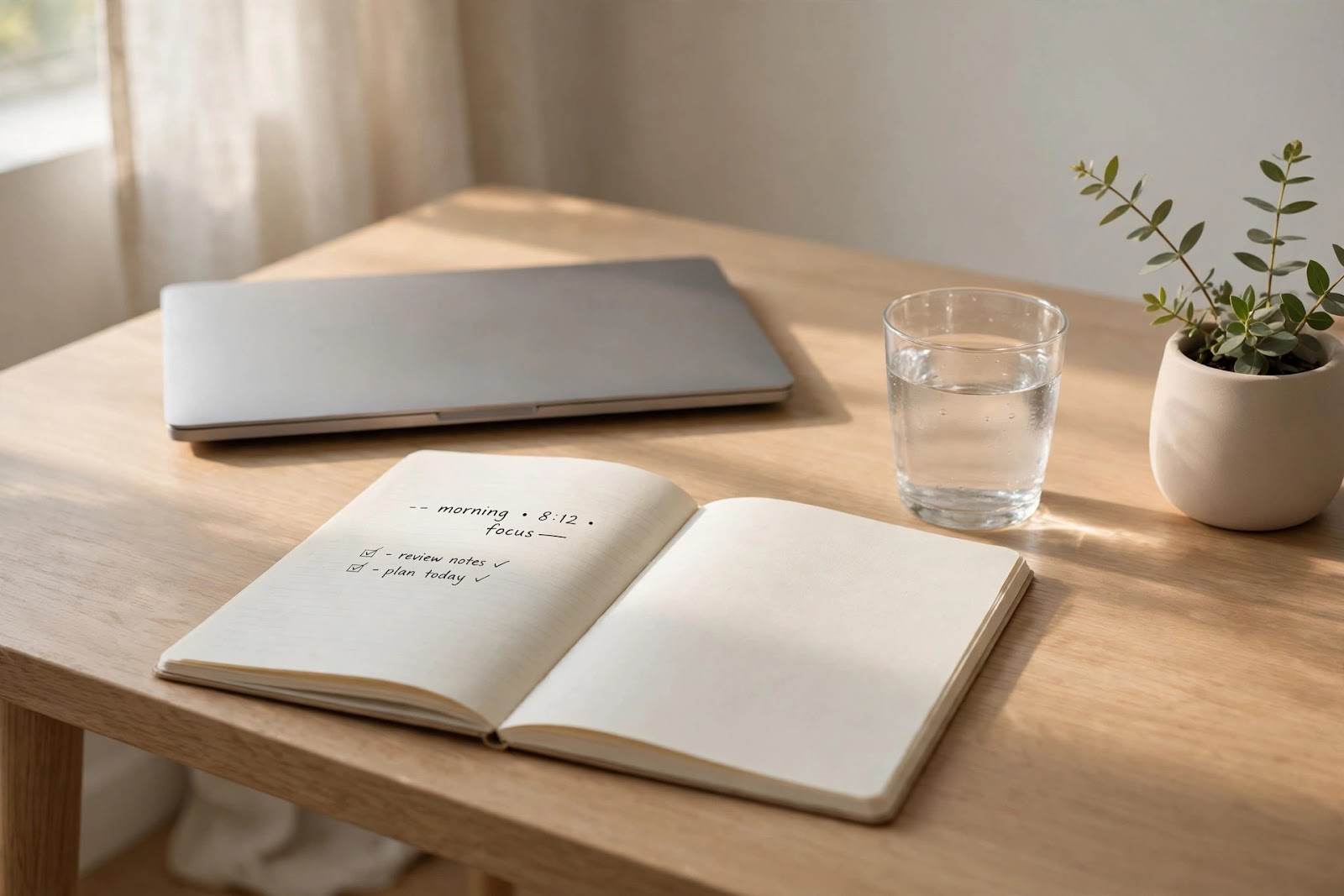
If you're curious, don't take my word for it. Run your own week. Alternate days, keep the work similar across both conditions, and write the log every evening before you forget. Four lines is enough: blocks finished, times distracted, energy at 5pm, one honest sentence. The evening log is the whole trick — without it, you'll remember the music days as better, because they felt better, and you'll forget that the silence days produced more.
One warning from my week: the first silence day will feel terrible, and you'll want to quit. That's not evidence, that's withdrawal from a habit. Give it at least three silence days before you judge. And one more: don't test this during a chaotic week. Pick a normal one. If your week is full of interruptions anyway, the log will measure the chaos, not the music, and you'll learn nothing except that you had a bad week.
My friend's original jab still makes me laugh, because he was only half right. Music doesn't make you focus better. But it does make boring work bearable, and that counts for something real — a task you actually finish while humming is worth more than a task you avoid in perfect silence. The honest answer from my week is that there's no single winner, and anyone selling you one is selling you a slogan, not a system. Silence for the work that matters, music for the work that bores you, and a notebook that keeps you honest about which is which. That's what I kept from the experiment, and six weeks later, it's still the rule on my desk.
What about coffee-shop noise and ambient sound?
People always ask me this after I tell them about the experiment: what about rain sounds, coffee-shop noise apps, brown noise? Aren't those a third option? Honestly, yes, and I tried rain sounds on one of my silence days out of curiosity, then threw that day out of the results because it muddied the test. Here's my take after using them since: ambient noise sits somewhere between music and silence. It masks the fridge hum and the neighbor's dog without giving your brain lyrics or melodies to follow. For writing in a noisy house, it's genuinely useful — better than music, not quite as clean as true quiet.
But I noticed a trap with it too. I started leaving the rain sounds on all day, every day, the same way I used to leave music on, and it became another background crutch. The point of the silence days wasn't that silence is magic. The point was learning to work without a constant audio blanket. So my rule now is practical: ambient noise is a tool for noisy environments, not a default. If the house is quiet, I work in the quiet. If construction starts next door, the rain sounds go on and I don't feel guilty about it. Tools serve the work. The moment a tool becomes a habit you can't work without, it's worth questioning, even a harmless one.
There's also the social side nobody talks about. Headphones are a "do not disturb" sign, and taking them off changed how my household treats my work time. In the silence days, family members walked in more often, because I looked available. I had to learn to say, out loud, "I'm in a deep block until 10:30, then I'm all yours." That small sentence did more for my focus than any playlist ever did, because it set a boundary that headphones used to set for me silently. If you try silence days, expect this. Plan the sentence in advance, or the interruptions will eat the whole experiment and you'll blame the silence for what was actually a boundary problem.
One last note from the log, six weeks on: I still cheat sometimes. A great song comes on during admin hours and I turn it up, or I put the headphones on for a writing block because the day feels heavy and I want the comfort. That's fine. The experiment wasn't about becoming a monk. It was about knowing the difference between music that helps and music that just feels like helping, and choosing on purpose instead of by default. Most days now, I choose right. The log taught me how, and the habit stuck because it was built on my own numbers, not someone else's productivity gospel.


